
By Sean Avery
Columbia Gorge News
HOOD RIVER — Fill out and return your ballot early. Use an official drop box. Voter fraud is ultra-rare.
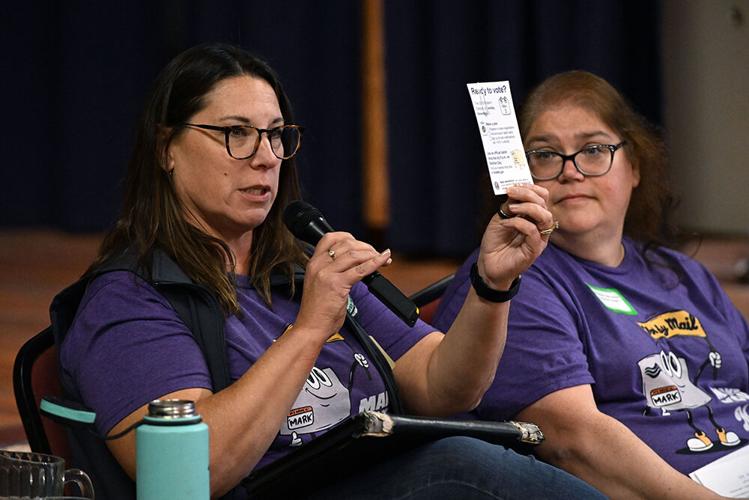
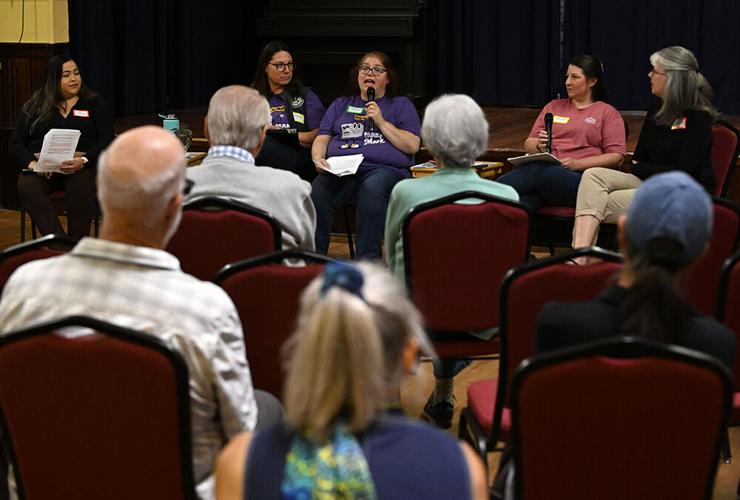
County clerks and election officials from across the Gorge shared voting best practices and clarified misconceptions at the Rockford Grange on Oct. 1, answering frequently asked questions from community members.
Hosted by the Mid-Columbia Unitarian Universalist Fellowship, the free, nonpartisan forum — third in a series highlighting issues pertinent to the democratic process — touched on all things elections, including registration, eligibility, tabulation, and fraud.
Speakers included Wasco County Clerk Chrissy Zaugg, Hood River County Clerk Kelly Silva Magaña, Klickitat County Elections Administrator Brandie Sullivan, and Klickitat County Auditor Heather Jobe.
Panelists were given the same questions — half from audience members and half from moderators Arturo Leyva, Hood River Latino Network, and Trisha Walker, Columbia Gorge News. Responses have been edited for length and clarity.
Q: How are citizenship and eligibility verified before people are added to the voter rolls? What safeguards prevent non-citizens or ineligible individuals from being registered automatically by the DMV?
ZAUGG: Through the DMV, they only push through the records that are verified citizens — if they aren’t presenting a U.S. birth certificate or passport, we don’t receive those records.
SULLIVAN: Only people who are applying for enhanced driver’s licenses are automatically registered to vote, and they are required to provide citizenship documents. If they’re applying for a regular driver’s license, they’re not automatically registered to vote.
Q: In what ways can the public view the vote counting process?
MAGAÑA: Anyone is always welcome to come in and observe how we conduct elections. You could set that up with our office, and we would give you a walkthrough of our processes, starting from receiving the ballots, how we scan them, signature verification, and we would have you sit in with the opening and adjudication board so that you could see that process while ballots are being opened and scanned.
JOBE: Klickitat County is very similar. You can watch us create the ballot, and then when ballots start coming back in, you can watch us collect ballots from the ballot box. You can watch us signature scan, open and inspect, tabulate, all the way through certification at our canvassing board. The whole process is open for observation.
Q: What training does staff receive to analyze and verify signatures on a ballot’s return envelope?
ZAUGG: Our signature verification staff is trained in forensic handwriting analysis, and we look at every single signature on every ballot. If a signature does not match the one on file, or there is no signature, they can correct it. We send them a notice that says either your signature didn’t match or you didn’t sign your ballot, and then they have up until 21 days post-election to respond to that notice.
SULLIVAN: We have signature verification training for the staff at least every two years. If a voter has a signature that doesn’t match, they are notified within 24 hours of us processing and given a form to cure the signature.
Q: What would you recommend to make the voting process easier?
MAGAÑA: Check voter registration on My Vote on the Secretary of State’s website so you can make sure your registration is active. Instructions are on your ballot when you receive it for how to mark your ballot. You can always contact our office if you have any questions concerning your ballot or your vote.
JOBE: Read your voters’ pamphlet so that you have time to think about and digest candidate information. Vote and return ballots early. Use an official ballot drop box by 8 p.m. on election day. If you are going to mail it, do it at least a week before the election.
Q: Oregon and Washington accept ballots postmarked by election day. Are there security measures to protect ballots while they’re in the hands of the U.S. Postal Service (USPS)? And what procedures are in place to track mail delays and ensure every legal ballot is counted?
MAGAÑA: We have well-established networking with our USPS partners, and we meet with them regularly, as well as regularly with the Secretary of State. If there are delays, we collaborate on solutions. We encourage you to use a drop box. And if you’re going to mail a ballot, mail it a week before.
SULLIVAN: If you are going to mail your ballot and it’s close to election day, you can take it into the clerk at the post office and have them hand-cancel the postmark on the envelope itself, so that we will get it and it will have the correct postmark. Sometimes it takes three days to get a postmark. If they’re stamping it in Portland when it travels through the mail, don’t trust that you’re going to see it with that day’s postmark or the next day.
Q: Do you have resources for Spanish speakers who want to vote?
MAGAÑA: We have several Spanish-speaking staff in our office that can help with that. We would use a two-person, nonpartisan team who can assist with that if any voters come in and need help. The Secretary of State’s office is going to push a voter’s pamphlet in Spanish as well, and in different translations. They won’t mail it out, but it will be available online.
SULLIVAN: The state side of the voters’ pamphlet will be available in Spanish as well. We will have a few copies of that in our office.
Q: How are drop boxes kept secure?
ZAUGG: All of our drop boxes are in well-lit areas. Most of them are at a city hall. They’re also all on camera that we can access.
SULLIVAN: The box is bolted to a post. Nobody can take the box. We have sensors inside the boxes to detect movement. So if somebody were to try to remove a box from its location, we would be able to track it.
Q: How big of an issue is voter fraud?
ZAUGG: We had none in the last election. It doesn’t occur very often. It’s very rare for actual fraud to happen.
JOBE: In the 10 years that I’ve been with the auditor’s office, I think we’ve referred maybe a dozen cases to the sheriff’s office for investigation. Not all of those have been forwarded by the sheriff’s office to the prosecuting attorney’s office, and I believe they ultimately prosecuted one case.
MAGAÑA: We haven’t had any voter fraud in Hood River County, and there’s actually a study that’s determined that there have only been 38 cases of improper voting in Oregon over two decades, and more than 60 million ballots cast.
Q: What happens when the ballot is removed from the envelope?
ZAUGG: We hire individuals to come in and extract the ballots from the envelopes. They smooth them out. They’ll count them by hand, and then it’s all logged, and the numbers are tracked through the whole time to make sure that they all match, and then it gets brought into the tabulation room, and they are scanned through the tabulators; that’s when they’re actually counted. The ballots are placed back in a box, then put on a shelf, and they remain on that shelf until we certify the election.
SULLIVAN: Our staff will open and inspect ballots, and we’ll look for things such as marks in the barcode where the scanner can’t read the ballots. We don’t move the information to our tabulation equipment until 8 p.m. on election night. So we do our pre-scanning as soon as the ballots come in, but we can’t tabulate until 8 o’clock on election night.
Q: How do we know election equipment (tabulators) isn’t rigged?
ZAUGG: Our tabulators are not connected to the internet. They’re in a sealed room. And to get the results from that, we use flash drives, and we use them one time. So we have a pool of like 30 of them that we use in an election, and we only use them once in the election, and then we have them wiped, like super wiped, and then formatted. Super wiped.
•••
Our journalism needs your support. Subscribe and read more at columbiagorgenews.com.


Commented