
By Sean Avery
Columbia Gorge News
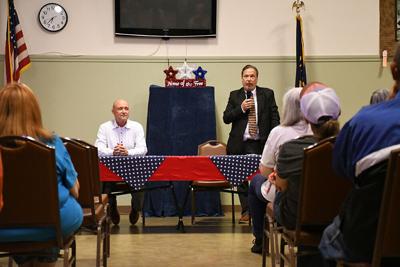
THE DALLES — A cluster of candidates vying for positions at the city, county, and state levels congregated at the Mid-Columbia Senior Center on Oct. 5, answering questions in a free, nonpartisan community forum sponsored by The Dalles Chamber of Commerce.
Attendees heard from 16 individuals across eight races, including House Districts 52 and 57; Senate District 26; The Dalles Mayor; The Dalles City Council Positions 1 and 3; and Wasco County Commissioner Positions 1 and 3.
Moderator Mark Bailey gave each set of opponents the same three questions, allocating one minute for each. Columbia Gorge News chose to focus on races it hasn’t featured this season. Responses have been edited for length and clarity.
HD 57
House District 57 spans the entirety of Gilliam, Morrow, Sherman, and Wheeler counties, along with portions of Clackamas, Jefferson, Marion, and Umatilla, and Wasco counties. The district is overwhelmingly Republican, having elected incumbent Greg Smith (R) — who often runs unopposed — by landslide margins since 2001, making him the longest-serving representative in the state.
Notably, Smith has been the subject of multiple ethics investigations, largely over his management of consulting contracts and personal financial gain while assisting development in eastern Oregon. He’s also being sued by Oregon’s Department of Justice.
A Heppner resident, Smith has a competitor this year in Josiah Dean, a Dufur resident and member of the Pacific Green Party.
Q: What role should the state of Oregon play in regulating and incentivizing future data center development, and what decisions should remain under local control?
DEAN: They are a necessary part of our community, but for the last 25 years, data centers have been getting out of control. They’ve been expanding without any oversight. We’ve had leaders who are doing nothing and then making backroom deals to enrich themselves in their budgets. We need to have public oversight and make sure that we are not giving away dollars to multi-billion-dollar companies.
SMITH: My comments align with Sen. Christine Drazan.
Q: What changes would you support to help rural school districts address needs and ensure dollars reach the classroom?
SMITH: You cannot learn if you’re not in the classroom. You cannot learn if mom or dad is not getting the student to school by 10 a.m. We have to hold parents, teachers, and students accountable. If you’re not a good teacher, you shouldn’t be teaching students. And parents, I’ll tell you what: a little discipline, making sure your kids do what’s right, will go a long way towards making sure they have the education they need.
DEAN: I would propose that we give rural counties additional funding because our rural schools have more expenses with transportation, more expenses with small classrooms, and older infrastructure.
Q: What is one state policy you would change to reduce costs for Oregon families and businesses?
DEAN: The biggest thing is to stop the corporate giveaways. As a small business owner and as a small business development center advisor, I understand how businesses work. I can help small businesses. I will go to Salem, and I will be supporting small businesses through the various incentives that we can have.
SMITH: You never truly own your home in Oregon because of our property tax. I would put a cap on the property tax for folks over the age of 65. You folks have worked hard.
County Commissioner 1
After securing 47.6% and 38.5% of the vote, respectively, in the May primary, nonpartisan candidates Lisa Gambee and John Grant advanced to a general election runoff to fill Scott Hege’s seat on the Wasco Board of County Commissioners, as he contends for House District 52.
Gambee has almost a decade of public Wasco County government experience, including service as the county clerk — another elected, nonpartisan position. Grant is a U.S. Navy veteran and Freebridge Brewery representative eyeing a new direction for the county.
Q: Wasco County is seeing significant new revenue from data centers and expiring tax agreements. How should this funding be used?
GAMBEE: Revenue from data centers can and should be used to address more immediate community needs. I would personally like to see the county prioritize infrastructure, including drinking water, wildfire mitigation and recovery, and bridge repairs, which requires significant matching grant funding.
GRANT: I mean, we can all make promises on how we want to spend money. The reality is, we have to have a bunch of people on the same page to be able to make things go forward. How do we make sure we don’t spend on anything that’s going to be long-term in case that money doesn’t last? We don’t want to get into the situation where the money runs out. One thing that we need to focus on is building a strong economy with our small businesses, as well as infrastructure.
Q: What measurable results should the county expect from programs and funds to address homelessness?
GRANT: The first step is assessing our programs. We need to see if we’re duplicating our spending. We need to see if our dollars are being effective, and then we need to make that assessment. I don’t think it’s a scaling question of whether we spend more or spend less. Spending effectively is the priority.
GAMBEE: Funding decisions should begin with clear data. In this instance, how many people are unhoused? Which groups are impacted, and which programs are having success? In Wasco County, there are 170 people experiencing houselessness, including seniors, veterans, youth, children, and families who have been displaced by wildfires. County investment should prioritize programs that have a proven record of increasing their impact, and certainly in this case on household stability.
Q: Where is the appropriate line between government supporting private development and government becoming too involved in the real estate market?
GAMBEE: I believe that we have an obligation to use taxpayer dollars for public benefit, for the benefit of our communities and our people, especially when it comes to funding things that citizens cannot afford to fund for themselves. I believe that real estate is the same kind of issue. Right? It’s public dollars. Where’s the public benefit associated with it? Is it land for affordable housing? Is it a new park for kids to enjoy, or is it a building?
GRANT: I think government should search and advocate for business, and I think that’s about as far as government should go. I believe that we should really cut back on SDCs, simplify codes, and then increase communication between government departments. We need to get out of the way and let private businesses do their jobs.
County Commissioner 3
After incumbent Phil Brady passed away on Primary election day, narrowly edging out Mike Urness by 97 votes, Urness advanced to the general runoff and now stands alone on the ballot.
However, Dick Schaffeld, who trailed closely behind, is still gunning for the seat as a write-in candidate.
Urness co-owns an over 80-year-old family business in The Dalles, and has served as a board member for numerous institutions, including the Chamber of Commerce. Schaffeld is a small-business owner and board member at Mid-Columbia Fire & Rescue looking to give back to his county.
Q: Wasco County is seeing significant new revenue from data centers and expiring tax agreements. How should this funding be used?
URNESS: The money in the endowment fund could be used in an emergency if needed, but the county has approximately $25 million over and above the $15 million being earmarked for the initial funding of the endowment fund. Public safety, infrastructure, and creating family-wage jobs are top priorities.
SCHAFFELD: My priority for that money is to go to the whole county.
Q: What measurable results should the county expect from programs and funds to address homelessness?
SCHAFFELD: It’s a challenge for everybody, for them, for us. I would personally like to see an opportunity to help the homeless, maybe give them a chance to get back on their feet more. It’s kind of like a gimme thing. I’d like a little something that you can give back to them, allow them to own it and have it for themselves.
URNESS: Homelessness isn’t Wasco County’s problem that needs to be fixed. The state of Oregon needs to come up with that solution, as the problem keeps getting bigger and more expensive for everyone; the major result would be a decrease in homelessness, which should reduce the amount of funding and taxes needed.
Q: Where is the appropriate line between government supporting private development and government becoming too involved in the real estate market?
URNESS: I believe that private investment and county funds should be separate, but with many of the grants available to counties by state and federal government, county commissioners typically have to contribute matching funds to get the free money. Local real estate market values are driven more by retail supply and demand than by county land purchases, the downside of which is that it takes the property off the tax rolls, but you can only change things by voting.
SCHAFFELD: I don’t think the county ought to be in the real estate business. That’s just my personal feeling, and I don’t think they had to be in the banking business. I know there are certain things, certain hoops you have to jump through to get things to work out, grants and whatnot, but I don’t think they should be taking property and things off the tax roll and putting the burden on the people.


Commented