
By Dan Spatz
For Columbia Gorge News
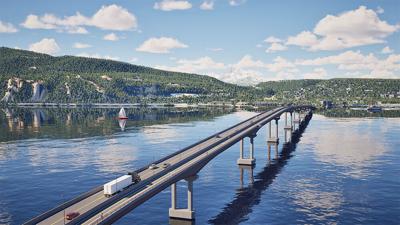
THE GORGE — One key source of federal funding gained a reprieve, but the fate of another is still uncertain as Hood River-White Salmon Bridge replacement efforts continue this fall.
If funding is secured, construction will begin in just one year. October 2027 is the long-planned start date for this $1.12 billion project. Completion would follow in 2032.
About half the funding is secured, including a combined $250 million from the Oregon and Washington legislatures. At their Sept. 28 board meeting, Hood River-White Salmon Bridge Authority commissioners learned that a previously approved federal source, a $200 million “INFRA” grant, has been extended by at least a year to coincide with planned construction.
INFRA is an acronym for Infrastructure for Rebuilding America. The 2024 grant was to have expired Sept. 30, 2027, but the bridge authority received word it would be extended to September 2028, with additional extensions possible upon Congressional direction. The extension will align with construction should work begin on schedule one year from now.
INFRA was awarded in 2024, but cannot be released by the Federal Highway Administration (FHWA) until the bridge authority has assurance of full funding. Ironically, the same federal agency holds one of the final cards on full funding, a $532 million “Bridge Replacement Program” (BIP) grant application. This, plus a loan to be repaid through future toll revenues, would complete the budget, of which $775 million is for actual construction.
Earlier in September, bridge authority commissioners also learned that the administrative path for $8 million in Congressionally-directed funding has been clarified: Oregon Department of Transportation will receive and administer those funds. This will be important in the months ahead, with design completion in early 2027 and a mid-winter “test pile” program to ensure construction won’t damage the existing bridge.
This past August, FHWA advised that the bridge authority’s 2025 BIP grant application had received a preliminary rating of “Recommended,” subject to additional evaluation.
Evaluation, presumably, is under way now. But the clock is ticking. While construction is still a year away, materials must be ordered and delivered, a construction contractor selected, and sundry other processes aligned for the period between October 2027 and March 2028 when work can take place in the Columbia River without disrupting fisheries.
Then too, FHWA and other federal agencies only function until Dec. 11, 2026, when a “continuing resolution” expires. Congress passed the “CR” in early September after failing to adopt a 2027-28 federal budget; another CR must be approved to avoid further disruption. Federal shutdowns earlier this year, compounded by agency staff cuts, have already delayed key permits needed for the “in-water” test pile project this winter.


Commented