
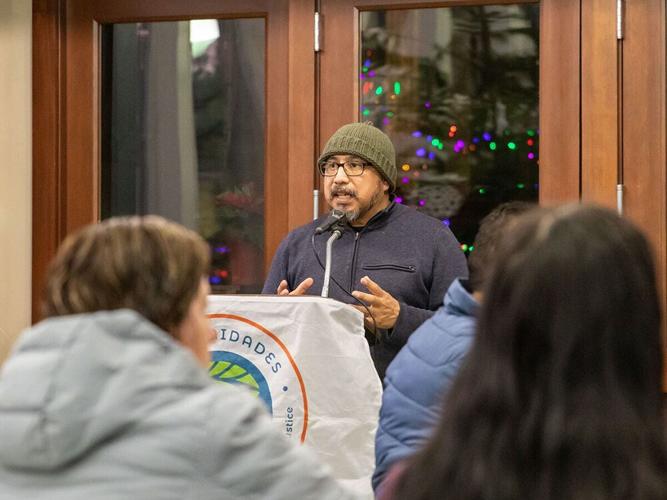
Hostility, dysfunction and poor oversight have long persisted, former employees and local leaders say
By Nathan Wilson
Columbia Gorge News
Para una versión en español de esta historia, visita www.columbiagorgenews.com.
THE GORGE — “I had to call a few emergency therapy sessions. I was not sleeping. I started getting a lot of inflammation. My hair was falling out way more than it ever has. There were multiple interaction-driven panic attacks,” said Zyanya Cruz, former lead organizer for Comunidades, a nonprofit organization focused on serving Latino communities throughout the Gorge. “And I was only there for eight months.”
By the time Cruz stepped down from her position this past May, two employees and one board member had already resigned, with another employee fired. Their catalyst was how Ubaldo Hernández, executive director of Comunidades, handled a pay dispute. Spurred by the fallout and Cruz’s semi-public resignation letter, however, more than a dozen people who collaborated with or worked for Hernández have since shared their experiences, including several of the region’s most prominent Latina and Latino leaders.
They described instances of a hostile work environment, sometimes to the detriment of mental and physical health. A mismanaged organization that has struggled in relationship with others to serve immigrants as federal enforcement intensified. And a broader funding system where oversight is minimal, resulting in operational breakdowns that undermined the work donors aim to support, they said.
Before creating Comunidades, Hernández immigrated to the Gorge from Mexico City, working in the fields and food industry before transitioning to the nonprofit sector. Comunidades now has a new office space in White Salmon, and Hernández also serves on the board of Radio Tierra, Washington Gorge Action Programs (WAGAP) and philanthropic group Seeding Justice.
Despite his grassroots career and efforts to advocate for Latino issues, some have questioned his standing as a local figurehead and ability to lead, especially considering the amount of resources at Comunidades’ disposal. Over the course of its existence, the nonprofit has received at least $2.11 million in grants.
“He is the Latino community member, the Mexican community member that represents us as Mexicans,” said Juan Reyes, the associate director of WAGAP, who spoke on his own behalf. “For so long, everybody that’s had some kind of interaction with him has been so afraid to say anything, not only because of retaliation from him, but also the concern that nobody was actually hearing them or would believe them.”
How Comunidades came to be
Comunidades officially formed in 2020 under the fiscal sponsorship of Columbia Riverkeeper, where Hernández had worked as a community organizer for three years prior. His role was to engage Latino and immigrant communities on environmental issues: pollution, cleaning up Bradford Island, protecting salmon and other matters. Hernández increasingly saw a larger advocacy opportunity, though.
“I knew I couldn’t just knock on someone’s door and say, ‘I’m here to talk about environmental justice,’” he told Columbia Gorge News over email after declining an in-person interview. “For farmworkers, pesticide exposure is about the environment, but it’s also about their health, their jobs and their families. Housing, workers’ rights, immigration. These things are connected in people’s everyday lives.”
Comunidades seeks to unify environmental and social justice while fostering Latino civic engagement, and works across a wide spectrum of issues. For example, after tenants of a White Salmon mobile home park received eviction notices in early 2020, Hernández met with residents, many of whom were immigrants working in the local agricultural industry, and encouraged them to testify before city council.
“He made this incredible space where they could tell their stories and get the help they required,” said Gabrielle Gilbert, a child advocate under contract at Rural Solutions, a separate nonprofit fiscally sponsored by Comunidades. “Having someone in your corner, hearing you in your language, being there in front of forces that are deeply entrenched and standing up for you — that is huge.”
Residents did provide comments to city council, and in July 2020, White Salmon changed outright uses allowed in mobile home zones and approved a new eviction process for those areas that mandated relocation support. In the following years, programming included environmental education campaigns on fire preparedness and fish quality; annual community celebrations, like for National Immigrants Day; voter registration and vaccination drives; supporting unionization efforts at Mt. Adams Fruit; and more.
In early 2024, however, Hernández chose to separate Comunidades from Columbia Riverkeeper following an internal investigation that centered around him. Hernández declined to comment on what prompted the investigation, saying he never saw the findings.
Columbia Riverkeeper also would not confirm what the allegations were or whether they were substantiated.
“Columbia Riverkeeper has a longstanding practice of respecting current and past employees’ privacy,” the nonprofit wrote in a statement to Columbia Gorge News. “This practice is rooted in our values and advancing compliance with laws that protect workers’ rights. In turn, the organization does not comment on personnel matters.”
‘Walking on eggshells’
Two women who worked for Comunidades at the time and were interviewed for the investigation said they never received the results either.
Lilia Monje joined Comunidades in January 2021 to help produce a weekly podcast livestreamed on Facebook called “Voces Del Noroeste,” where a group would essentially gather and discuss regional news of interest in Spanish, in exchange for a stipend. Ingrid Fuentes Espinoza started helping out with the podcast later, and then Hernández hired her as a communications and program coordinator in April 2022.
She recalled how Hernández would often talk badly about other employees when they could overhear, and felt like she was “walking on eggshells” in the office because Hernández “would bring this temper” at random. Fuentes Espinoza explained one instance where Hernández yelled at her for being late to a meeting, even though she was delayed because her mother-in-law had an accident. She couldn’t shake the interaction, including at an event later that day.
“The way he was talking to me, it triggered a bad experience that I had with a previous marriage,” Fuentes Espinoza said. “I just cried during the event, and I didn’t care if people saw me that way because I was so uncomfortable.”
Fuentes Espinoza resigned in April 2023. Monje followed a few months later in August, alleging that she never received the full stipend amount promised for her podcast work, which Hernández denied, claiming that he didn’t approve the arrangement. Monje saw the anger that Hernández somtimes brought into work like Fuentes Espinoza, but Monje, an immigrant, also emphasized that Comunidades’ mission didn’t extend to staff and volunteers.
“People tend to weaponize your desire, your initiative and the need that’s in the community,” Monje said. “[Hernández] treated us like subordinates. We were helping and reaching out to the community, but all of this amazing work that he would talk about didn’t apply to us. It only applied to them.”
Reyes of WAGAP also told Columbia Gorge News about two other people, not affiliated with his organization, who had tried to collaborate with Hernández in the past and faced conduct similar to Fuentes Espinoza and Monje, ultimately leading them to walk away.
“I can see the anxiety, the stress, the mental strain, the emotional toll that it has taken on them to give up a project they absolutely love and believe in,” Reyes said. “Being yelled at, or being mistreated, or being made less of — those traumas have really resonated.”
One of the individuals Reyes referred to, who requested to remain anonymous to protect future career opportunities, began working with Hernández in 2017. She was tasked with creating Organizing Latin/x Advocates (OLA), a group dedicated to improving the Latino community’s access to cultural, educational and health-related information, and her supervisor thought that bringing Hernández into the fold would help move things along.
In meetings with representatives from already-established agencies, they would discuss the importance of producing materials in both English and Spanish, hiring bilingual staff and effective outreach strategies. OLA also facilitated leadership trainings to spark civic engagement and kept a calendar of community events.
Hernández, however, would often derail meetings with topics of his own interest, she said, adding that she was put into the role of “secretary,” bearing the brunt of planning meetings while Hernández took the credit.
“I felt like he didn’t respect me as a woman, as a partner,” she said. “I truly think [OLA] could have been Comunidades.” When she approached Hernández about the imbalance, Hernández “got bright red” and scolded her, so she left in 2018 and went back to school. OLA unraveled shortly thereafter.
The other individual that Reyes mentioned didn’t respond to a request for comment.
Poor follow-through’
When Columbia Riverkeeper and Comunidades were separating in summer 2024, Hernández and Christopher Cazares, an artist who has long drawn creative inspiration from women and pre-Hispanic culture in Mexico, started talking about ways to collaborate. Hernández wanted to commission a mural and have Cazares lead afterschool sessions for local students on how art has been used in social movements. Upon completion, which also included a painting that illustrated why voting was important to them, the students would receive a $100 gift card.
Cazares agreed, but it took two months for him to see any payment and receive a formal contract, even though he had already completed the mural. The lack of organizational follow-through quickly became apparent, too. Cazares remembered having to call parents and explain why their kid hadn’t received the gift card, using his personal vehicle to transport them and how sessions were routinely delayed.
“There were administrative breakdowns on that project, and I take responsibility for them,” Hernández wrote, noting that both Cazares and the children were ultimately compensated. “We should have handled those details better, and I regret that we didn’t.”
Unemployed at the time, Cazares stuck with Comunidades and accepted more work from Hernández. Incidentally, that involved tabling at an event where a sector of Mt. Adams Fruit workers were looking to unionize in November 2024, and Cazares picked up a position with UCFW 3000. Cazares grew increasingly busy, and similar to Fuentes Espinoza, Hernández snapped when union work made him late to a meeting.
“He just started yelling, ‘I told you, I told you — for people who serve two masters, it doesn’t go well with one of them,’” Cazares recounted. “It specifically was the mistreatment that was taking a toll on me. I could have done that amount of work if I felt supported.”
Cazares, 27 years old then, fainted for the first time right before he was supposed to visit family in Mexico over the December holidays. While there, he began experiencing respiratory problems, migraines and insomnia until he couldn’t get out of bed one morning. A doctor subsequently informed Cazares that he was prediabetic and suffering from hypertension, attributing both to work-induced stress.
“When you work so much and you don’t allow your body to rest or develop anything it needs to develop, you don’t get sick until the work is done, and that’s what happened,” Cazares said, describing how he “felt like a tool” and developed a nervous tick as a result.
Hernández couldn’t confirm the exact interaction with Cazares, but said it doesn’t reflect how he saw the conversations they had about balancing responsibilities between two organizations.
Immigration enforcement
Come May 2025, Comunidades officially received tax-exempt status from the IRS. At that point, the Trump administration had halted legal assistance for undocumented minors, and the threat of immigration enforcement was already impacting the Latino community’s day-to-day lives.
Altogether, U.S. Immigration and Customs Enforcement (ICE) agents detained nearly 50 people across Hood River and Wasco counties last year, a federal spokesperson told Uplift Local and Columbia Gorge News in November.
“Comunidades is committed to protecting and standing with immigrant communities in the Gorge,” Hernández wrote in a statement. “We organized volunteers to serve as community observers. They accompanied packinghouse workers, drove with them and documented enforcement activity. As the situation changed, so has our response.”
Cruz, Comunidades’ former lead organizer, remembers it very differently. The organization did form a rapid response team to monitor ICE activity, but that work only began once Cruz came on board last September, months after agents started roaming local streets. And it wasn’t without resistance from Hernández.
“He didn’t want that to be organized,” Cruz said. “Mitigating the risk and supporting families on the ground, that’s not what he wanted to focus on.”
Hernández warmed up to the idea because “he got to take pictures to raise even more money,” Cruz said, but she also wanted some sort of backstop for volunteers, knowing the work was dangerous. Individuals have been arrested for exercising their First Amendment rights, like videotaping federal law enforcement officers without interfering in their operations, so she asked Hernández to support a bail fund.
He agreed, and Cruz informed the team. A few months later, though, Hernández reversed course.
“As we weighed the legal, financial, and operational responsibilities, I concluded a bail fund wasn’t the right vehicle for an organization our size to take on at that time,” Hernández wrote. “I take responsibility for how it was communicated. I should have been more clear earlier on about what we could commit to.”
That decision spurred the most severe panic attack Cruz had during her brief tenure at the organization. She was already avoiding the office, where she felt talked down to and frequently got into arguments with Hernández, but the ability to ensure volunteers’ safety was the only reason she felt comfortable bringing them in.
Cruz began thinking about next steps soon afterward, especially because the team was cut off from a larger coalition of observers that the Hood River Latino Network, another local nonprofit founded in part by Martha Verduzco-Ortega, had been operating since 2024. Attempts to coordinate their efforts weren’t successful, and Verduzco-Ortega said that Hernández was the barrier, probably because he was “threatened by female leadership.”
“In the past, women from both organizations showed an interest in working together for the benefit of our community. However, we did not see the same initiative from the leadership of Comunidades to move those efforts forward,” she wrote in a statement.
“With all of the ICE activity, this is a time that we have to work together,” Verduzco-Ortega added during an interview.
Hernández emphasized that Comunidades remains focused on supporting local immigrants through know-your-rights education, community organizing, youth leadership training and direct support for families affected by enforcement, but the volunteer network that Cruz pulled together now functions completely separate from Comunidades.
The pay dispute
When Cruz submitted her resignation letter this past May, more turnover had already occurred at Comunidades after Hernández realized that three employees were receiving full-time salaries when he thought they were only contracted to work 30 hours per week.
Two of them, Marcos Aguirre and Karen Rodríguez, had been operating under verbal agreements since January and still work for Comunidades. But another employee, who was subsequently fired, had explicit terms of employment written out since August 2025.
Once Hernández moved to reduce her contractually agreed-upon salary by 25%, she requested to speak directly with the then four-member board of directors in charge of “overseeing its financial affairs” and “authorizing its expenditures,” as stated in Comunidades’ bylaws. During an April 28 emergency meeting, Hernández explained that the reductions were necessary because of budgetary constraints and had been caused by an administrative error, according to former Board Member Amanda Kitchings and two others present.
“We asked for numbers over and over, and never got anything,” Kitchings said during an interview. “You can’t claim that it was for the financial welfare of the organization if you have no idea what your budget is.”
Hernández confirmed that the board had not received a completed 2026 budget prior to the meeting. Documents provided by Comunidades do show that a non-itemized, working budget was presented that day, but partial, redacted minutes also establish that Hernández wasn’t able to put a figure on Comunidades’ total income.
Kitchings couldn’t tell where money was coming from or who it was going to from the working budget, and she emphasized that offering living wages had been identified as a priority in previous board meetings. Hernández didn’t consult the board on potential workarounds before making the cuts, she said, and Kitchings resigned mid-session after Hernández “lost it” when he learned that she had talked with an employee about the dispute.
“I’ve been in tense board meetings. You don’t act like that. You can have hard conversations, but the pointing, the leaning over the table, the raising of the voice — it just took any sort of validation away from him,” Kitchings said.
“The board’s only real power in that situation would be to fire the executive director and start looking for another one, and those votes were not there,” she continued. “I cannot get behind an organization when I don’t trust or align with the director and leadership.”
Because the incident involved personnel matters, Hernández and Board President Alfredo Fuentes said they couldn’t comment on specific details, but both acknowledged that it exposed administrative vulnerabilities related to payroll and human resources. They also noted that transitioning to an independent organization contributed to the budget delay, as funds and records arrived from Columbia Riverkeeper in piecemeal.
“Our internal systems have been evolving alongside the growth of the organization,” Fuentes wrote in a statement. “The board has not received financial information as consistently or comprehensively as we should, and we expect that to improve.”
Contrary to Kitchings, Hernández said that conversations about preserving compensation did occur, and that those didn’t lead to the same outcome for each employee. The nonprofit has also brought in additional human resources expertise and hired an outside financial analyst to perform an audit, which should be done by this fall, and all Comunidades employees now have written contracts.
Still, though, two former employees who didn’t face the threat of pay reductions stressed that the dispute was preventable. They left Comunidades in protest and requested to remain anonymous, either for fear of retaliation or to protect future employment opportunities.
“The decision not to honor the salaries of three employees due to the executive director’s misunderstanding of basic compensation is a failure of both morality and oversight,” one, who worked on the administrative side, wrote over email to Hernández and board members after the emergency meeting. “I have repeatedly voiced the need and urgency for a qualified bookkeeper. The current handling of financial inquiries and the lack of transparent, informed management in this department have left me with no confidence in our financial stability.”
Trust-based philanthropy
Although former Comunidades employees fault Hernández’s leadership and behavior, they believe that the larger system bankrolling nonprofits is culpable for Comunidades’ operational lapses, too.
Several foundations have provided money to Comunidades since its inception, including Seeding Justice ($75,000), Community Foundation for Southwest Washington ($225,000) and the Inatai Foundation ($1,812,000), according to the most recent tax filings available and former employees with direct knowledge of Comunidades’ finances.
“It’s a double-edged sword,” said Laurie Styron. “How quickly do we want to get money to people who need it, versus how much do we need to collect for due diligence?”
Styron is the CEO and executive director of CharityWatch, a national group that rates nonprofits and their oftentimes deeper-pocketed foundations based on financial statements, tax filings, privacy policies and other information. As she explained, many philanthropic organizations follow a trust-based approach characterized by fewer application and reporting requirements, and money that can be spent as an organization sees fit, rather than for specific programs.
That’s because getting grants isn’t easy, and funders have realized that if one application for a few thousand dollars takes 40 hours, pursuing dozens with no guarantee of success isn’t sustainable for understaffed groups.
It’s about balancing accessibility with accountability, Styron said, and foundations view the flexibility as empowering for organizations.
“We look to organizations to self-identify what their key performance indicators are, how they define success, what are their opportunities for growth,” said Esra Khalil, Community Foundation for Southwest Washington’s (CFSW’s) senior program officer. “We truly believe, as a north star, that people have their solutions.”
But one former employee, who supported fundraising and now splits time at several nonprofits in the region, said that foundations failed to ensure Comunidades had the administrative backbone necessary for operational stability and to responsibly allocate money before grants were given. While she recognized the importance of unrestricted funding, she also noted that many foundations, unlike CFSW, only have dialogue with executive directors and not employees, limiting what concerns are communicated.
“There is a fear that if you have money for a specific cause, you shouldn’t be spending it on staff or you shouldn’t be spending it on systems, you should be spending it on the community and people, but it eventually falls apart if you don’t have those systems in place,” she said, requesting to remain anonymous for reasons already stated. “The executive director can decide where it’s spent, and there’s no rhyme or reason to it.”
Like others, she called for a new bookkeeper and better financial management at Comunidades. The pay dispute was a glaring example of both poor internal oversight and inadequate due diligence on the part of foundations. Additionally, Comunidades missed grant opportunities because employees couldn’t get an accurate picture of past and projected expenses in a timely manner, she said.
As Khalil explained, CFSW does offer support to organizations managing growth and will recommend best practices on personnel policies, internal controls and fiduciary responsibility if requested. Her organization avoids being prescriptive, though, and while CFSW holds biannual meetings with recipients supplemented by engagement through an independent grantmaking committee, they don’t require a written report.
Both Seeding Justice and the Inatai Foundation declined interview requests. Asked whether CFSW will review the pay dispute and Comunidades operating without a complete budget for roughly a year, Communications Director Maury Harris said this over email:
“When concerns are brought to our attention, we evaluate them in the context of our responsibilities and determine an appropriate response based on the nature of the issue. The process varies depending on the situation. In this case, our leadership and program staff will review the matter internally, track any updates and assess next steps. As we mentioned, many organizations experience challenges as they grow. What’s important is that they recognize those needs and take meaningful steps to address them.”
Not felt by all
Columbia Gorge News spoke to nine people who have been yelled at or demeaned by Hernández, or learned about the same treatment directed toward colleagues, but that experience isn’t shared by everyone tied to Comunidades.
Hearts & Minds Communications, a public relations firm hired by Comunidades after Columbia Gorge News started reporting this story, organized the following interviews.
Ana Elisa Wilson is a program co-manager at the Northwest Center for Alternatives for Pesticides, working primarily in Umatilla and Morrow counties. She’s known Hernández for about seven years and participated in a journalism training coordinated by Comunidades, which she then used to launch a radio show. The two have since appeared as guests on their respective shows and regularly share resources for workshops.
Wilson said she’s never seen Hernández act disrespectfully to members of his team or those who have participated in a Comunidades program.
“His character is firm. He’s firm with his values and how he feels about justice,” she said. “When he’s talking, it’s with a lot of passion and is strong, but it’s to help us — to help the community understand that we need to be united.”
Luis Rivas, who grew up in the Hood River Valley, agreed. He sees Hernández as a mentor and started volunteering with Comunidades while still a high school student. Recently, that’s meant passing along important information to immigrants: numbers to call in an emergency, what rights they have, where to find legal help.
Now aiming to become a community organizer himself, the work gave Rivas purpose. He learned that creating local change is equal parts patience and commitment.
“I never felt like I was made less than or that [Hernández] was angry at me. We just had serious discussions and disagreements,” Rivas said. “In the future, I would like to get the chance to apply for a job with Comunidades, or another nonprofit.”
Ana María Rodríguez, who met Hernández through a group called Fortaleza, described him as “hardworking individual who has risen to his current position through effort and dedication.” She also participated in Comunidades’ journalism training, alongside a class on political sociology, and collaborated with Hernández to offer face-painting services.
Rodríguez praised Hernández’s ability to provide justice-focused opportunities for employment, participation and learning, particularly his work with young people. Hernández champions both culture and environmental issues, she said, and consistently stands in solidarity with others.
Moving forward
Former Comunidades employees differ on what it would take to restore their faith in the nonprofit. One was heartened by the hiring of an independent financial analyst, adding that the board should be reshaped to recruit members with specific professional skills, such as accounting, legal experience and community organizing.
By contrast, Cruz, the former lead organizer for Comunidades, firmly believes that Hernández should resign, or at a minimum, share the leadership. Hernández excels at fundraising, but Cruz said that there is “more than enough proof” he shouldn’t be responsible for managing employees anymore.
Leti Valle Moretti, a Hood River County Commissioner and active member of the Latino community, said she has observed troubling patterns at Comunidades for years: frequent turnover, Hernández’s “machismo” and a trail of frayed relationships. As a result, Moretti has intentionally kept her distance from Comunidades, but she didn’t realize the problems were so severe until former employees started sharing testimonies.
“It’s just like the César Chávez effect,” Moretti said. “I was angry, not shocked, because it’s happened to me. I’ve kept quiet because I want things to work out for the larger community, but that was when I was younger. Now, I know that it’s our duty to be transparent and be honest. We have to hold people accountable and be accountable.”
The road to rebuilding trust is long, she added, emphasizing the “hypocrisy” of a social justice organization treating its employees poorly, and that board members bear responsibility as well. Moretti wants to see clear strategic planning, an acknowledgement of wrongdoing and better accounting that demonstrates how resources are being utilized in the future, both for programming and employees.
“An executive director doesn’t need to know how to do everything, and so they shouldn’t pretend that they can do everything, but you need to put the right people in place to do the different parts of the work,” Moretti said.
It appears Hernández will continue at the helm, however. Board President Alfredo Fuentes supports him, pointing to his commitment, track record of helping marginalized people find their voice and stressing that he’s willing to grow as a leader, which Hernández reiterated.
“I understand that a number of people who have worked with Comunidades have concerns about my leadership and how the organization has operated,” Hernández wrote. “I may see some of what happened differently, but I can’t dismiss how people experienced working with me or the fact that some people who gave themselves to this work came away hurt. Intention and impact are not the same. I have to take responsibility for my impact, even when it wasn’t what I intended.
“I should have communicated more clearly, handled pressure better, and grown as a leader faster than I did. Separately, we also needed to build stronger financial and operational systems earlier than we did,” he continued. “Those responsibilities are mine, as the founder and executive director. I’m committed to that work, and to earning back trust through how I lead going forward, not through words alone.”
Hernández also remains a board member overseeing Radio Tierra, Seeding Justice and Washington Gorge Action Programs.
•••
Uplift Local assisted with translations for this story, and community journalism director Emily Harris contributed editing.


Commented