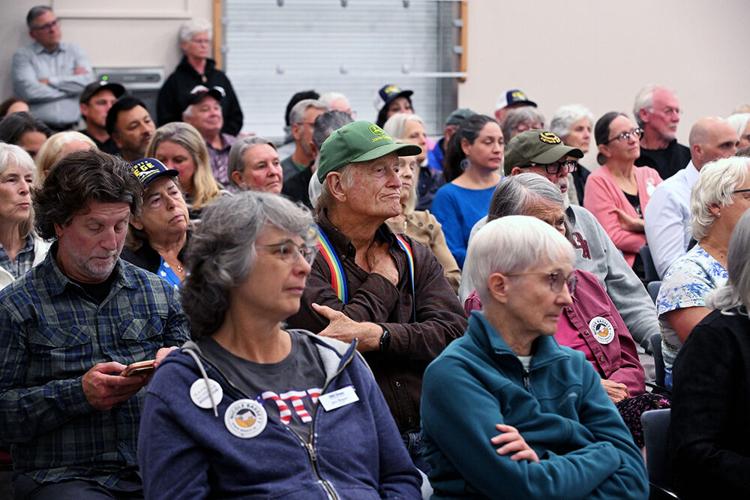
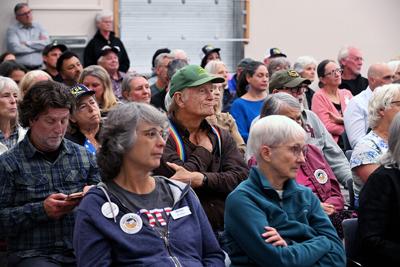
Local residents packed the Hood River Valley Adult Center to hear candidates running for state office in Oregon take questions on Sept. 24. The event, organized by the Columbia Gorge News, hosted House District 52 contenders Hank Sanders and Scott Hege, along with Jeff Helfrich and Nicole Bassett, who are looking to secure the Senate District 26 seat.
Local residents packed the Hood River Valley Adult Center to hear candidates running for state office in Oregon take questions on Sept. 24. The event, organized by the Columbia Gorge News, hosted House District 52 contenders Hank Sanders and Scott Hege, along with Jeff Helfrich and Nicole Bassett, who are looking to secure the Senate District 26 seat.
HOOD RIVER — It’s election season in the Gorge, and with Nov. 3 inching closer every day, candidates for Oregon’s House District 52 (HD 52) and Senate District 26 (SD 26) are vying for a seat in Salem.
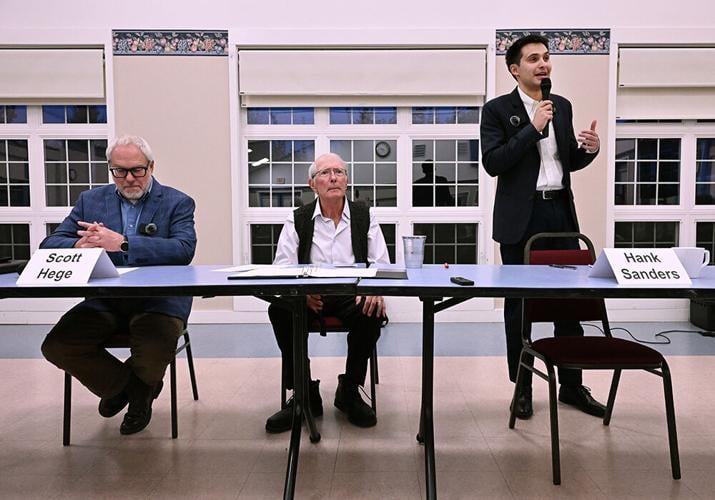
Scott Hege (R) and Hank Sanders (D), up for HD 52, addressed constituents during a nonpartisan public forum at the Hood River Valley Adult Center on Sept. 24, hosted by Columbia Gorge News. Jeff Helfrich (R) and Nicole Bassett (D), candidates for SD 26, followed.
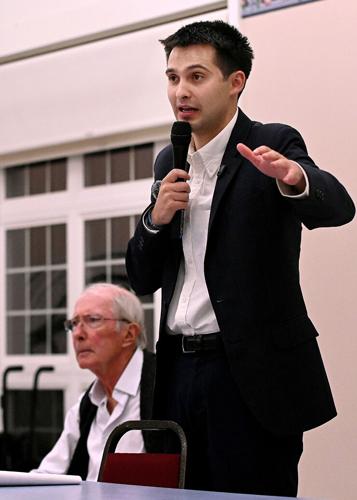
Hank Sanders (D)
Helen H. Richardson / special to Columbia Gorge News
Both districts include all of Hood River County, a slice of Wasco County that encompasses The Dalles, and chunks of eastern Multnomah and Clackamas counties.
Part 1 looks at HD 52 candidates; next week will cover SD 26. Read the full story online now at columbiagorgenews.com. This story is also available in Spanish.
House District 52
With Rep. Helfrich departing the position to run for Senate, HD 52 is up for grabs — and it’s a battleground. Republicans and Democrats have flip-flopped control of the seat over the past decade, often winning by razor-thin margins.
According to the Oregon Capital Chronicle, roughly 30% of registered voters are Democrats, 25% are Republicans, and 38% are unaffiliated.
Hege, 64, is a resident of rural Wasco County, a current county commissioner, and a former Port of the Dalles executive director. In his opening statement, he pointed to his background in engineering and vast legislative experience as sculptors of strong collaborative skills.
“I have served in pretty much every capacity, in every element of county and local government,” Hege said. “The reason I’m running for House is because I think Oregon can do better.”
Sanders, 25, grew up in Gaston, Oregon, where he watched neighbors fight back against a corporation’s attempted pipeline installation nearby, sparking an interest in journalism that took him to the Chicago Tribune and New York Times. Now a Hood River resident, affordability and education are at the forefront of his campaign.
“We need to make this a place where people can and do choose to build their lives,” Sanders said. “I’m running for office to return Oregon to the most amazing place that it can be.”
Both candidates were given the same questions by moderator Judge Paul Crowley, and allotted 90 seconds each to answer. Responses have been edited for length and clarity.
Q: What is your stance on data centers and what guardrails, if any, should be in place to ensure responsible development?
HEGE: They’re not all bad and evil. I think there’s a lot of information out there that maybe is not accurate. When they came to The Dalles in 2006, it was a very different time. Those data centers have done very well. They haven’t raised the price of anything — not power, not water. But I do believe control is important. I think jurisdictions should have the ability to put bans on data centers, but also should be allowed to do them. There’s a lot to be learned. I don’t believe everything is good or bad.
SANDERS: I’m calling for a data center moratorium. We talk to community members; we hear every single day about how much water they’re using at a time of drought, how much their utility bill is going up, how AI companies are bragging about new technologies that are going to take your job, and doing it while taking our tax breaks. My opponent voted multiple times to give those tax breaks and worked as the vice president for the company that Google selected to build those data centers. It’s about making sure that our community comes before trillion-dollar corporations like Google.
Q: Farmers face intense pressures from housing demands, tourism expansion, skyrocketing land values, and infestation. How do we ensure that farmland is adequately protected for future generations?
SANDERS: There’s a bill that went through the legislature and passed into law called the Farm Stamp Bill. The bill took away the caps on how much revenue a farm can make from a farm store; that’s a slippery slope. We have to hear from farmers about the challenges they’re facing, understanding we need to be innovative in allowing farmers multiple sources of revenue. How do we ensure that farming continues to be stable generation after generation? Invite them to the table, invite them into Salem.
HEGE: One of the main things we can do is make sure that it’s profitable. Farmers are price takers, not price makers, so we can’t put rules and regulations that drive their prices up. The farmers are making less; the workers are making less. The Oregon Farm Bureau has endorsed me. The AgPAC has endorsed me. Pretty much every agricultural business entity out there has endorsed me because they know I’m going to stand up and support them.
House District 52 candidates Scott Hege, left, and Hank Sanders, right. Senior Judge Paul Crowley, at center, acted as moderator.
Q: The single question submitted most to Columbia Gorge News concerned access to women’s healthcare, including abortion. What’s your position on women’s healthcare options?
HEGE: I am pro-life. I believe life is good. At the same time, I think Oregon has a very good track record of protecting women’s rights to choose, and that’s what it’s going to be, regardless of what I feel or what I want to do.
SANDERS: I’m pro-choice. Reproductive care, including access to abortion, is healthcare and should be fully supported. I’ll defend it fully.
Q: The cost of gas, food, utilities, and housing continues to increase. What can be done on the legislative level?
SANDERS: We need to build more housing. We need to cut red tape. We need to make sure that we have a yes-and approach to housing while adhering to the prevention of urban sprawl. That looks like private housing; that looks like public subsidized housing. It looks like the whole gambit. We also need to come up with a better solution for how we can lower costs for healthcare. We need to support small and medium businesses. And it’s not just one side of the equation, which is the cost side. We need to make sure that there are stable jobs here.
HEGE: In Oregon, we tend to like regulation — trying to make new rules to govern us. The reason why things just keep going up is that there’s no collaboration, there’s no cooperation, there’s no working across the aisle. I want to be the person who works with both sides to work on the solutions that reduce the cost of living here. And it’s a variety of things.
Q: How would you address wildfire risk?
HEGE: Living in Wasco County, we know a lot about wildfires. Most of these fires are started by man, but sometimes by nature. They start on our public lands and burn on private lands. We need to do a better job of controlling fire fuels on these public lands. We need to stop litigating and start taking care of our forests. We need to use our forests as a natural resource and not just let them burn down.
SANDERS: Growing up, I remember when a day in the 90s was an oddity, and now weeks in the 100s are normal, and months of smoke blanketing our communities are normal. We have a changing planet. We need to be mindful of how renewable forms of energy alter the speed of climate change; we also need to make sure that we are supporting our fire teams. We need to make sure that they have the support and resources.
Q: The vaccination rate in Oregon is below the herd immunity threshold. Is that concerning, and what should be done?
SANDERS: It is concerning. When you don’t have somebody who’s a doctor making decisions for the country on vaccination recommendations, you’re going to get decisions that aren’t based on what doctors recommend. We must go back to the science-based evidence and do everything we can with the Western states to ensure that science is leading decisions.
HEGE: We need to keep our population healthy. At the same time, I do believe that parents should be the ones making decisions for kids. So I think the idea of forcing people to do stuff medically that they don’t want to do is problematic in my mind.
Q: What are two to three policies that will drive your work as a legislator?
HEGE: Supporting the agricultural community is key. I’m going to work on policies and make sure that Salem does right by the ag community. Second, I think our business climate in the state of Oregon is not good. It’s horrible, actually. We’re seeing businesses leave the state. If you talk about affordability and pretty much everything across the board, if you don’t have a business climate that supports businesses, you’re not going to have jobs.
SANDERS: We need to have a data center moratorium. Making sure that we’ve got guardrails around AI, so that your job and mine and our grandkids’ jobs aren’t replaced. Number two, handling both mental health and substance abuse challenges. There are laws in the books that prevent those from being in the same structure. This is a serious issue in our community. We shouldn’t be stuck approaching one of the two, so that we can help people who are struggling with both of those interlocked issues and get them the help that they need.



Commented