
By Sean Avery
Columbia Gorge News
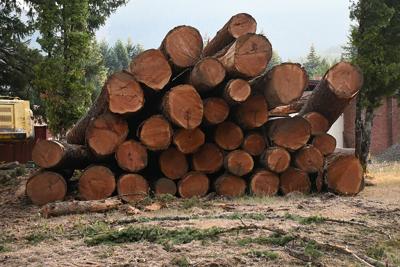
MILL A — After student safety concerns sprouted last December, the Mill A School District (MASD) authorized a commercial harvest of its on-campus outdoor classroom, the Little Interpretive Forest (LIF) — a move that netted the district more than $62,000 and spawned outrage from community members at an Aug. 17 school board meeting, as previously reported by Columbia Gorge News.
With logging operations having ceased at the time of its Sept. 21 meeting, the MASD board explained that generating revenue was never the project’s intent, and a large sum of harvest earnings will be reinvested toward restoring and maintaining what’s left of LIF.
Concerns persisted among returning public commenters, and the board was again unable to respond to or answer their questions, in compliance with state meeting laws. Since LIF’s post-harvest report fell on the agenda as a discussion item, however, talk regarding the woods’ past, present, and future came to light.
Post-harvest report
LIF’s post-harvest report, a 25-page packet completed on Sept. 14 by a consulting forester with Pacific Ghost Forestry Services (PGFS), lays out the project’s total timber receipts (available to view on the MASD website).
MASD grossed $62,180.24, good for 52% of the total revenue and 38.2% above initial estimates. According to Superintendent Kelly Stickel, the money will go into the district’s capital project fund, which encompasses any reinvestment efforts into forest management and ecological classroom beautification.
PGFS described the operation as a “science-consistent, moderate variable-density forest-health thinning,” citing an overstocked stand with failing, self-thinning Douglas firs. Individual trees were cut down selectively to reduce overcrowding and make way for increased species and structural diversity — a mixed-species residual rather than a simplified Douglas fir-dominated forest.
According to the report, its primary objective, therefore, was forest health and long-term stand stewardship, not maximum short-term timber revenue.
This harvest cannot be declared a long-term biological success until time passes, as annual visual inspections and formal remeasurements are conducted, thereby determining whether residual tree growth and vigor respond as expected.
The report includes a multi-step, multi-year stewardship and monitoring plan, including suggestions for inspection, slash pile management, and student participation in further wet-weather outdoor classroom rebuilding (trails, interpretive signs, covered learning pavilion).
Board Member Erik Lundby echoed the report’s emphasis on financial gain as a subordinate motivation. “I don’t think anybody on this board chose to move forward for a financial harvest,” he said, pointing to their findings in conversation with PGFS as a catalyst. “The community wants to make sure [the report] is intellectually honest, and I can say from my perspective, many things stated are in alignment with what my understanding was when we moved forward.”
Lundby continued, “We don’t want to be poor stewards of our district’s finances at a time when we’re hitting a budget going from positive to negative ... but this is a drop in the bucket in the district’s finances.”
He concluded that a diverse, mixed-species ecological classroom environment is uncommon in the Pacific Northwest, and will grant Mill A students 50 years down the line “something we haven’t seen in a really long time.”
Arborist perspective
A returning public commenter and the initial abutter that sparked conversations concerning leaning trees, Rebecca Stonestreet, remained unhappy with the direction of LIF. She urged the board to change their path and view ongoing monitoring from multiple perspectives, not just PGFS.
“There are financial ways of looking at trees, and there are ecological ways to look at trees; it’s your turn to look at ecological ways so this forest can survive,” she said.
Stonestreet’s been in contact with multiple arborists, including International Society of Arboriculture (ISA) Board Certified Master Rick Till; she shared Till’s arborist report with MASD, which predicts continued tree failure.
Based on ISA’s Tree Risk Assessment Qualification (TRAQ) methodology, the harvest shifted some trees within LIF from “improbable” to “possible” or “probable” likelihood to fail. In addition, there may be trees that were damaged that now have an “imminent” likelihood of failure, increasing risks to future visitors and adjacent properties.
Till suggested that additional tree risk assessment within the ISA TRAQ system is warranted to identify unacceptable risks and inform future management. “These risks can be managed by implementing management strategies that empower the Mill A School to assess risk, improve the health of the LIF, and provide an important educational resource to the students and public,” he concluded.
Next steps
During further discussion, Stickel recommended that MASD assemble an LIF committee — including community members, students, and a board representative — so that discussion can proceed outside of meeting minutes “in a more natural and robust way,” she said.
One of the district’s science instructors, Ryan Van Duzor, has agreed to participate and contribute to managing LIF. The school board’s student representative Marissa (who requested use of her first name only) said that “students are very interested in being involved with the LIF,” hoping to “rejuvenate trails, make new signs, keep out invasive species, and provide a helping hand with rebuilding.”
Over the next several months, the committee will meet regularly while the issues are most pressing, with congregation frequency expected to peter out as the years go by.
Lundby agreed a LIF committee is a great idea, but highlighted the board’s ongoing responsibility in a process they started. “We can’t pass the buck on what I think is our purpose: to provide the resources ... coordination, time, and leadership,” he said. “Right now, we’re at a point of maximum disruption in what was done. The opportunity for students, for community members ... to help shepherd this forward is really important. But we’re responsible, accountable for the decisions that are made.”
Stickel suggested community members submit questions to be sent to PGFS, with the ultimate goal of assembling a FAQ page on the MASD website.
Immediate next steps include addressing leftover slash piles. The board is considering opening up the piles as firewood for the public, and concluded that mastication — a mechanical process that uses heavy machinery to grind slash into a mulch layer directly on the forest floor — is preferable to the cheaper and traditional burning option.
Stickel wants the committee to consider leaving larger logs on the forest floor, however; their biomass can sustain wildlife habitats and retain soil moisture for growth.
Crow mentioned that MASD can also apply for grants with American Forest Management that could help meet some of LIF’s needs. “I don’t think you’ll see any action regarding any of these things in the forest until winter is over,” she said. “You want to deal with those slash piles first before you put kids in there.”
Additional comments
Lynn Bergeron, a returning commenter and experienced teacher with a plethora of forest-related credentials, had many questions about the post-harvest report, which Stickel will direct to PGFS.
She urged the board to earmark the entirety of its generated revenue towards restoring LIF and suggested heightened transparency going forward.
Bergeron echoed Stonestreet’s idea that MASD should welcome a new perspective into the mix, namely a Washington Department of Natural Resources stewardship forester, before agreeing to participate and welcoming the opportunity to serve on the LIF committee.
Finally, public commenter Zach Smith agreed that as much biomass as possible should remain on-site and that varying opinions are needed, especially those who aren’t financially tied to the operation, characterizing it as an obvious conflict of interest in an attempt to protect LIF. “It would be a really good show of faith in terms of where you’re putting your resources,” he said.


Commented