
By Emma Renly
For Columbia Gorge News
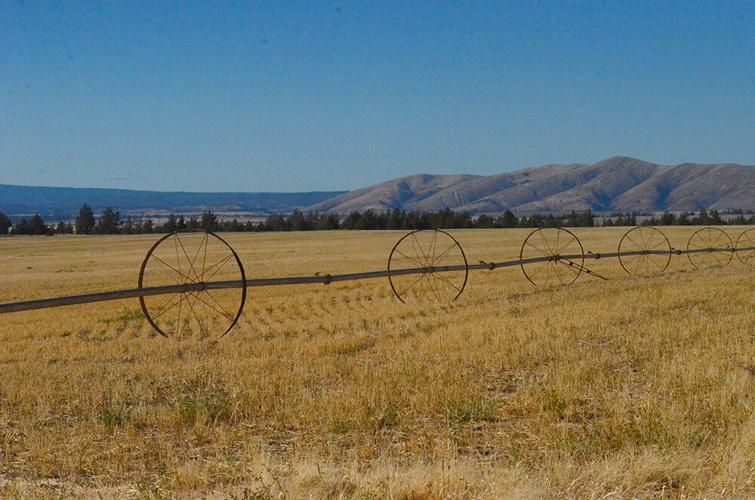
WASCO CO. — Just west of Maupin is a small farming community known as Juniper Flat, with a clear view of Mount Hood above rolling hills of grass and juniper trees. It’s a quiet area, and cars are seldom seen driving through the labyrinth of gravel roads.
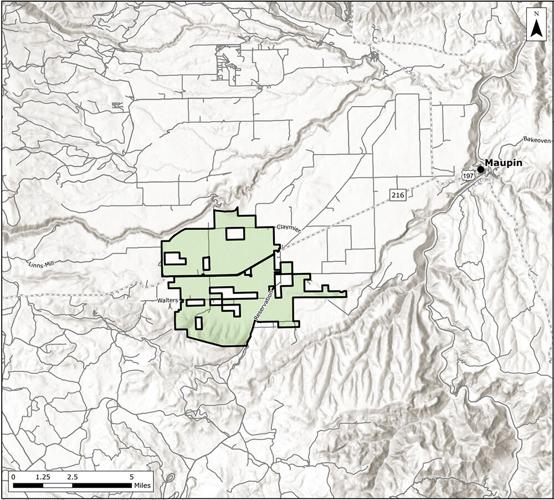
It’s also home to the proposed Deschutes Solar and Battery Energy Storage System Facility that BrightNight, a large-scale renewable energy developer, is pursing. Around two million solar panels would cover 5,442 acres in Juniper Flat, part of a larger, patchy 12,532-acre total corridor, if the project is approved. Plans also include a 30-acre battery.
BrightNight is aiming to build on leased private property, 99% of which is zoned as Exclusive Farm Use. Residents have shown mixed reactions to its proposal, leading one farmer, Connie Lee, to create the organization Save Juniper Flat.
Lee is a sixth-generation “Juniper Flatter” with deep ties to the land — her great-grandfather moved from Indiana to homestead there and most of her grandmother’s side came over on the Oregon Trail.
She’s concerned about what an industrial farm of this size could do to the land, water and wildlife. Parts of the project reach within 10 miles of the Deschutes River and right to the canyon wall of the White River.
“I don’t hate solar. I don’t believe in solar on farmland,” Lee explained. “We didn’t sign up to be in the middle of an industrial site.”
In Wasco County, both farm and forest land are considered “resource zones,” where a commercial power-generating facility is allowed with a conditional use permit. According to Director Daniel Dougherty, the planning department did not have jurisdiction to review BrightNight’s project locally before it went to Oregon’s Energy Siting Facility Council due to size.
Lee’s property, along with 15 other landowners, would be inside what they call the “doughnut hole” — pockets of land surrounded by the site’s boundary. Her family chose not to lease, but she understands her neighbors are making a financial decision in an industry where the profit margins are lean.
“People try to make it seem like we’re having this war with our neighbors ... and that’s not the case at all,” she said.
But Lee pointed to uncertainty when it comes to impacts from solar, including possible insurance cost increases, flooding from leveling out the land and fire danger. “There’s so many unknowns,” she said. “We don’t know what the cumulative impacts are going to be.”
Going forward, Lee hopes that better ways can be found to produce power that “does not destroy the natural land resources.”
“Everything we do affects our neighbors, and we have to be good stewards of our land to support our communities and support our ecosystem,” Lee said. “Juniper Flat is a huge ecosystem. If I decide to plant mustard seed in my field, everybody downwind of me is going to be having mustard in their fields.”
BrightNight’s facilty System Facility would generate up to 1,000 megawatts of electricity from solar, with a battery energy storage system of up to 1,000 megawatts
Mitigating lost farm income
This past July, Columbia Gorge News reported on BrightNight’s proposed fund for lost farm income, which would go to impacted organizations like the Juniper Flat Irrigation District if the project moves forward. It’s part of BrightNight’s effort to meet Oregon Energy Facility Siting Council requirements to identify and mitigate the project’s impacts.
Since then, the topic was discussed at a Wasco County meeting on Aug. 21. Community Development Director Kelly Howsley-Glover said BrightNight’s payment of $167.22/acre, equal to $2.1 million for the project’s entire 30-year lifespan, “seemed inadequate to really offset impacts to agricultural operations,” citing concerns of residents and at least one commissioner.
“With the volatility in commodities markets, particularly cattle, but also wheat, one year doesn’t really give you a clear snapshot of prices that are really within the range of the life of a commercial renewable energy project,” Howsley-Glover said.
Currently, the project is awaiting approval from Oregon’s Energy Facility Siting Council. BrightNight Senior Developer Jaron Wright declined to comment when asked who has the power purchase agreement, saying it’s proprietary information. BrightNight is now updating aspects of their application to address comments from the Special Advisory Group, which consists of the Wasco County Board of Commissioners.
Alongside BrightNight, Shell Energy/Savion’s Yellow Rosebush Energy Center, which is also located on farmland, is also up for approval in Wasco County. It’s proposed to generate 800 MW of energy with a 800 MW battery.
If either project receives a Site Certificate, Wasco County’s Planning Department will review the Land Use Compatibility Statements from other agencies to ensure the project is in line with local codes.
As for Lee, she submitted materials to make Save Juniper Flat a nonprofit earlier this year and may hire an attorney, if needed.


Commented