
By Dan Spatz
For Columbia Gorge News
HOOD RIVER — If all goes according to plan, installation begins this fall on a preliminary test designed to support later replacement of the Hood River-White Salmon Bridge.
While bridge replacement itself won’t start for at least another year, bids will be issued late this month for a “test pile” project, which will drive several temporary, 36-inch- diameter steel pipes into the riverbed this winter.
There are two purposes. First, the project will generate data on riverbed conditions to help engineers design a temporary work trestle or other structure allowing materials to reach the Washington shore. A steep embankment west of the current bridge makes it impossible to access the construction area from Highway 14, where a roundabout will be placed at the bridge intersection.
Second, the test piles will enable engineers to determine whether later, permanent pier installation will have any adverse effect on the current bridge, given the close proximity of the two structures. (The current bridge will remain in operation through construction, scheduled to conclude in 2032.)
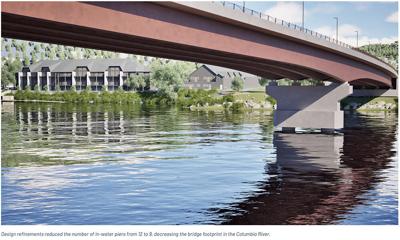
The test piles are a safeguard: on two occasions elsewhere (Lansing, Iowa, and New York State), bridge construction destabilized older, adjoining bridges, leading to costly delays. Hood River Bridge replacement will require installation of nine massive, reinforced concrete piers largely parallel and immediately west of the current bridge. (Twelve piers were originally planned.)
Engineers have installed monitoring technology to gather “baseline” data on how the current bridge moves and shifts under the weight of traffic, wind loads, seasonal temperature changes and the Columbia River’s current. Once the test piles are in place, new data will be compared with baseline data. Should this reveal any alterations in the current bridge’s physical behavior, engineers would seek countermeasures.
The Hood River–White Salmon Bridge Authority is the bi-state entity responsible for the $1.12 billion bridge replacement effort. A separate entity, the Port of Hood River, owns the current bridge; the port is one of several key partners in the multi-year replacement effort, scheduled to start in October 2027 contingent upon federal funding.
At their Sept. 21 meeting, bridge authority commissioners approved a related $2,022,335 contract amendment with HNTB, a consulting firm that reports to the bridge authority’s board of commissioners. HNTB already leads project oversight, administration and daily project management. The amendment will add management responsibility for the test pile program.
The next step, expected Sept. 30, is an invitation for bids to drive the test piles. There will be about 16 of these piles, placed just downstream of the current bridge.
Notice to award the test pile contract is Oct. 27. The project must proceed quickly over the winter, during a brief “in-water” work period when construction doesn’t interfere with fisheries. That period closes March 15.
The test pile initiative is one of myriad engineering, administrative and environmental issues being tracked by the bridge authority. Another priority reported Sept. 21 is a need to secure about two or three acres in western Klickitat or eastern Skamania counties, ideally in the Jewett Creek or Major Creek drainages, for wetlands mitigation. This is prompted by the anticipated impact of bridge construction on small streams and wetlands along Highway 14, the railroad tracks, and adjoining properties.
Project managers are looking for ecologically degraded property, such as over-grazed pastureland, disturbed stream corridors or abandoned quarries, to acquire or otherwise protect through long-term conservation.
The bridge itself will actually reduce environmental impacts — most notably by routing oils and other automotive wastes into a collection system; the current metal grating allows waste to drip directly into the Columbia River. The new bridge foundations will also require less physical space than the current supports.
The new bridge will feature 12-foot vehicle travel lanes with bicycle paths and a dedicated eight-foot pedestrian path. Recently updated designs are available on the bridge authority’s website, www.hoodriverbridge.org.


Commented