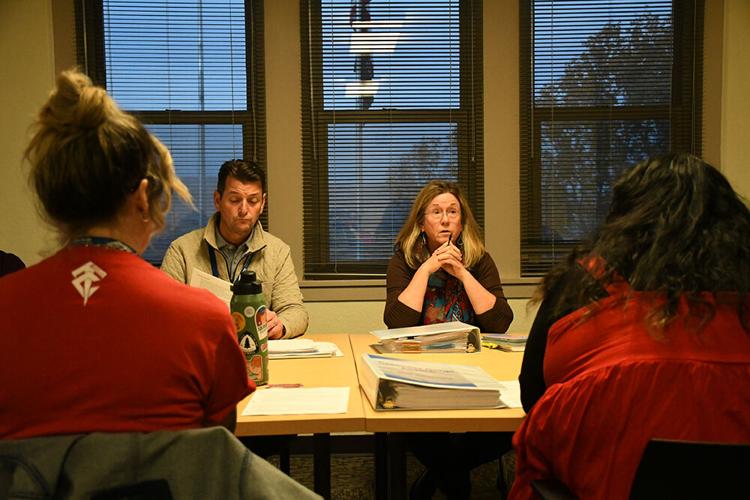
CGESD administration and representatives from its labor union, the Education Association, participated in a final bargaining session Nov. 5 at Columbia Gorge Community College. From left to right: Amanda Parrott, Kip Miller, Dana Pedersen, and Josephine Colburg.
CGESD administration and representatives from its labor union, the Education Association, participated in a final bargaining session Nov. 5 at Columbia Gorge Community College. From left to right: Amanda Parrott, Kip Miller, Dana Pedersen, and Josephine Colburg.
HOOD RIVER & WASCO CO. — Amid concerns about a hierarchical management structure and mistreatment of employees, the Columbia Gorge Education Service District (CGESD) and its labor union, the Education Association (EA), are deadlocked in an ongoing dispute that could lead to a strike.
Four members of CGESD’s administration, including Superintendent Dana Pedersen, met face-to-face with four EA members, led by Union President Josephine Colburn, at a final bargaining session on Nov. 5, where disagreements on association rights, compensation, insurance, and working conditions persisted.
Several union members, including preschool teachers, school nurses, migrant educators, and STEM specialists — all sporting coordinated red shirts and “working without contract” pins — sat in on the session.
A union member wears a “Working Without a Contract” pin.
Sean Avery photo
If the conflict remains at an impasse after a Nov. 19 mediation meeting, final offers, and 30-day "cool-off" period, an employee strike is imminent — and EA is already gathering pledge signatures.
CGESD
CGESD directly supports four component school districts across Hood River and Wasco counties, including the Hood River County School District (HRCSD), North Wasco County School District, South Wasco County School District, and Dufur School District.
It acts as a regional backbone, pooling resources to deliver equitable, high-quality, and cost-effective services that individual rural districts cannot easily fund or manage on their own. Work is divided into specialized departments: special education; early learning and parenting; migrant education; health; technology; and education innovation, among others. CGESD, for example, employs all of HRCSD’s nurses.
“By centralizing these programs, we save school districts money and make sure a child living in a remote canyon has the exact same access to high-quality education as a child living in a major city,” said Union Secretary Amanda Parrott, who serves as an early childhood mental health coordinator.
Broad concerns
The EA represents essential specialized staff that Gorge students and communities rely on every day, but without an agreement they consider a fair resolution, the region faces the very real threat of losing access to these vital professionals.
Colburn, who also serves as a teacher on special assignment (TOSA), said the months-long dispute grew from concerns about pay and working conditions, alongside broader issues with employee mistreatment.
“I feel that there is a hierarchy,” she said. “That if you have the right title or authority, then you get to be valued at a greater level.”
Colburn also described racial inequities.
“We have a staff that is primarily Latinx, and 100% of our directors are white,” she said. “That’s impacted union leadership and our ability to advocate. That’s impacted what’s happening at the table, how [staff] are viewed, and how [administration] treats us.”
Thus, the EA entered bargaining over employment terms hoping to ensure its members have everything they need to serve the community — to keep pace with the rising cost of living in the Gorge, and feel valued both financially and as human beings.
Bargaining session
The final bargaining session lasted about 40 minutes and went nowhere — consistent with negotiations throughout the dispute.
“It was a representation of the stonewalling we’ve received,” Colburn said. “There were assumptions on their part that were made about our intentions and also our knowledge.”
Union member Ben Feil, who serves in CGESD’s technology department, noted that the district’s board of directors failed to make an appearance.
“They didn’t even care to show up ... didn’t even have the respect to support [Pedersen],” he said. “That shows how much they care about us.”
The first topic discussed was association rights; the EA is requesting meaningful, codified employee representation and input in hiring administrative positions, particularly those that directly supervise or work with members. Staff believes their job-specific expertise is valuable in these spaces.
Pederson said that hiring was, in her view, a permissive — not mandatory — bargaining topic, and that decisions were an administration’s right. During a post-bargaining EA debrief, Parrott questioned Pedersen’s approach, stating, “We’re not asking to make the decision; we’re just asking to be in the room.”
The second topic was compensation: the EA wants to ensure employee compensation keeps pace with the rising cost of living, recognizes employee contributions, and maintains competitive salaries that support recruitment and retention.
Colburn questioned why the parties couldn’t agree, noting directors had budgeted for roughly 4% salary increases and 4% insurance increases the prior year. Administration said retroactive pay would overburden the fiscal office; union members challenged that explanation and said they had offered a way to spread out the payments.
Referencing a hierarchical or “tiered” approach to specialist stipends, Colburn also questioned why a person’s hiring date determines their compensation in the administration’s proposal. Pedersen said that removing existing stipend language could amount to regressive bargaining and harm current employees. “It’s our continued work with pay equity and feeling like this better represents how to compensate employees for comparable skills and education attainment,” Pedersen said.
Union members had additional questions about whether leftover grant funds could support employee compensation, changing job titles affecting pay, bilingualism being removed from job descriptions, and ensuring insurance benefit changes are transparent.
“All of the proposed cuts are actually meant to impact our least paid people, primarily classified staff,” Colburn explained post-session.
"Unlike traditional K-12 school districts funded primarily through local property taxes and general state school funds, CGEDSD relies heavily on specialized state/federal grants and specific service contracts," Pedersen said in a follow-up e-mail. "These revenue sources have restricted uses, which shape our operating budget and compensation limits"
The third and final topic discussed was working conditions; the EA wants to ensure employees who work at different locations have meaningful, consistent, and contractual access to the administrators who manage them. The union proposed requiring directors to visit the worksites of the employees they supervise twice a year, partly because visits could inform employee evaluations — a modest amount, members noted, considering employees require meaningful observation and accountability in such evaluations.
Pedersen said administration was comfortable with language indicating visits, but not a specific number of required opportunities, which they felt could make the provision grievable.
Preschool teacher and Union Treasurer Deocelen Muñoz said it was upsetting to feel unrecognized by administration while dealing with students “destroying our classroom, hitting us, and fighting us.”
Mediation and strike
In the coming weeks, the EA will hold a team prep meeting before mediation begins on Nov. 19. The mediator, who is state-assigned, will be chosen within a 15-calendar-day window.
In the meantime, members will continue gathering strike pledge signatures, on top of the about 30 that have already been collected (roughly 35-40% of members).
One member said they would ask the union’s lawyer whether the job-description changes in the administration’s proposal could raise an unfair labor practice or side-bargaining issue.
Members were urged to contact union leaders if they felt pressure because of their union involvement.
“We consistently feel that we’re asking for reasonable things,” Colburn said. “We’re hoping that this mediator, a third party, will help.”
"CGESD remains focused on reaching a balanced agreement that compensates our staff competitively while ensuring the long-term financial sustainability of regional education programs," Pedersen concluded in her follow-up. "Our employees are at the heart of the services we provide. We respect their dedication, appreciate the work of both bargaining teams, and remain committed to finding a positive path forward."
•••
This is a continuing story and will be updated as information becomes available.





Commented