
By Neita Cecil
Columbia Gorge News
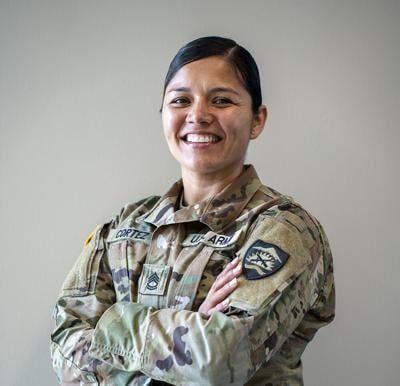
THE DALLES — Suspecting a scam, Oregon National Guard Sgt. First Class Rosa Cortez ignored the handful of emails and even some phone calls she got in April about being “a nominee.”
“I’m not gonna click on ‘click here,’” she recounted.
Finally Cortez, a recruiter for the National Guard in The Dalles, returned a message, and learned she actually won a national award with a $25,000 prize she could give to a local organization.
The Courage Project named Cortez for her work helping recruits use a longstanding military program to help family members of those in the military to expedite legal status in the U.S.
Cortez gave the prize to Gorge Soccer. Ironically, Matthew Dallman, the president of Gorge Soccer, also almost deleted the email notification of the wholly unexpected large award.
He sent Cortez a text asking if it was real. “Sure is,” came the response. On hearing it was real, Dallman said he was in “complete shock” and just “full of emotion. So incredible.”
The money is buying equipment and helping two gorge families financially with their immigration process. Both families include National Guardsmen.
“I know people are really struggling right now,” Dallman said. He said his own family is struggling with immigration issues.
Cortez said Gorge Soccer teaches teamwork, service, commitment, “and what it means to be part of something bigger than themselves, values that align so closely with what I believe in and what we teach in the National Guard.”
At a time when others in her shoes are lying low in the heated national debate about immigration, Cortez is doing all she can to help eligible recruits help their parents attain legal status with the hope of getting U.S. citizenship.
Called Parole in Place (PIP), it’s been a route to citizenship since 2013. It allows eligible people to remain here while their immigration process starts, so they don’t have to go back to their country of origin.
People who qualify are parents and spouses who have not had a dual entry to the country since 1996. Dual entry is getting caught once and then re-entering the country once more.
Word quickly spread about her work. In February, the New York Times wrote about her. That got the attention of The Courage Project, which “Celebrates and Honors Everyday Acts of Bravery.”
Cortez said, “People are scared to promote PIP because they don’t want to be seen as leaning on a political spectrum. But if you talk about it right, there’s no way to see it as a political thing. You talk about it just like you talk about training. Just like you talk about education. It’s an additional tool for our local community members to take advantage of if they need it. Make service be the first thing you join for and the rest will fall in place.”
The Guard does not do the immigration paperwork, she said. They only handle the military paperwork for the recruit.
When she first started talking about it, “even my coworkers said, ‘Be careful.’ I’m like, ‘Be careful with what?’”
For a few months last fall, she was the top National Guard recruiter in the nation. She doesn’t know for how long, because she lost interest.
In Oregon, she’s been the top recruiter all year. She passed up one incentive, a class that would’ve helped her advance, because it would’ve meant missing her recruits’ high school graduation.
But she’s taken other incentives, including a trip to Hawaii and another trip where she chose to see her recruits graduate from Fort Benning, Ga.
National Guard Capt. Jessica Potter, Cortez’s commander, said, “SFC Cortez is an outstanding soldier, recruiter, mother, and community member. However, her family is who is truly deserving of all her accomplishments. They are the reason why and how she can be successful. Without the support and understanding from them it would not be possible. She is so humble about her accomplishments and passionate about her job because of those she helps and her family- and that is what is truly admirable about SFC Cortez.”
Cortez grew up in a migrant labor family that traveled around the Pacific Northwest. At one time she lived in a two-bedroom house with 22 family members.
Her family spent its money hiring coyotes, people who smuggle people into the country, to repeatedly bring her grandfather back after his many deportations.
In Walla Walla, some family members got into drugs. Her house was raided when she was six and she saw “cops throwing our uncles to the ground.” She ran off in fear to her grandmother’s house.
Later, two uncles joined the military. Multiple generations of her family piled into a car to see one graduate in Fort Knox, Ky.
There, she saw the structure, the uniform, “the pride in my family’s face,” and she knew she wanted that too.
She had to fight the cultural tug of her single mom both wanting her to go to college, especially as the oldest child, but also to marry and start a family.
Against her mom’s wishes, she joined the National Guard at 18. But she ultimately did both things her mom wanted: she got two bachelor’s degrees and started a family. She and her husband have three young kids.
At just 23, she was offered a full-time National Guard job as a recruiter. She initially didn’t want it, given the reputation recruiters have for stretching the truth about military service.
But she’s a natural. An extrovert, Cortez loves to visit, loves to network, loves to share how the military has helped her in so many ways.
If kids don’t want to join the military, she’s got plenty of contacts and resources to send them in other directions.
Now with 20 years of active duty, she’s not too many years from retirement. With kids ages 9, 7 and 5, she plans to spend her time being a mom and attending their sports and school activities.
When her active duty ends, she plans to be a local substitute teacher. She already subs sometimes, and she’s allowed to wear her uniform.
Unsurprisingly, she has well-behaved classes.


Commented