
By Martin Gibson
Gorge News
WHITE SALMON — Locals chose to share their traditional Mexican celebration of the dead with White Salmon’s residents this year.
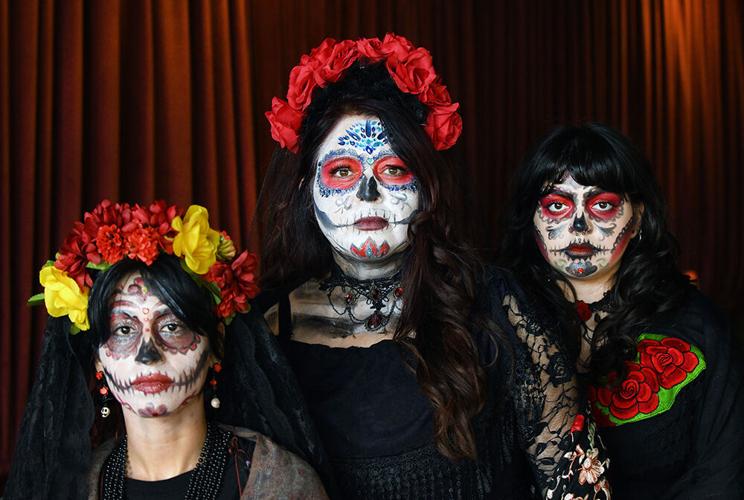
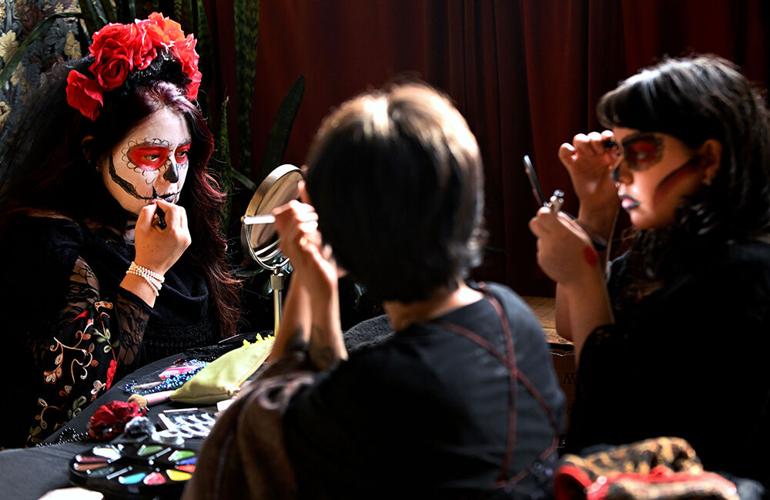
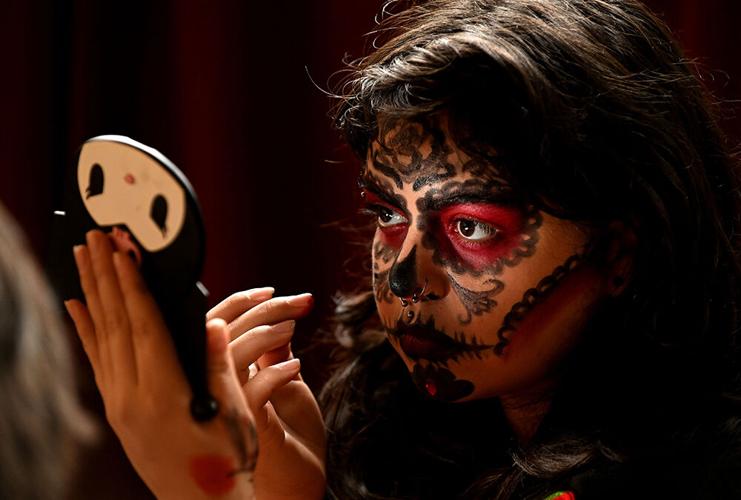
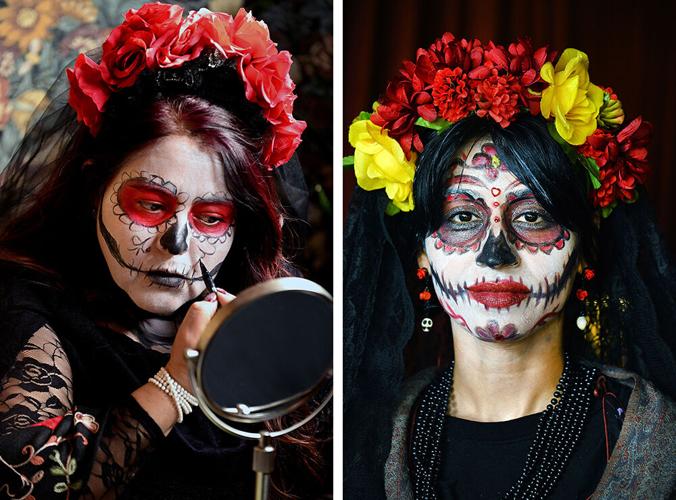
To celebrate — as Día de los Muertos is more festive than sombre — women often dress up as Catrinas, or La Calavera Catrina (“the dapper female skull” in English). It’s an artistic tradition begun by Mexican artists, to mock the rich and “to make a point of, at the end of the day, we’re all going to be dead, and we’re all going to be bones, so it doesn’t matter if you have money or not,” said Christopher Cazares, education and engagement coordinator for WAGAP. Artist Diego Rivera later used the old cartoons in his murals, and catrinas became a Mexican symbol.
Catrinas and altars on Jewett Boulevard, during White Salmon’s Halloween trick-or-treat, shared the story of Día de los Muertos.
“The Day of the Dead is a celebration that dates way back to pre-Hispanic times,” Cazares said.
The altars hold pictures of loved ones who have passed away; sugar skulls; and the flower the Aztecs called empasúchil, which we call marigolds. Food, water, tequila and mezcal are traditional, with Copal to clean “the air, the environment, the energy,” and candles to signal the way.
The marigolds also mark the soul’s way. “You are letting your family know ‘Hey, you’re here, this is your altar, these are your pictures, this is your favorite food,’” Cazares said. The symbol is similar to the monarch butterfly, “because it also represents immigration, and immigrants moving from Mexico away to the north ... It serves a similar purpose, represents the souls of the people coming in, and leaving.”
Historically, many of these things were buried with people who passed away. People faced a years-long journey to the underworld Mictlan, and would need supplies. Often their dog was buried with them, to guide that journey.
“Dogs were buried with their owners because it was believed that in the afterlife, those would be the ones to guide you to the Mictlan. So if you were mean to dogs in your life, you’d probably get stuck,” Cazares remarked.
Later, the Spaniards brought All Saint’s Eve, and the customs of the holidays mixed. They put on the altars, and the specific days. The Indigenous celebration was a cycle. Every 20 days, “they would go in, change the water, the food, change all the elements to make sure that ... the soul had what it needed to get to [Mictlan].”
“It is something really beautiful that to this day, we remain with very, very core values of what the celebration was. And then it just amazes me, how much has happened since ... and how we are still celebrating.I think it’s a symbol of resilience, it’s a symbol of resistance, and also it’s a symbol of remembering,” Cazares said.
The holiday immigrated north from Mexico with its people.
“Every person is going to be able to tell you that around these days, they have had some kind of experience with their loved ones. Something that I haven’t tried, ever, but... it’s said that during this holiday, whatever food is put out for the people to take — usually their favorite food — the next day should you taste it, it is flavorless ... Take that with a grain of salt, or believe it, but that’s something that is known to be part of it.”
The altar that day had pictures from coworkers and local partners, and elements from Hispanic culture; like the lord of the Mictlan, to make sure there’s a connection between the Indigenous and European roots of the holiday — “as much as it is hard, sometimes, for us to realize that we’re a mix of two cultures; and we are something new, which is Mexicans,” Cazares said.
“It is something that we carry deep within us. ... We are a history both of people who were conquered and of people who kept coming above that. Even the dead ones who have already passed, they still have a remaining presence every year, and probably every day. That’s something that is very beautiful, despite everything that has happened.”


Commented