
By Nathan Wilson
Columbia Gorge News
THE GORGE — With harvest coming to a close across the Mid-Columbia, this year’s pear crop looks better than the last, when growers suffered an estimated $45-50 million economic loss largely due to pear psylla damage.
But growers, crop consultants and scientists alike still don’t understand why psylla pressure, which abated this year, varies dramatically by season, all the while management remains a combination of educated guesses and luck.
“Some years, everything works out and you can get good control by just using natural enemies and one or two sprays,” said Dr. Chris Adams, assistant professor of tree fruit entomology at the Mid-Columbia Agricultural Research and Extension Center in Hood River. “And sometimes you throw everything, including the kitchen sink, at it and you still can’t get control.”
Among a host of other market and regulatory challenges, psylla is just one variable making pear cultivation a less sustainable livelihood (see related story on A1).
As Adams explained, psylla came to Oregon and Washington from Europe in the mid-19th century, and growers have been struggling for control ever since. It’s a tricky, incredibly mobile invasive insect: pear psylla typically have three generations per year and migrate off orchard every winter. So, no matter how effective growers are at managing psylla over the previous season, they start from scratch every spring, Adams said.
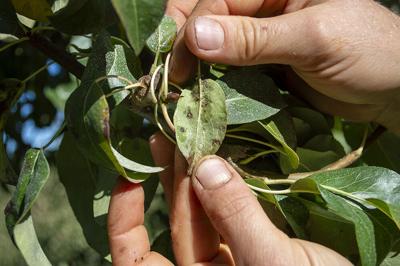
Unlike codling moth, which bore into pears, psylla stay on the leaves and excrete a sugary substance called honeydew that can drip down onto the fruit and manifest in an edible but unsightly black, sooty mold. If the sticky goo isn’t completely washed off pears when they enter cold storage, even a small number of “bad apples” can make an entire half-ton bin of pears unmarketable.
Of all the pears that Duckwall Fruit was supposed to process from the 2025 harvest, almost 10% never made it to grocery store shelves because of psylla. That’s a combination of pears simply left on the tree and those thrown out at the time of packing. The sheer number that Duckwall Fruit stored last year, thinking they were good quality only to find sooty mold when they started running lines, was a first for the Odell-based packing house.
“We’ve never seen anything like that,” said Ed Weathers, president and sales manager of Duckwall Fruit. “We don’t really have tools at this point in the warehouse … What we do know is the longer that it’s in storage, the more challenge we have of getting it off the pear.”
Since Duckwall Fruit and other packing houses can only process so much fruit at once, mitigating psylla damage comes down to management at the orchard level. In addition to the total fruit lost, Weathers also noted that Duckwall Fruit downgraded pears by at least double the normal rate, which exacerbated the economic hit amidst an otherwise large crop industry wide.
To control psylla and other unwanted insects, most growers in the Hood River Valley use targeted chemical applications while remaining mindful of natural enemies, like green lacewings and earwigs, that feed on them. The exact approach to integrated pest management often varies by property boundary, at least slightly.
Knowing when to spray isn’t an easy question to answer, though. Neither is determining how many natural enemies are present in an orchard, or how to attract them at the right time.
“No one has the crystal ball. It’s a lot of taking what information you do have and making the leap,” said Lesley Tamura, a fourth-generation pear grower who manages 42 acres near Odell. “You just have to make a decision, go with your gut and hope it turns out for the best.”
Ever since 2019, growers have been able to consult a model that predicts when each psylla wave will arrive based on the number of days where temperatures are just right for growth. Dr. Robert Orpet, an assistant professor of entomology at Oregon State University’s research center in Medford, helped maintain the model for several years. Although helpful, he noted that it relies on averages and doesn’t account for the microclimates that are present across the Hood River Valley.
High winds, not enough available hands and the cost of insecticides, which can top five figures, all impact spray timing as well. And even then, whether chemical applications are truly effective against psylla is an open debate.
“A lot of the tools that we’ve been using for controlling psylla — one has been around for about 40 years, the other for about 20 — are they doing anything? Are we just throwing spit into the wind and thinking that we’re going to make a difference here?” said Jeff Heater, a crop consultant for G.S. Long Company.
Growers need to be careful about employing insecticides too frequently so that psylla don’t develop a tolerance, and using overbroad ones that end up killing natural enemies. Soon-to-be-released research by Orpet, Adams and other scientists actually demonstrates a positive correlation between pear psylla damage and pesticide use among a survey of 130 growers on the West Coast.
A few miles from Tamura, Lisa Perry and her husband manage 14 acres alongside The Farmer in Odell Farm Stand, where education is an emphasis. They intentionally left a bald-faced hornet’s nest in one tree and let their weed strips grow relatively unchecked to create habitat for natural enemies.
Unlike insecticides, though, only one natural enemy is available for purchase commercially, and there’s no guarantee that they’ll stay on orchard. As Adams explained, natural enemies migrate based on food availability, so growers inadvertently need some psylla to ensure that the good bugs stay.
Perry reported that she received less than half of what it took to grow and harvest the 2025 crop, noting that some growers received nothing at all. Tamura recouped about 25-30% of her total cost.
“I’ve always heard that you would not be a farmer if you weren’t an optimist,” Perry said. “Deep down, I think people want to keep trying, but we are getting hit again and again and again.” She personally knows two growers who have pulled out of farming after the 2025 season.
Urged by Columbia Gorge Fruit Growers, which Tamura also chairs, Oregon Gov. Tina Kotek asked the U.S. Department of Agriculture to issue a natural disaster designation for Hood River and Wasco counties back in July. There’s been no response from the agency, however, apart from that the application has been received and is under review. If approved, it would make additional low-interest loans available to growers, but Tamura said that just means more debt.
And while she’s hopeful that prices for the 2026 crop will be higher, Tamura emphasized that it won’t be enough to make up for that level of financial loss regardless. Overall, psylla pressure fell this year, and it was more prominent in the Hood River Valley’s upper half than lower half.
Given the mild winter, Heater hypothesized that psylla expended more energy earlier on in the 2026 season, making them less able to lay eggs or survive through the spring. Since the upper valley is always slightly colder, he thinks that accounts for the difference, but he couldn’t explain what drove the 2025 surge. If the whole valley was managed as a unit, rather than hundreds of individual growers, Heater thinks psylla would be a less severe issue.
As for Adams, he’s working on developing more concrete action thresholds for when spraying must occur, and a pheromone-based lure that could attract male psylla, trap them and prevent mating.
“How do we do this so that the grower wins at least three or four out of five years, instead of losing five out of six?” Adams said. “That’s what we’ve been struggling with.”


Commented