
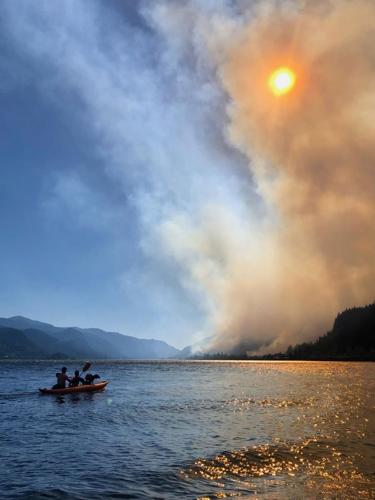
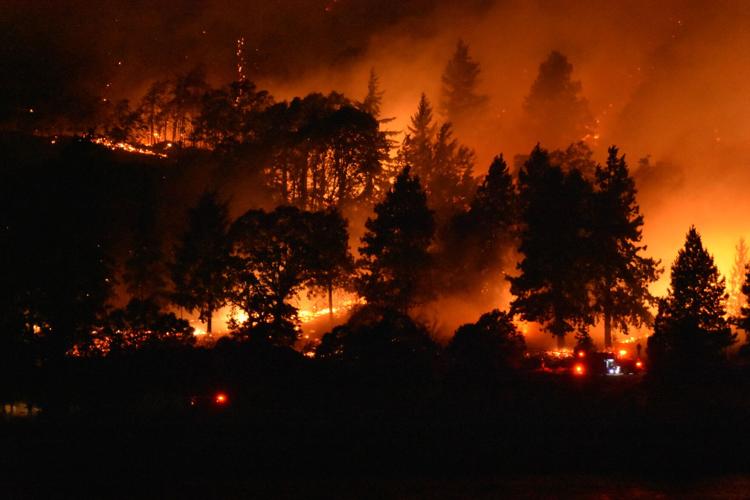
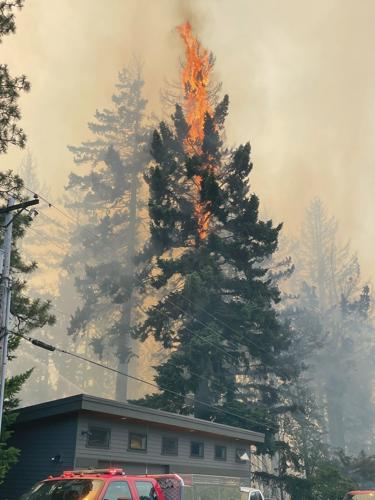
THE GORGE — On July 3, Underwood residents were faced with a fast-moving fire exploding up the cliffs below their homes and businesses. There was no Level 1 or Level 2 evacuation notice: Their first call was a Level 3, Evacuate Now.
Christie Silverman had just arrived at her job at the veterinary clinic in Bingen when she heard the news and headed back to her Underwood home above the Gorge cliff. Her neighborhood is surrounded by a dense forest of White Oak. There was no smoke and no visible fire when she arrived home. So, she and husband Ron hastily filled their vehicles with important papers and anything they most wanted to save, loaded their dogs, and headed back to the clinic where the dogs could be boarded.
Making sure their animals were safe was the single most important action they took, Christie said.
She and Ron then gathered with others from the community at a White Salmon restaurant to follow the news, both from firsthand accounts by others and a Facebook page that gave real-time, eyewitness details of the fire.
“We were calmer than most there,” Christie said. The couple had their dogs safe, they had done what they could, and knew that they could cope should their newly remodeled house be destroyed. They realized that other friends were closer to the blaze and could lose not only their homes, but their livelihoods.
Although the Silvermans left as ordered, many others in the evacuation zone did not, and many of those who did returned long before the evacuation level had been reduced. Older residents had experienced numerous fires over the years that were closer than this one, and none had reached their properties. This time, many were willing to take the risk of staying home.
Later that day, while the fire was still raging, the Silvermans moved themselves and their dogs to a motel in Hood River.
“We had a riverside view from our hotel and saw the fire climb the hill, a huge column of smoke above it,” she said, admitting that having the fire view may have been a mistake.
Although Christie and Ron’s comfort level had improved, the view of the fire had its own effect on her. In the foreground were dozens of colorful kite boarders playing in the wind with visible embers behind and above them. The contrast of joy and disaster shocked her.
“It was unbelievable,” she said. “This disaster just didn’t mean anything to them.” By then the planes had come, adding to the drama.
Eventually, when the evacuation warning was reduced, they returned home, discovering that the fire had spared that area of Underwood.
It was a time to reflect on what they needed to do before the next fire, knowing that there likely would be a next one.
The neighborhood had already taken measures to protect their homes. Fire hydrants had been installed (though in the Tunnel 5 wildfire, the fire department had emptied the tanks of available water fighting the fire just west of them). The neighborhood even had the Underwood Conservation District help them assess their vulnerability to wildfire.
Every neighbor had committed to keeping leaves raked during the summer months and limbing the lower eight feet of the hundreds of white oaks that are such an important part of their landscape. But what else should they do?
Because water is both limited and expensive in the Underwood system, Ron has decided to use what he does have — stones — to build a firebreak, at least on the back boundary that abuts acres of Pacific Power and Light land. And Charlie Landsman, community resilience coordinator for the Wildland Fire Management Division of the Department of Natural Resources, agrees that it is a valuable tool.
Landsman detailed additional measure the Silvermans and their neighbors might consider:
People should first eliminate flammable items near their homes. Arborvitae, juniper, and other highly flammable plantings should also be removed. He says a rule of thumb is to keep understory plants low to the ground and all trees limbed to three times the height of the tallest understory plantings. (However, to protect tree health, no more than 1/3 of the tree’s branches should be removed.) See www.dnr.wa.gov/publications/rp_fire_resistant_plants_guide_easternwa.pdf.
Eliminate flammable fuels on and around buildings before every summer. This should include removal of needles and leaves from gutters and around the base of trees, and elimination of everything flammable on the ground within five feet of structures.
Flammable mulch should not be used in flowerbeds along any structure, but only applied in beds surrounded by bare ground or other non-combustible such as stone or concrete paths.
Woodpiles and propane tanks should be at least 30 feet from any structures. And special care should be taken to be certain no fuel accumulates around either.
Assess any areas that allow fire below structures. If your home has vents into a crawlspace, have them covered with 1/8-inch galvanized screen. Enclose all spaces below decks and porches so that embers or fire can’t intrude during a wildfire.
Plant deciduous trees rather than evergreens, because they are generally less flammable. Eliminate tree limbs that overhang structures. And for those who are lucky enough to have a white oak forest on their land, remove any trees that are leaning to reach more sun. That’s a sign that the planting is too dense. Defensible space and landscape plant suggestions can be found at these informative sites: disastersafety.org/wildfire/fire-resistant-landscaping-for-your-home, and catalog.extension.oregonstate.edu/pnw590.
Being Prepared:
- Replace connecting points to structures with metal flashing, or replace a wooden gate attached to the house with a metal one.
- Replace flammable roofing with Class A materials.
- Coordinate with neighbors to bring all properties up to FireWise USA standards.
- Prearrange a place to stay for you and your animals and have all household and family members aware of that location.
- Carefully prepare a list of the most important documents and personal items that you wish to take with you. And do that before fire season. If possible, keep these in one location or even off property.
- Have an escape route planned from your property to the place where you plan to stay, and have an alternate route to take if fire has made your preferred route dangerous or impossible.
- Follow evacuation guidelines. Be aware of threats at Evacuation Level 1; be packed, have animals corralled and transport vehicles available, and be ready to leave at Level 2, AND LEAVE when emergency services directs a Level 3 warning. Emergency Services makes this decision by using multiple factors, not just the distance to the fire from your property — like weather predictions, and reliability of the roads for escape and for transporting firefighters and emergency vehicles. Hopefully, a Level 3 will be nothing more than an inconvenience, but you can live with it. Literally.
- Although our fire responders will not demand that people leave, by staying, homeowner safety becomes the firefighters’ primary responsibility, not fighting fire.
- There are many useful pamphlets available from Landsman and the DNR at the department’s website, www.dnr.wa.gov. In participating counties, request a Wildfire Ready home visit from a wildfire professional.
- Be preemptive, get the information now to start your own FireWise USA®Community, and save yourself and your neighbors if and when that firestorm hits.


Commented