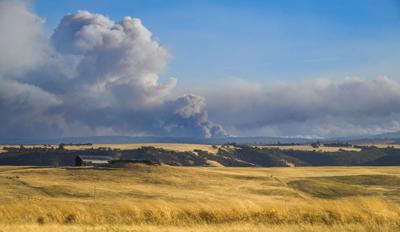
THE DALLES — After the Grasshopper Fire burned 93,000 acres that impacted Wasco County’s drinking water, irrigation, forest roads and recreation, county officials estimate that recovery may cost as much as $49.5 million on top of the approximate $109 million already spent fighting the fire.
Wasco County commissioners are asking federal officials to help pay for ongoing recovery efforts following the lightning-caused blaze in August, as well as coverage for forest management projects they say have gone unfinished after years of delays.
Commission Chair Scott Hege expressed frustration, saying that the county was unable to put out the fire earlier in its outbreak due to a lack of resources, “and now we got $150 million bill pay,” he said. “So we really need to think about how we can avoid that, but I think the biggest thing is to try to figure out how we can get our forests healthy again.”
At a regular meeting of the county board on Oct. 7, commissioners agreed to send two letters: one to the state congress asking for supplemental disaster funding, and another to the Mount Hood National Forest branch of the United States Forest Service outlining recovery priorities.
The letters are based on longstanding work by the Wasco County Forest Collaborative, a partnership established in 2015 that brings together public agencies, tribal representatives, conservation organizations, forest industry and other local interests to develop recommendations for forest restoration and wildfire-risk reduction.
The forest treatment debate
For more than a decade, local agencies have implemented long-term plans to reduce fuels in the area impacted by the Grasshopper Fire, which include over 21,000 acres of approved thinning and prescribed burn treatments, according to a briefing written by collaborative director Andrew Spaeth.
“The last recorded fires in the Grasshopper Fire area likely occurred at least 130 years ago, meaning that this area missed between 8-10 fire cycles,” Spaeth wrote, citing research from a collaboration between Oregon State University Tree Ring Lab and the Forest Service.
While much of the non-commercial thinning projects in these plans were completed, the last two years have paused larger commercial projects. Spaeth’s briefing points to budget shortfalls and major federal funding and staffing cuts in 2025 by the Department of Governmental Efficiency, as well as litigation by conservation organization Oregon Wild over the Grasshopper Restoration Project.
In comments to the Oregon Journalism Project, Oregon Wild officials have publicly denied a causal relationship between the project’s legal delays and the Grasshopper fire’s intensity. The organization is vocally critical of a commercial-logging-led approach to wildfire mitigation.
FUSEE Fire Communications and Outreach Director Helena Virga writes on Oregon Wild’s website that the use of clear-cutting and heavy equipment does more to damage the forest and agitate sediment, advocating instead for non-commercial thinning and home-hardening practices.
Spaeth ended his brief arguing that the current environmental review process moves too slowly.
“Many of the restoration projects planned on the Barlow Ranger District and elsewhere on the Mt. Hood National Forest have required 8–12 years from collaborative development through NEPA and implementation. The Grasshopper Fire highlights why that timeline is incompatible with today’s wildfire environment.”
Requests for support
Wasco County’s letter to Forest Supervisor Monique Loftsgaarden asks the Forest Service to continue working with the collaborative to move shared priorities into implementation.
The county said recovery efforts would focus on watersheds impacted by the Grasshopper Fire, particularly the Badger Improvement District, Rock Creek District Improvement Company and portions of The Dalles’ watershed. These watersheds support thousands of acres of irrigated farmland in South Wasco County.
Wasco County asked the Forest Service to assess potential threats from erosion, debris flow, sediment, hazard trees and damaged infrastructure, coordinating with the city of The Dalles and irrigation providers.
The fire also burned approximately 135 miles of forest roads, according to the county, which will require hazard-tree removal, plus road and culvert repairs.
Use the full legislative authority in the USFS Reforestation Trust Fund to invest in postfire restoration and hazardous fuels reduction (see The REPLANT Act - American Forests);
Fully fund USFS/NRCS Joint Chiefs projects for fuels reductions; and
Invest via existing or new Good Neighbor Agreements for the capacity needed with local partners.
Hege acknowledged that these letters were not a guarantee of outside support or resources.



Commented