HOOD RIVER & WASCO COS. — Apart from about one mile of line that is still uncontained, crews on the Grasshopper Fire have transitioned to suppression repair and mopping up hotspots.
On Monday, the fire was 98% contained and 93,971 acres large, roughly the same it was at the beginning of September. The Wasco County Sheriff’s Office lifted all Level 3 evacuation orders last Tuesday. A total of 33 structures have been destroyed; most were lost after the fire turned east and made a blistering run near Friend on Aug. 10.
Only one area in the southeast corner of Hood River County remains under Level 3 orders. The majority of personnel assigned to the Grasshopper Fire have been transferred to the Austin and Narrows fires in neighboring Clackamas County, where one firefighter was injured on Sept. 9 and later died. Both were also 98% contained on Monday, and 953 people were collectively on the incidents.
Cooler temperatures and spurts of rainfall have tamed the Grasshopper Fire’s behavior over the past few weeks, but conditions did pose some challenges.
“There were a couple of times in those deep drainages where firefighters had to disengage when we had heavy rains,” said Kate White, public information officer for Northwest Team 10. “Roads can get really saturated with water and just turned to mud and slush, so having a bunch of firefighting equipment and vehicles can be an issue.”
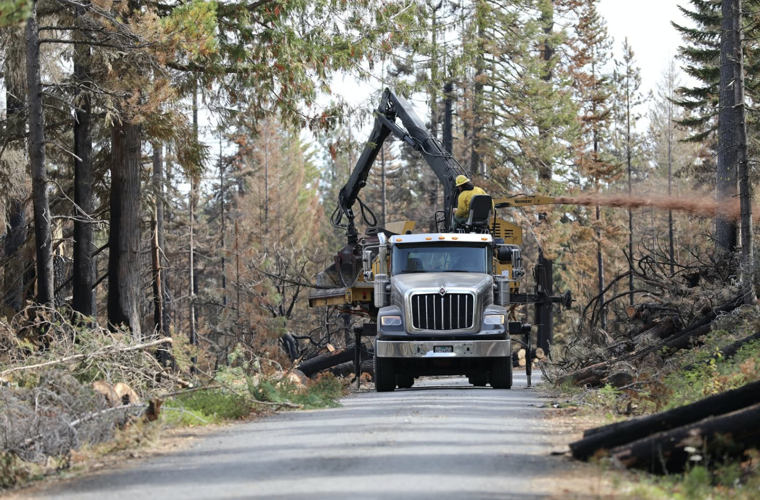
For roughly two weeks, a segment of line just south of Badger Butte in the Boulder Creek drainage has been the last that crews need to tie in. A combination of steep slopes, hazardous trees, poor access and abundant fuels has prolonged efforts.
It’s what crews call a “dirty burn” — a mix of burned and unburned areas with potential for remaining embers to ignited adjacent vegetation or duff. An unmanned aerial system with infrared capabilities has helped to identify hotspots, however.
Much like the larger scar, which encompasses most of the Badger Creek Wilderness, fire consumed fuel in a mosaic pattern and to varying degrees of severity. A Burned Area Emergency Response team is currently evaluating the damage.
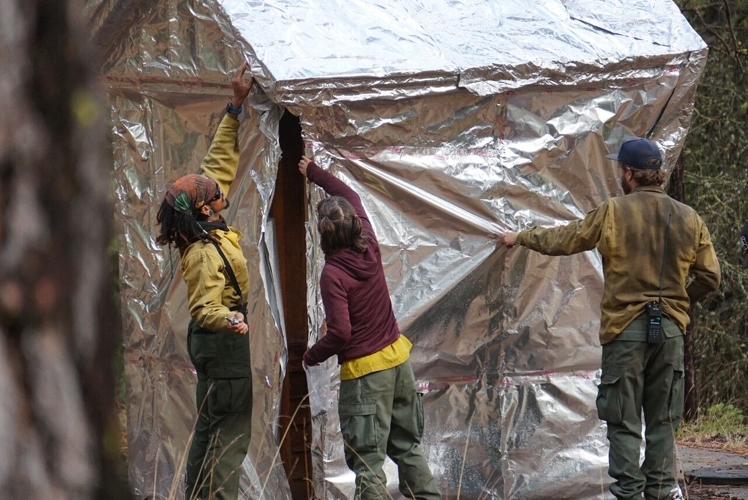
Crews take down protective wrap from a structure now that the Grasshopper Fire has largely died down.
Photo courtesy of Grasshopper Fire incident command
As for developed recreation sites, Flag Point Lookout was lost in the fire, and Bonney Horse Camp, Bonney Crossing Campground, Little Badger Campground, Fifteenmile Campground and Badger Lake Campground all sustained some damage, according to preliminary assessments. Firefighters were able to protect Pebble Ford Campground, Eightmile Campground, Underhill Campground, Lower Eightmile Campground and Camp Baldwin, however.
Impacts can range from fire-weakened trees to burned infrastructure, like picnic tables, signs and hitching posts.
California Interagency Incident Management Team 2 assumed command of the fire last Friday, and they will continue to focus on bringing the forest back to a more natural state. Over 330 miles of containment lines were established or augmented to help limit the fire’s growth.
“The work doesn’t just stop once fire isn’t on the ground anymore,” White said. “We need to make sure we’re repairing damage that was done from suppression activities, and that can help reduce erosion and stabilize some of those soils that were disturbed by dozer lines, hand lines.”
A closure remains in place across much of the Mt. Hood National Forest. While Timberline Trail, Tamanawas Trail, and Rock Creek Campground and Day Use area are again accessible to the public, at least 45 other trails ad 14 campgrounds are still affected under the order. Click here for more information.




Commented