
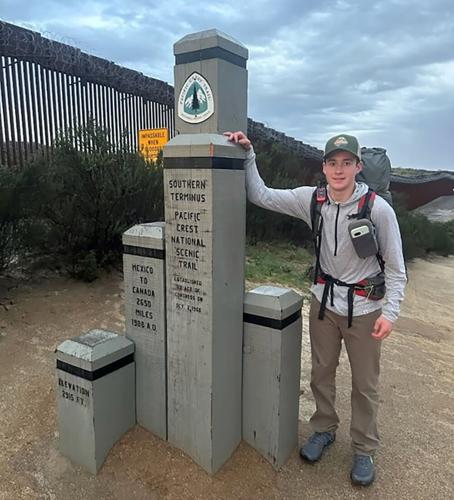
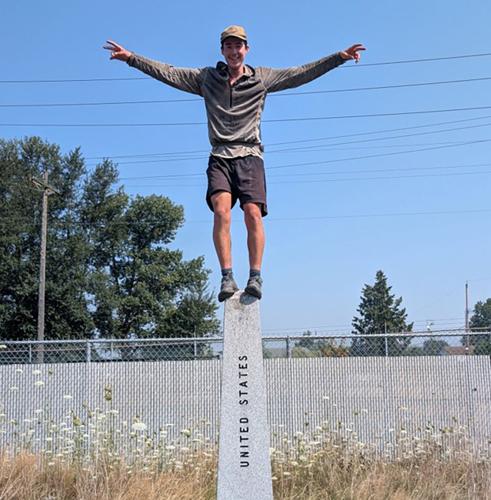
HOOD RIVER — When I heard that incoming Hood River Valley High School (HRVHS) senior Finn Cargo had just completed the Pacific Crest Trail (PCT) solo — no parents, older sibling, or a competent chaperone — I was intrigued and had a couple of questions that begged to be asked:
• How did his parents feel about their son embarking on the 2,650-mile trek from the Mexico border, traversing California, Oregon, and Washington?
• What was the “why?”
When the Cargo family visited the PCT days at Cascade Locks years ago, the seed was planted; the germination process was slow but unrelenting. Finn would have to successfully employ resourceful skills to complete a trek done by a few hundred hikers each year. Little did his folks envision that young Finn was enamored by the idea of hiking south to north over the San Jacinto, Sierra Nevada, Oregon Cascades into the rugged northern Cascades of Washington before he graduated from high school.
Fast forward to Finn’s freshman year at HRVHS, when he broached the idea with his parents. The first step was to create the resources to make the adventure a reality. The research plan “was not extensive,” he said, but he had backpacking skills and most of the equipment. He began to save money, since he would finance the cost himself. The last hurdle was persuading HRVHS administrators that completing the PCT would require him to take classes online during the spring of his junior year.
The plain truth is that pursuing and completing this dream would require Finn to begin the journey during the academic year. Most thru-hikers begin the sojourn in April and finish in late September. Finn’s plan was to begin earlier, in March, and complete the trek in August.
As Finn walked through the airport in Portland with his folks, he realized, “Oh, [expletive], this is really happening.” Flying on an airplane would be the first of a handful of times he would be out of his comfort zone.
The joie de vivre of a young man; unlike the over-the-hill trekker crowd of wannabe section hikers on the PCT who think and plan as if the “glass is half empty” and overpack, overplan, and over-worry, Finn approached the idea with nothing except potential: “I’m going to go as far as I can before I give up.”
He did do some planning — he knew the route, the resupply points, and that he’d need to have good equipment — but no more than necessary. He decided to limit his supplies to see how far he could make it.
The one thing he did not know, but would be keenly aware of by the end of his trek, is the symbiotic relationships inherent on the PCT. No room for parasitism, only mutualism. Every thru-hiker has the goal of completing the route, with no time to babysit a teenager on the trail.
Finn completed the 2,650 mile trek through the West Coast states in a bit less than five months. Despite the fact that he spent two weeks with a relative in Los Angeles as he waited for the snow to melt enough to find the trail in the Sierra Nevadas, he was still nearly a month ahead of the large cohort of thru-hikers. Hiking in the Sierra Nevadas during the winter is discouraged. Finn was hoping that the trail would be visible, but it still wasn’t. He had to use GPS to navigate and deal with 10 degree temperatures, near hypothermic nights.
Top dangers on the Pacific Crest Trail include falling, drowning, getting lost, lightning, heat illness, hypothermia, and medical emergencies. The Sierras bring all seven of these dangers to the fore.
While “cat-walking” up to summit Mt. Whitney (the highest mountain in the continental United States), Finn fell and had to self-arrest with his ice axe. He climbed back up, and although he didn’t reach the summit, he lived to tell the tale.
The highest point on the entire PCT is Forester Pass in Northern California (13,200-feet), and getting up and through the pass required the use of an ice axe again to make foot holes and micro-spikes on his trail shoes.
After many ascents and descents and traversing untold drainages, Finn had a watershed moment: “I can finish this,” he thought after safely completing what is considered the most challenging section of the trail. He would make friends with other thru-hikers as if they were family, the portmanteau: tramily.
There were some interesting and, in one case, attention-getting wildlife encounters with black bear (a sow and cubs), rattlesnakes, and, most horrifyingly, a mountain lion. Like coyotes, many thru-hikers hike early in the morning and late after sunset. The scariest five minutes were when he was hiking at night and saw glaring eyes in the bushes ahead of him.
Many 20- and 30-mile days lay ahead, though he wouldn’t repeat the 70-mile, no-sleep challenge he had done earlier in the desert of California, where the scenery was spectacular.
Thru-hikers find the Oregon-southern Washington section of the PCT a respite, with easy miles, a good canopy, and occasional beautiful sights, including Crater Lake, Jefferson Park and the Eagle Creek Trail to Cascade Locks. Southern Washington was more of the same, but not without its challenges: the Knife’s Edge. There were neat waypoints with the passes: White, Stevens, and Rainy.
For some of the 2,650 miles, Finn used a tarp (or cowboy camp), a sleeping bag rated to 40 degrees Fahrenheit, and no cook stove, which meant eating cold soaked Top Ramen and using tent stakes as if they were chopsticks.
A bit of good luck fell his way: lower-than-usual snowpack, especially in the Sierras, and a dearth of forest fires on the trail, with the exception of northern Washington which required a 150 mile reroute through Mt. Baker area.
All young folks have visions — their paths are numerous. Finn Cargo found his journey lived up to its potential.
•••
Chris Dawkins is an over-the-hill section hiker on the Pacific Crest Trail


Commented