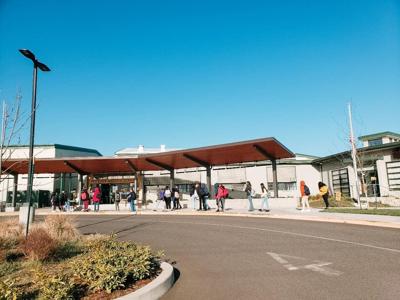
Hood River County School District’s (HRCSD) Long Range Facility Planning Committee is a year into its work to identify the needs of all district sites, like Wy’east Middle School, above, built in 1952.
Hood River County School District’s (HRCSD) Long Range Facility Planning Committee is a year into its work to identify the needs of all district sites, like Wy’east Middle School, above, built in 1952.
HOOD RIVER — Hood River County School District (HRCSD) board members met on May 27 at the Coe Administration Building for an update on the findings of its Long Range Facility Planning Committee (LRFPC).
The committee has been touring buildings and identifying the needs at each facility, looking at enrollment and economic projections, and considering financial options for the past year. Though initially planning to have a finalized priority list for the board this June, LRFPC has reconfigured its timeline to include more public feedback. With 80 as the average age of its facilities — aside from May Street Elementary, which was built in 2019 — there is much to consider, including whether to put a bond on the May 2027 ballot.
“These structures were designed for a different era of education and were not built to accommodate modern security protocols or the modern technology required for today’s learning,” said HRCSD Superintendent Bill Newton. “Decades of patchwork updates have created complex, aging systems, including HVAC, fire alarms and plumbing that are increasingly difficult to maintain and often incompatible with 21st century educational standards.”
District history
The first schoolhouse was established in 1873 on Barrett Road, thus beginning the building, consolidating, adapting, and/or decommissioning of as many as 23 sites through the years. Today, there are 12 facilities, from schools to specialty spaces like the district office. The consolidation of several schools in the 1970s created what are now Hood River Valley High School and Parkdale, May Street, and Westside elementary schools.
This move has given students more opportunities, from athletics to the arts to academic support, said Communications Director Stephanie Hoppe, and “provides important context for how our facility footprint has evolved.”
Decommissioned schools, such as the State Street School in 1921— now the county courthouse — and Frankton in 1984 — now a church — continue to serve as community gathering places, she said.
Issues identified
Cassie Hibbert, Wenaha Group senior project manager and committee partner, said that school administrators and the maintenance team have identified five critical priorities:
• Mechanical, electrical and plumbing deficiencies
• Worn finished and amenities
• ADA (Americans with Disabilities Act) and Title IX compliance
• Fire / life safety and security
• Structural, building exterior, energy and drainage issues
LRFPC also identified five critical issues after touring each building:
• HVAC / critical systems (mechanical, electrical, plumbing, and building exteriors)
• ADA and state mandates, especially ADA in outdoor locations
• The district’s transportation and maintenance facility
• Safety and security
• Lack of building and campus cohesion
Just maintaining the district’s current facilities over the next 20 years has an expected price tag of almost $220,000,000.
HRCSD Chief Financial Officer Mark DeMoss said that the district has utilized the Oregon Department of Education (ODE) Facility Assessment — a statewide evaluation of public K-12 buildings — as a free resource to identify potential deferred maintenance issues that could be addressed in the next 10 or more years.
While cost estimates are likely to exceed estimates, “ODE figures that a certain amount needs to be spent on a regular basis to maintain the efficiency of each building at its standard of operation,” he said.
•••
In part 2, Columbia Gorge News looks at enrollment trends, room capacity at each site, and the district’s plans for optimizing spaces, among other topics.



Commented
Sorry, there are no recent results for popular commented articles.