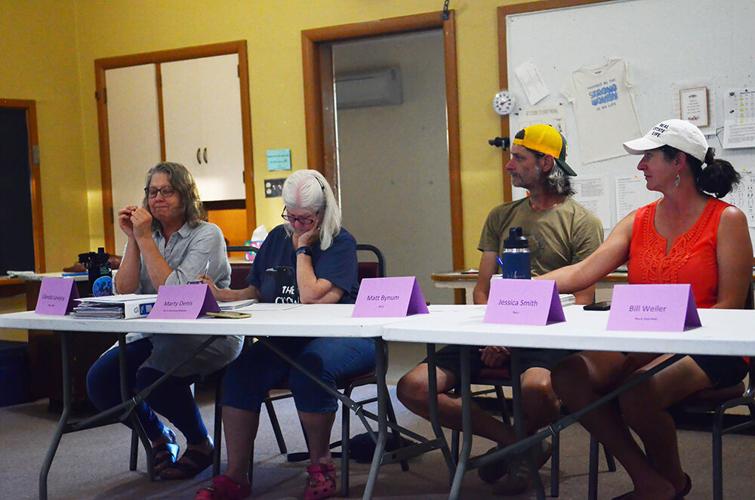
Glenda Lovejoy (chair), Marty Denis (secretary/treasurer), Matt Bynum and Jessica Smith during the June 17 Lyle Community Council inside the Lyle Activity Center.
The project, far from a done deal, may require a substation in the small town and uncertain impacts on PUD rates
LYLE — There are 284 water customers in Lyle under the Klickitat Public Utility District (PUD).
Each bill includes an additional flat fee of 50 cents. It’s collected and donated directly to the Lyle Community Center to pay for its water bills, both inside the building and its outdoor lawn.
To keep up with rising costs, the 50 cents will likely increase to 85 cents. While the difference is a small amount of change, residents of Lyle want a full scope of the details before committing, even unofficially, by a show of hands.
“People are supportive of the idea, but they want to make sure the space is well kept for the support that’s being given,” said Glenda Lovejoy, chair of Lyle Community Council. “For me personally, I think it’s a fair thing to expect.”
So what happens when details, as first reported by The Goldendale Sentinel, are released about a proposed substation within the town’s boundaries that would power a nearly 300-acre data center eight miles east in Dallesport — without any projected impacts on future power rates?
Since the project was a surprise to some residents, opinions were still forming during the monthly Lyle Community Council meeting on June 17.
“I’d really like to know more about what a big substation could mean in Lyle,” said resident Julie Larson. “We’ve had some wires catch on fire. We live near that area, so safety is a big concern for some big fires.”
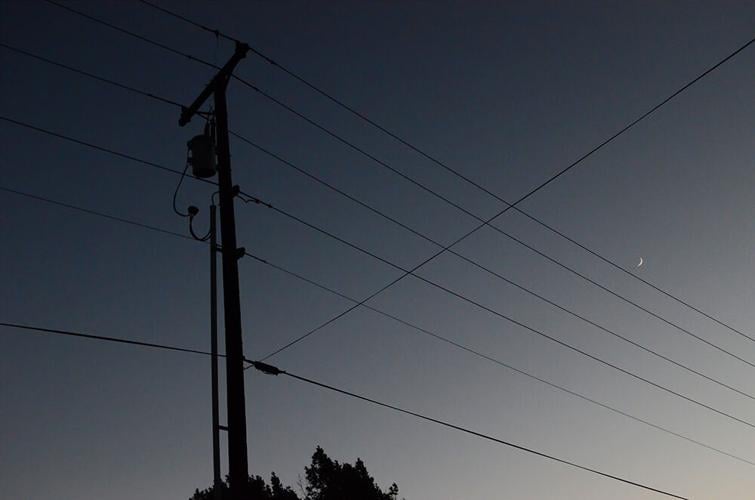
The substation proposal would be on 1.65 acres of land owned by the Klickitat PUD and operate at 230 kilovolts.
Larson also wants to better understand how the data center itself would affect the immediate Lyle community, as well as the larger Columbia River Gorge.
“I have a lot of concerns about environmental impacts,” she added.
Glenda Lovejoy (chair), Marty Denis (secretary/treasurer), Matt Bynum and Jessica Smith during the June 17 Lyle Community Council inside the Lyle Activity Center.
Emma Renly photo
Across the way, Google’s suite of data centers in The Dalles consumed nearly 550 million gallons of water in 2025, indirectly reducing instream flows for migrating fish. Other data centers return heated water to municipal or natural systems, further stressing aquatic life in the face of climate change.
No information is currently available on whether the Dallesport data center location would have an open- or closed-loop water system. It’s also unclear where the project would source power or water from.
Data center development, however, is spurring more fossil fuel-derived electricity sources across the region, according to a recent report from Columbia Riverkeeper. An Oklahoma-based gas methane giant called Williams Companies, for instance, is looking to build a new pipeline from Umatilla, Oregon, to Washougal, Washington, citing data centers as the principal driver of demand.
And in an assessment completed by the Northwest Power and Conservation Council, which modeled power adequacy for Oregon, Washington, Idaho and Montona come 2029, a scenario where data center development proceeds rapidly would violate the organization’s metrics that protect the electricity grid from events that occur too frequently, are too large in magnitude, or last too long in duration. All metrics must remain within established thresholds for the modeled power supply to be deemed adequate.
“A lot of people are really upset and don’t see this as something that they want in their future,” said Lori Zoller, who serves on the Board of Klickitat County Commissioners. “Our only mechanism is to abide by and impose the law and the ordinances to make sure that we stay within all the boundaries for health and safety, and also push for economic growth if it comes forward.”
Zoller added that construction of a data center will have construction debris, which has one of the highest tipping fees at Republic Services’ Roosevelt Landfill.
“Waste that goes into our landfill benefits our county, and it’s divided out between junior tax districts, between the schools, between the fire districts, between the hospitals — everybody will benefit,” she said.
While Zoller remarked that state regulations require data centers to come up with their own electricity generation systems, no such Washington law is currently in place. During the recent short session, House Bill 2515 would have mandated that utilities implement a tariff or policy to ensure other ratepayers don’t bear the brunt of data center development, but it never got out of the legislature.
Zoller also pointed to nuclear energy as a possible aid to the electric grid for supporting data centers.
At the council meeting, discussions about economic growth through job creation were also brought up. Lovejoy was cautious and pointed out how data centers can initially bring in many employees during construction, but it doesn’t always lead to long term jobs for sustainable economic growth.
The proposed data center site is owned by Scott Webster, CEO of The Fruit Company, and is currently an orchard. He told The Sentinel that “no final decisions have been made regarding any specific project, development partner or alternative use for the property,” but the company is exploring options.
Klickitat PUD has submitted a Line Load and Interconnection Request to the Bonneville Power Administration (BPA), which would have the project either tie into BPA’s existing Big Eddy substation in The Dalles, or a new substation in Lyle.
Mike DeMott, director of finance and power management for Klickitat PUD, said it’s too early for any construction or energization timelines to be determined.
•••
For more information on where data centers can be cited in Klickitat County, and a crucial code interpretation that paved the way for more development, see the July 1 edition of Columbia Gorge News.
This story was updated to clarify the findings of the Northwest Power and Conservation Council’s adequacy report for the region’s power supply in 2029.



Commented