
THE GORGE — For ages, a small spider has gone undetected by science, scurrying through the caves and crevices of the Columbia River Gorge.
That changed in October 2021, when Greta Binford, a professor of biology at Lewis & Clark College in Portland, made a unique discovery near Wahkeena Falls on the Oregon side of the Gorge.
“I rolled over a boulder and there was a spider underneath that I knew was very different,” said Binford.
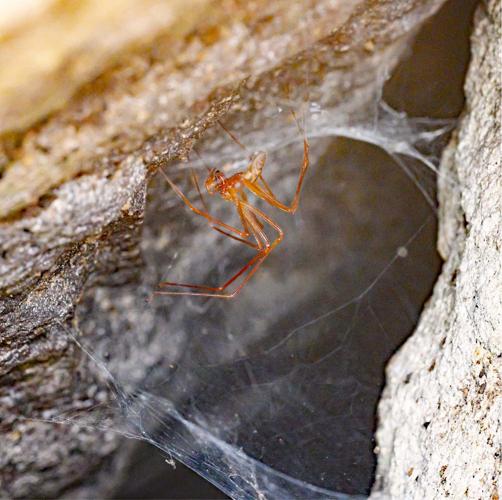
What Binford found, and what she and colleagues would spend years confirming, was a unique species of spider found only in the Gorge. The spider, Trogloraptor tulishpun, is only the second known species in the family Trogloraptoridae, which itself is a recent discovery.
The scientific classification of the Trogloraptoridae family dates to 2010, when a different, unique spider was found in a cave in southern Oregon.
The spider was so unusual it required not only a new species name but also a whole new family to correctly place it on the tree of life. (A family is a broad biological category; the Canidae family, for instance, includes dogs, wolves, coyotes and foxes.)
The spider was named after the caver who discovered it.
To name the Columbia River Gorge member of the Trogloraptoridae family, Binford and her students who helped identify the spider reached out to local Tribes. The name tulishpun comes from the Ichiskíi, or river dialect, of the Sahaptin language.
Yakama Nation elder Anthony Washines named the Columbia Gorge spider. The Sahaptin name he chose roughly translates as “Cave Predator Master of Domain.” The name “Trogloraptor” is a combination of the Greek “troglo,” for “cave-dwelling,” and the Latin raptor, meaning “robber.”
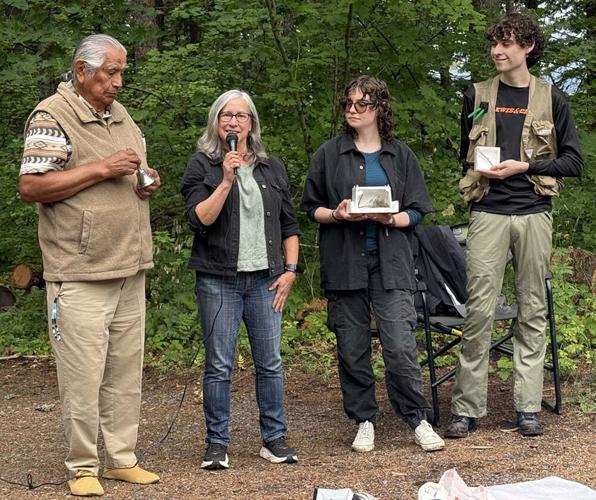
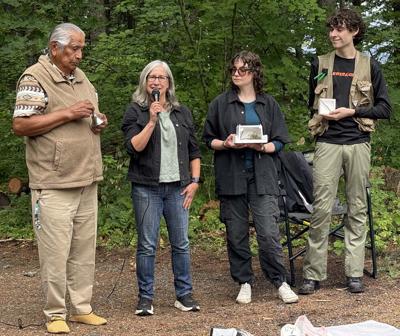
On June 10, at the Herman Creek trailhead near Cascade Locks, the spider was formally given its Ichiskíi name in a ceremony attended by researchers and tribal members.

Hundreds of thousands of Trogloraptor tulishpun are estimated to be living in caves in the Columbia River Gorge.
Marshal Hedin photoCave crawlers
Binford said she suspected from the start that the spider she found near Wahkeena Falls was a Trogloraptor. But she initially second-guessed herself because the only known species in the family had been found in caves near Grants Pass in southwestern Oregon, some 250 miles away.
She also had a problem: the spider was a juvenile. This made identification difficult.
“One of the things that we use to tell species apart in spiders is the shape of the genitalia. And they don’t develop mature genitalia until the spiders are mature,” explained Madeline Jones, a recent Lewis & Clark graduate who assisted Binford with the genetic analysis of the spider that helped identify and properly categorize it.
Hoping to rear the spider to adulthood, Binford took it back to her lab. It died.
She, Jones and others who worked on the project were, however, able to extract the animal’s DNA and run a genetic test. The results confirmed the spider belonged to the family Trogloraptoridae.
Binford began searching the Gorge for more specimens, turning over more boulders. Finding nothing, she reached out to her caving friend Neil Marchinton.
“I said, ‘Neil, would you mind going into some caves so we can try to find Trogloraptor in the Gorge?’” Binford recalled. “And he said, ‘Hell yes.’”
Marchington is the director of special projects for the Western Cave Conservancy, a California-based nonprofit that works to protect threatened caves in the western United States. He is the discoverer of Trogloraptor marchingtoni, the only other known species in the family, which is named after him.
Exploring the caves of the Gorge, Marchington and his team eventually found the spider that had eluded Binford, locating T. tulishpun in four cave sites within the Columbia Gorge.
He estimates there are likely hundreds of thousands of the spiders in the Gorge’s lava tubes and shallow basalt caves.
A genetic analysis of the species conducted by Binford and her students confirmed the new Gorge population is similar to but distinct from its southern Oregon relative.
A paper formally describing the new species, led by Jones and co-authored by Binford and two of her students was published June 8 in the scientific journal Zootaxa. Binford described the family Trogloraptoridae as evolutionary outliers with no close relatives.
“They’re kind of like a platypus or something that represents this long branch that’s different from everything else,” she said. “They’re very precious.”
Trogloraptoridae are characterized by distinctive raptorial tarsi, specialized claw-like structures on their legs that help them grab the legs of other spiders, hold them down and inject venom into them before eating them, a “beautiful thing to watch,” according to Binford, who has observed the behavior in her lab.
The spiders are believed to be the top predators in their cave environments.
“The fact that we still have them on Earth is awesome because they give us some information about the evolutionary history of spiders and the diversity of the family,” said Binford.
How to name a spider
When the time came to name the new species, Jones said the team wanted to honor local indigenous traditions, but they wanted to do it right.
“It’s easy to try and be genuine, but I think that sometimes we don’t always go about it in the right way,” said Jones. “So, I felt it was important to reach out to the right people and to make sure that we were actually honoring who we intended to honor.”
Jones contacted the Columbia River Inter-Tribal Fish Commission, which represents the Yakama, Warm Springs, Umatilla and Nez Perce Tribes on fisheries and natural resource issues in the Columbia River Basin.
Donella Miller, a biologist and manager of CRITFC’s Fishery Science Department, received the request. Miller is a member of the Yakama Nation.
“Being a biologist, I totally nerded out about the whole thing, a new species and naming that,” she said. “I really appreciated their thoughtfulness and wanting to connect with the tribal community and have a really meaningful name that’s affiliated with the people and the place.”
Miller brought the request to Washines, who consulted the language of his elders and drew on Sahaptin to craft a name that reflected what the spider is: a predator, hidden underground, sovereign in its domain. The name is similar to the Sahaptin word for the black widow spider.
Miller said she saw a parallel between scientific naming conventions and Indigenous naming traditions.
“The whole classification and scientific naming and affiliating that with our cultural perspectives is the same thing,” she said.
Miller said one of the important elements of the naming ceremony was recognizing the individuals who participated in the spider’s discovery.
“That’s why we have a ceremony around [naming] and why everybody comes to witness and each person is acknowledged and why we have the different generations here for us to be able to learn and carry these things forward,” said Miller.
The naming ceremony was held at the Herman Creek trailhead on the morning of June 10. About 30 people, including many children, gathered under the tall Douglas firs and bigleaf maples for the ceremony. Binford, Marchington, Jones and another of Binford’s students, Finn Watson, were recognized for their work. Also present was the spider.
Before the ceremony began, Jones, Watson, Marchington and his eldest child, Oz, emerged from the woods covered in muck, having spent the morning crawling through a nearby cave. They had found a live specimen of T. tulishpun.
Jones carried the spider in a container during the ceremony. The idea was to have the animal present when it was named.
The ceremony was led by the Yakama Nation’s Washines, who asked that the traditional-language portions not be recorded.
He rang a bell throughout the ceremony. Participants closed their eyes, raised their hands and held their hands over their hearts. There was singing while in the background the sound of a train and traffic on nearby Interstate 84 could be heard.
“I was asked how I came up with the name,” said Washines during the English language part of the ceremony. “But it’s not me. It’s the elders that took care of the language. It’s the elders that took care and understood. They gave a name.”
At 10:33 a.m., the spider received its name.
After the ceremony, gifts were distributed. Binford received a painting of the spider by a local artist. Marchington was presented with a blanket with a traditional spider pattern. Jones and Watson received mouse pads bearing the same design. Everyone received canned salmon from the Yakama Nation and T-shirts from CRITFC.
In remarks after the ceremony, Washines reflected on what the discovery means. “To me, it’s a celebration and it’s an awakening of the land,” said Washines. “When we come to the land and we stand on the land, we are recognized by those brothers and sisters that are still here and it makes them happy that they’ve done a great job. To me, they’ve done a great job taking care of this land.
“Some might think it’s an insignificant spider in a cave. What’s the big deal about that? But in our way, they were there for a reason.”
John Washines, a member of the Yakama Nation and nephew of Anthony Washines, was also present at the ceremony. He was recently elected to the Yakama Nation Tribal Council. He held his tired grandson in his arms during a brief interview afterward.
“To me, it means we’re still here. And not only as a people, but our brethren of the animal kingdom,” said John Washines. “It means that no matter what happens in this lifetime with the modernization or differences, there’s still things that are being found, still things that are being rediscovered or re-implemented into our ways of life that were already here before.”
•••
This story was produced by Columbia Insight (columbiainsight.org), a nonprofit based in Hood River that reports on environmental issues in the Pacific Northwest, with a focus on the Columbia River Basin. Contributing Editor Nathan Gilles is an award-winning journalist and science writer based in Vancouver, Washington. Contact him at www.nathangilles.com.


Commented