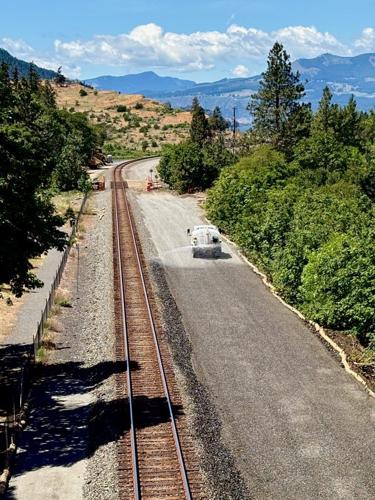
A water truck works to keep the dust down as it proceeds along the newly-graded right of way for Union Pacific’s extended passing siding at Mosier. The new track will be placed directly north of the existing single-track mainline.
MOSIER — Twelve years after Union Pacific (UP) proposed adding a second track through Mosier, the company has started building a much smaller rail infrastructure project there. Called the “Mosier Siding Extension,” the work will lengthen a stretch of railroad siding, a low-speed section of track separate from the main running line that allows trains to pass each other.
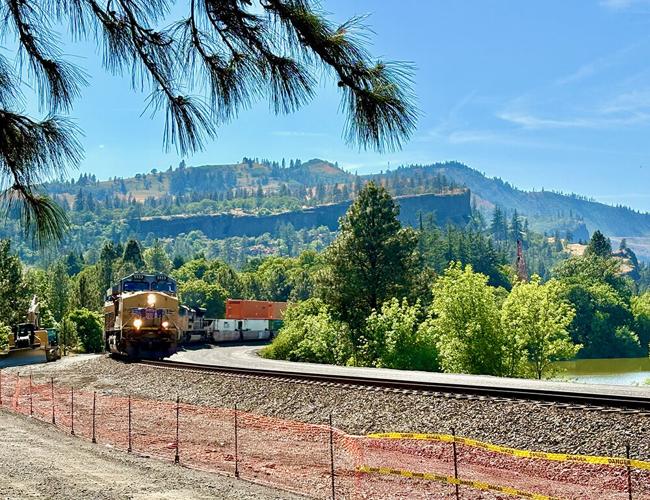
The railroad has long eyed expansion in the Mosier area due to a reportedly severe traffic bottleneck on UP’s single-track mainline through the Gorge. The current siding at Mosier, 6,300 feet long, is too short for the longer freight trains commonly operated in contemporary railroading. It’s the shortest along UP’s Portland Subdivision, which stretches 190 miles, from Portland to Hinkle in eastern Oregon.
In the current construction project, UP plans to extend the Mosier siding to roughly 9,000 feet (about 1.7 miles).
According to Aaron Hunt, Union Pacific’s senior director for public affairs for the Pacific Northwest, lengthening the passing track at Mosier will ease rail network congestion and delays along UP’s east-west route through the Gorge and, by ripple effect, throughout the Northwest. Currently, there is no rail siding long enough to allow freight trains to pass each other between The Dalles and Meno, a station about five miles west of Hood River, so trains are forced to wait at those stations for the single track to clear.
A staging area for the railroad’s construction contractors has been set up behind the Mosier Fruit Growers building adjacent to Rock Creek Road. The project — which has a price tag of approximately $25 million — is planned to proceed in phases, with completion expected in July 2027.
As part of the upgrade, bridges that carry trains over Rock Creek and Mosier Creek will be replaced by new bridges with two tracks instead of the existing one-track. Pile-driving work was completed on the Rock Creek bridge in early May. Pile driving for the Mosier Creek bridge is expected to take place sometime this July or August.
It has taken Union Pacific a long time to see construction work finally underway at Mosier, as public opposition and regulatory hurdles — spurred by an oil fire and years-long cleanup — proved difficult to navigate.
UP originally planned to add 5.37 miles of a second track through Mosier. On June 3, 2016, while the railroad company was in the middle of the review and permitting process for that project, 16 tank cars in a westbound UP oil train derailed in Mosier. Several of the tank cars caught fire. The accident galvanized opposition to UP’s proposed second track in the Gorge, and environmental and tribal groups ramped up their efforts to block UP’s expansion plans.
After a series of public hearings, demonstrations in opposition, court challenges, and regulatory agencies denying key approvals, UP agreed to withdraw the project and put in place a five-year moratorium on future Mosier-area rail expansion in 2021.
A water truck works to keep the dust down as it proceeds along the newly-graded right of way for Union Pacific’s extended passing siding at Mosier. The new track will be placed directly north of the existing single-track mainline.
Photo by Douglas Burkhardt
Mosier City Manager Andrea Rogers, who served as Mosier’s mayor from 2008-2014, said Union Pacific re-engaged with the city in the fall of 2025 to discuss restarting a revised expansion project.
“Mayor Witt Anderson, councilman Ron White, a few other community members and I met with UP officials on at least two separate occasions,” Rogers explained in email correspondence on May 27.
In December 2025, Rogers penned an open letter to inform the community’s residents that the project was moving forward.
“The UP double track in Mosier was litigated and debated for over a decade by multiple agencies, including Wasco County and the city of Mosier,” she wrote. “The UP siding is now permitted.”
One of the primary organizations that led opposition to UP’s Mosier initial rail project was Friends of the Columbia Gorge, a group with offices in Portland, Hood River and Washougal dedicated to protecting the scenic landscapes and natural habitats of the Gorge. Steven McCoy, staff attorney for the organization, explained that the regulatory environment for the project today is very different from 2014, when the railroad first proposed building additional rail capacity at Mosier, due to a court ruling several years ago.
“In August of 2021, the Ninth Circuit Court of Appeals decided that the Gorge protection laws do not apply to railroad projects because the Gorge laws are pre-empted by federal railroad law,” McCoy explained in a May 26 email. “While we vigorously disagree with this decision, that is the state of the law.”
However, McCoy noted that the current project is less impactful than the version being planned in 2014.
“It is no longer a proposal for a second mainline track, but instead is a proposal to lengthen the (existing) siding,” McCoy wrote. “This means trains will not be passing at full speed through Mosier. Instead, one train will stop on the siding while the other passes.”
McCoy added that the project also no longer impacts sensitive natural areas at either end of the construction.
“This includes no cut through the mesa adjacent to Memaloose State Park, no staging areas in what is currently an oak woodland, less harm to cultural resources, and less degradation of scenic resources,” he noted.
The railroad’s construction work, however, has significantly reduced the foliage on the north side of the tracks, where the city has established a scenic trail, and Rogers indicated she is hopeful the railroad will agree to help rebuild a trail in the area.
“This is where the city has had a pathway in the past that creates a loop from Rock Creek to Mosier Creek and back,” Rogers explained in her email. “I am hopeful we can reconstruct this, and that Union Pacific contractors will assist us in that. It was an early talking point.”
Union Pacific pays Mosier $250 per day when pulling water from a hydrant to keep dust down, and leases construction staging land from Mosier for $2,500 per month, according to Rogers. She noted that transportation has always been of critical importance to the city’s history, with the railroad through town intertwined with the city’s past, present, and future.
“The City of Mosier is located in a transportation corridor that began before the city was founded as part of the Oregon Trail. Remnants of the Sandy to The Dalles highway remain. Mosier once had a train station and rail yard,” she explained. “Union Pacific is part of our heritage. We pride ourselves on having a cooperative relationship with them.”
•••
The Union Pacific siding project has been discussed at multiple public meetings covered by Gorge Documenters. See full notes from relevant meetings here:
Wasco County Board of Commissioners’April 16, 2025, Town Hallin Mosier, by Documenter Lynda Ontiveros.
Mosier City Council’s Sept. 3, 2025, meeting, by Gorge Documenter Lynda Ontiveros; Nov. 5, 2025, meeting by Gorge Documenter Kathy Omer, Dec. 10, 2025, meeting by Sherry Ann, and Jan. 7, 2026, meeting by Chelsea Clark.
•••
Douglas Burkhardt, aka D. C. Jesse Burkhardt, is a University of Oregon graduate. He served as an editor, reporter, and photographer with four different community newspapers in Washington and Oregon over a career spanning 23 years. Burkhardt also has published several books on railroad history and operations, as well as two travel-adventures.



Commented