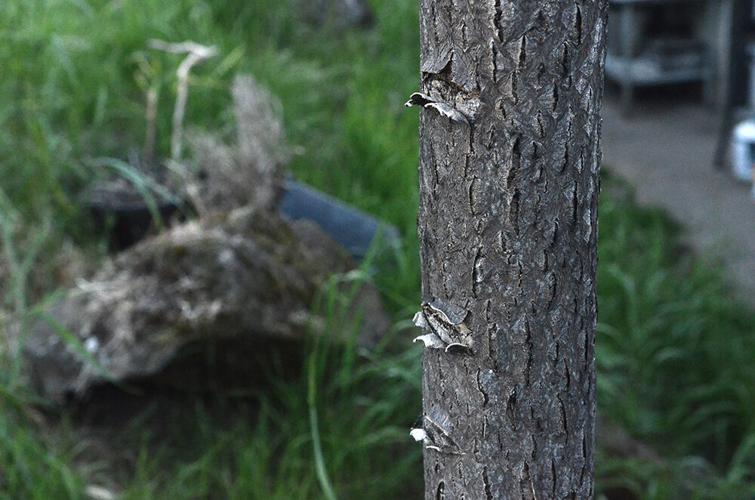
Hatchet marks on the Tree of Heaven’s trunk from the “frill” or “hack-and-squirt” method — herbicide is applied to the cambium layer of the tree, which transports water to the roots, poisoning it.
Hatchet marks on the Tree of Heaven’s trunk from the “frill” or “hack-and-squirt” method — herbicide is applied to the cambium layer of the tree, which transports water to the roots, poisoning it.
This story was updated to clarify figures related to the Washington Department of Natural Resources' Urban Forestry Grant. In 2024, the agency provided $8 million in funding to more than 40 successful applicants across the state, not solely to the Underwood Conservation District.
THE GORGE — With bright symmetrical green leaves sprouting out of the Tree of Heaven’s crown, the plant almost earns the namesake based on looks alone. Corrie Podolak, conservation outreach coordinator at Underwood Conservation District (UCD), will tell you otherwise.
“It’s a beast of a problem,” Podolak said, adding the tree is aggressive and often mismanaged. “In other invasive trees you can cut the whole tree down, and then treat the stump, but this is not one of those trees,” she added. “Just cutting it down, that actually makes it produce more shoots — it’s a Medusa Head.”
The Tree of Heaven originates from China, and is already found heavily in the Midwest and East Coast. Due to its fast-growing, drought resilient and allelopathic (meaning it poisons other plants) nature, the tree can quickly take over native plant species.
According to the Oregon Department of Agriculture (ODA), Wasco County was the state’s first documented site of the Tree of Heaven in 1904. Additionally, in the Columbia River Gorge, the Tree of Heaven was used as a shade tree and for erosion control in the 1930s-1940s by Sam H. Boardman, first Oregon State Parks superintendent, unknowing of repercussions.
“It was planted purposefully,” Podolak said. “It spread like wildfire.”
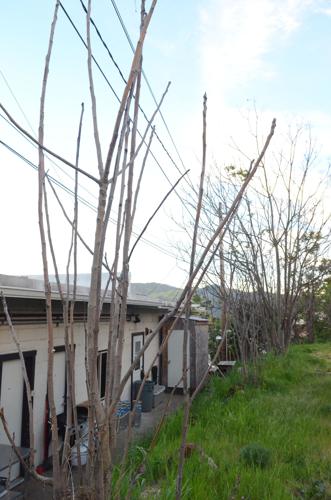
Dead Tree of Heaven behind the White Salmon Bakery.
Emma Renly photo
Efforts have been made by both Oregon and Washington to prevent further spread on both public and private land — Oregon Department of Transportation (ODOT) reported that in Region 1, from Portland Metro Area to Hood River, maintenance managers have not found or treated the plant in years on the interstate or shoulders.
Oregon State Weed Board Grant also provides funding for noxious plant removal, but Troy Abercrombie, program manager at ODA, says while the Tree of Heaven is eligible, as a B rated species, it’s not as competitive as those rated A of BT.
He says they are in the early stages of working with other agencies to create a biocontrol agent that can be released on the Tree of Heaven, a pathogen that would infect and kill the tree.
“It takes a long time to develop and get them through the permitting process and approved for release,” Abercrombie said. “But it allows us to manage problems that we don’t have the human capacity to manage.”
Specific to the Gorge, Hood River Soil and Water Conservation District offers technical assistance for treatment of the Tree of Heaven, but is unable to conduct the actual removal. Jed Arnold, district manager, stated the district is entirely grant funded, and small in scope.
He recommends that individuals who do find the Tree of Heaven fill out the form on the Oregon Invasive Species Hotline website at oregoninvasiveshotline.org/reports/create.
Additionally, there is no dedicated noxious weed control group in Hood River or Wasco County, which both Skamania County and Klickitat County operate.
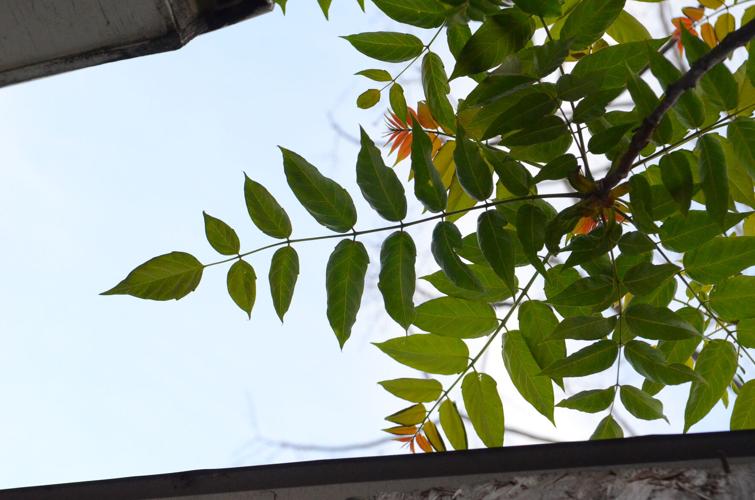
Tree of Heaven with new growth, with leaves arranged in opposite pairs.
Emma Renly photo
In 2022, the Washington Department of Natural Resources provided UCD $18,375 in funding for outreach and removal of the Tree of Heaven through the Urban Forestry Grant. While around $8 million was awarded from that same grant in 2024 to more than 40 other grantees, due to the state and federal budget cuts the following year, only $20,000 was given from state and $28,000 from federal.
Podolak said UCD targeted the Tree of Heaven with the grant because it’s the preferred home of the spotted lanternfly, another invasive species that can negatively impact the agriculture industry — such as vineyards and orchards — since the bug eats the sap.
“Luckily, we have not found any spotted lanternfly in our area,” she added. “But the bug or its eggs could hitchhike on a truck and be here in no time.”
Additional funding for the program was provided by the Columbia Gorge Cooperative Weed Management Area, Washington State Department of Agriculture, the City of White Salmon and Klickitat County Noxious Weed Control. Together, they treated the Tree of Heaven in right-of-way spaces and private property in Bingen and White Salmon.
“We did our best to get to all the locations, but obviously, we did not get all the locations,” Podolak said. In total, the organizations were able to treat 65 sites between White Salmon and Bingen, including behind the White Salmon Bakery, at the Bingen waterfront and by the railroad.
“I think we made a dent in the population, but there’s always more,” Podolak said. “We’re never going to completely eradicate the tree but we can control it, as was the mission.”
She explained the process of applying the herbicide is time consuming, with the success rate dependent on the season it’s applied (July to October, with room for flexibility due to climate change), repeated application and regrowth monitoring for the next five to 20 years.
“Not only do the trees shoot up roots 50-plus feet away from the mother tree, but also, they have an incredible seed dispersal,” Podolak explained.
Since the funding for the herbicide Tree of Heaven program stopped, she explained UCD’s approach has switched to education outreach, with potential for future classes on how to apply treatments. Individuals wanting to learn more can reach out at toh@ucdwa.org.
Podolak also pointed to the native plant sales UCD hosts and plans to focus and emphasize positive action going forward. Oregon White Oak or Big Leaf maple can be replacements for shade, she said, while Smooth Sumac and Blue or Red Elderberry share a similar Tree of Heaven aesthetic, without the same consequences.



Commented