
By Bob Yoesle
Recruiting, maintaining, and retaining adequate staffing is a core management function that ensures an organization has the right number of qualified people in the right roles. The inability to do so at the Goldendale Observatory is a huge “red flag” for Washington State Parks.
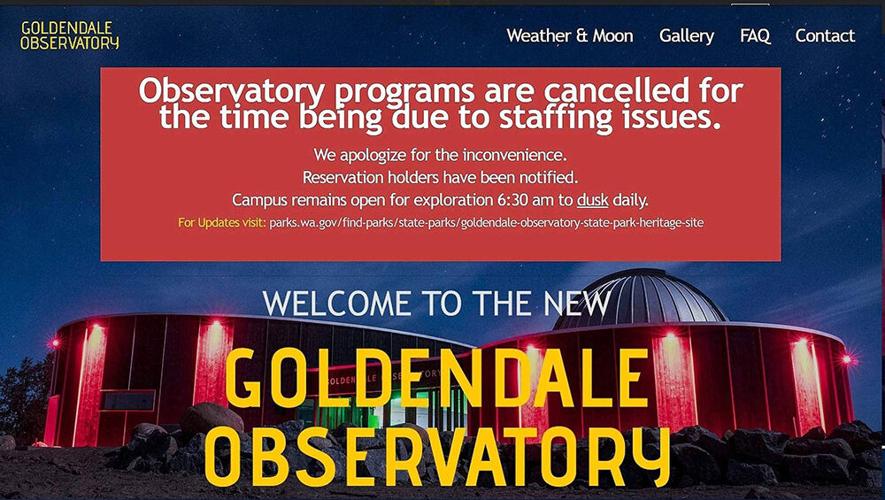
On Aug. 5, the Goldendale Observatory State Park Heritage Site indefinitely suspended and canceled all scheduled solar and evening public presentation programs due to a staffing shortage. Despite spending $5.9 million to upgrade the observatory, and the generous pay and benefits offered by Washington State Parks, several past attempts to recruit additional staff to the observatory appear to have been unsuccessful.
An email from East Columbia Gorge Area Manager for Washington State Parks Jill Sprance-Carr framed it as “a pause.” Impacted ticket and reservation holders have been notified and canceled slots refunded or cleared by Washington State Parks.
“We are working on a plan to reinitiate programs,” she wrote, “but at this point we don’t know when that will be.”
Spance-Carr noted that the Observatory outdoor campus will still be open for self-guided tours from 6:30 a.m. to dusk daily.
What caused the staffing shortage?
The staffing shortages at the Goldendale Observatory can be attributed to several factors. The main reason stems from the sudden absence of its long-standing facility administrator and lead interpreter, Troy Carpenter, who effectively operated as the singular “face of the observatory.” While Washington State Parks officials have avoided detailing specific personnel matters publicly, the core friction surrounding his tenure involves a mix of internal structural vulnerabilities and high-profile localized disputes.
Solo-operator structural vulnerability: The primary logistical reason for the total programming shutdown is that the observatory’s highly specialized operations relied almost entirely on a single person. Ever since taking the helm in 2013, Carpenter was the main person handling the complex telescope demonstrations, solar presentations, and evening lectures. Because the facility lacked a deeply staffed roster of specialized astronomy interpreters or cadre of trained docents, his sudden departure has left an immediate operational vacuum that Washington State Parks cannot readily fill.
High-profile controversy and clashing priorities: Carpenter’s departure follows years of tension between his administration and regional dark-sky conservation advocates.
Dark Sky decertification: Under Carpenter’s management, the site became the first International Dark Sky Park to be decertified (see below). Local advocacy groups, such as the Friends of the Goldendale Observatory, clashed heavily with Carpenter. Activists accused him of deprioritizing the importance of dealing with increasing light pollution at the observatory, missing critical data reporting, failing to provide mandatory night-sky conservation education, and deemphasizing observational astronomy. Conversely, Carpenter maintained that light pollution was decreasing, and that night sky conservation advocacy was “pandering to amateur astronomers” and a politically charged issue that distracted from his lecture-based “science center” tourism priority, sparking a “battle of personalities” within the local astronomy community.
Website ownership and legal disputes: The back-end friction intensified into formal disputes regarding the Goldendale Observatory website, which originated with the Friends of Goldendale Observatory and included information on the problem of increasing light pollution and the need to implement the city/county lighting codes. Court proceedings and public filings revealed that Carpenter personally claimed ownership over the website’s digital infrastructure and domain name. He removed the Friends access to the website and eliminated all references to light pollution and the existing regulatory requirements for its mitigation. This created a standoff between Carpenter (along with the local Chamber of Commerce), and the Friends group, as Carpenter openly stated that Washington State Parks policy technically barred him from maintaining an outside website, and he used the local Chamber of Commerce to fund and protect his private hold on the website domain.
Lack of qualified candidates: Washington State Parks, which manages the observatory, seems to struggle with attracting and retaining staff with the necessary priorities, knowledge, and qualifications for operating an astronomical observatory. This is evident from the observatory’s experiences with poorly qualified staff and Washington State Parks management’s unfamiliarity with astronomical and public observatory operation matters.
Inadequate hiring process: The Washington State Parks hiring process for the Interpretive Specialist position was criticized for being perfunctory, with only two or three candidates interviewed by the area manager, and additional interviews for support staff that also have included the director of the Chamber of Commerce. This raises concerns about the effectiveness of the recruitment process.
Poor management culture: The management culture at Washington State Parks and the observatory has been criticized for being exclusionary and unresponsive to the astronomy and science education communities, with an unwillingness to engage with external expertise. This lack of knowledgeable and qualified program input and oversight has resulted in numerous facility issues that can make it challenging to attract and retain qualified staff.
Limited community support: The local anti-regulatory business community and government have prioritized tourism over the observatory’s core astronomy mission. This mindset was adopted by Carpenter and Washington State Parks, and is further reflected in the City of Goldendale, Klickitat County, and Washington State Parks lack of support for the outdoor lighting codes and any night sky conservation education efforts. Washington State Parks has failed to put forth any leadership effort to change the local community’s orientation and values for the observatory as an authentic astronomical resource needing protection. This generally poses a significant challenge in attracting and retaining genuinely qualified and well-educated astronomical science educators and practitioners. And Goldendale is a small, isolated, conservative rural community with limited amenities, a stagnant economy, and gets mixed reviews as a desirable place to live.
Dark Sky Park no more
The Goldendale Observatory State Park is infamous for being the only International Dark Sky Park in the world ever to be decertified by DarkSky International (DSI) for failure to meet the requirements to provide a minimal amount of educational experiences related to night sky conservation and the promotion of good outdoor lighting practices.
In late 2016, DSI suspended the park for lack of compliance with their requirements, and ultimately removed the dark-sky designation in 2017, the only time they have decertified a site. Washington State Parks later stated that they were no longer interested in this status for Goldendale Observatory State Park, and they would go out of their way to avoid such a designation.
The City of Goldendale and Klickitat County, along with the Greater Goldendale Area Chamber of Commerce, are similarly ill-disposed to protecting the night sky of the observatory, which Goldendale and Klickitat County promised to do decades ago as a condition to being entrusted with the observatory’s historically significant main 0.5 meter (24.5 inch) telescope, built by amateur astronomers at Clark College in Vancouver, Washington. This might partly explain the difficulty in recruiting qualified astronomy education staffing.
•••
Sources: “Staffing shortage at Goldendale Observatory,” Gorge Country Media (Rodger Nichols), Aug. 12, 2026; Friends of Goldendale Observatory (www.goldendale-observatory.com); and Yoesle’s time as president of the Friends of Goldendale Observatory.
•••
Bob Yoesle built his first telescope in seventh grade. In 1979, he traveled to Goldendale with other amateur astronomers to see the total solar eclipse at the Goldendale Observatory. After retiring he moved from Goldendale to southern Arizona, where he currently enjoys the great weather and clear dark skies. He continues to build telescopes and is serving as a docent at Kitt Peak National Observatory.


Commented
Sorry, there are no recent results for popular commented articles.