HOOD RIVER — Two new art exhibitions, each confronting the history, humanity, and meaning of place, debuted at Columbia Center for the Arts (CCA) on Sept. 4 and will run through the end of October.
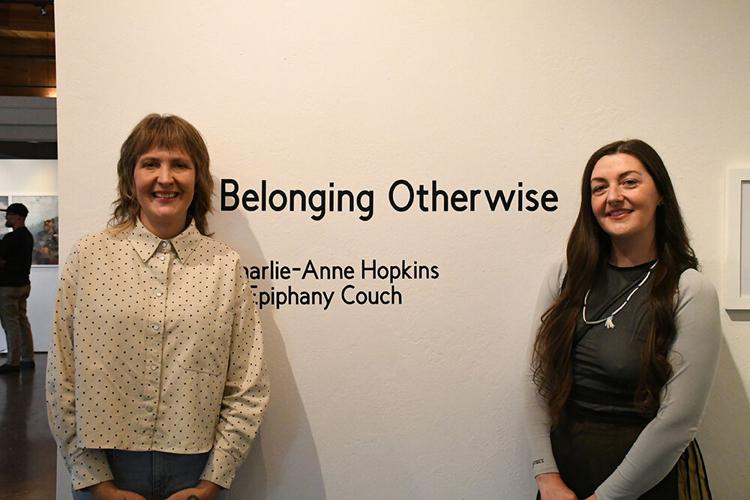
“Belonging Otherwise,” an immersive gallery featuring various sculpture, photography, and textile works from creative duo Epiphany Couch and Charlie-Anne Hopkins, explores relationships between land and identity, questioning what it means to belong in and connect to the shared spaces we navigate.
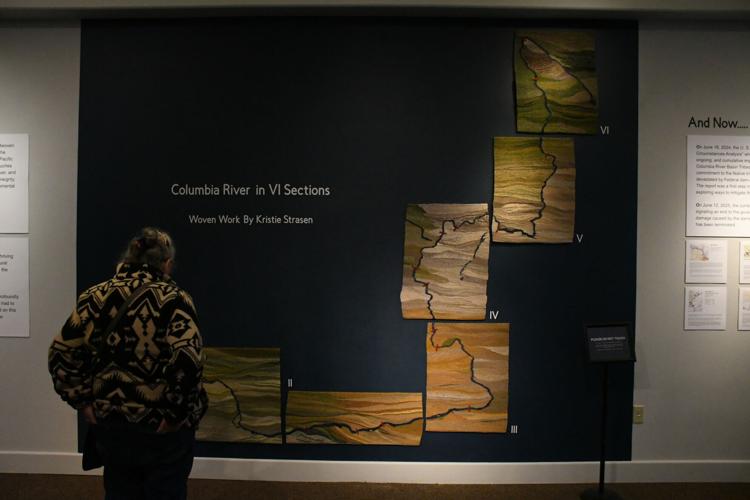
A fragmented tapestry from Kristie Strasen, “Columbia River in VI Sections,” weaves together the winding history of the mighty waterway, acknowledging the devastating impacts of federal dam development on the Native American communities along its path.
Belonging Otherwise
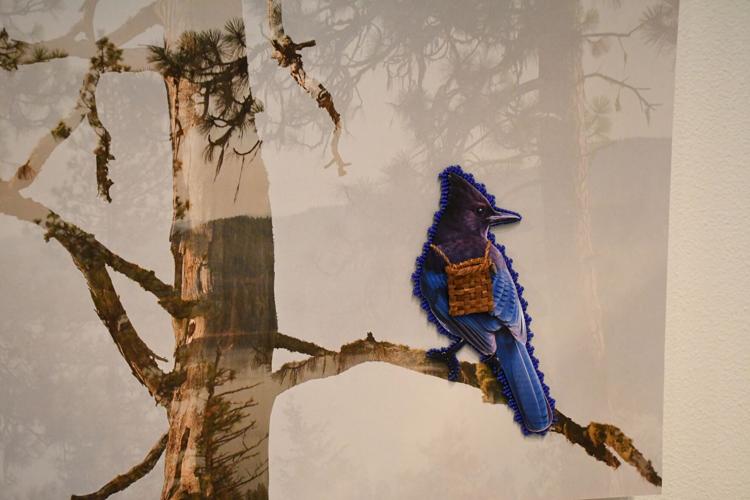
A lifelong artist, Couch possesses an innate desire to create — a means to understand herself and her place in the world. Her work, composed of double-exposure photography, beadwork, weaving, and collage, draws on family stories, her Tribe (Puyallup), and her upbringing in Tacoma.
Also a maker since childhood, Hopkins contemplates preservation, ecological issues, and the climate crisis through their work, drawing from childhood experiences in Central Oregon witnessing humanity’s footprint in previously wild areas. By foraging materials to make inks, sculptures, and works on paper, they demonstrate a thoughtful, tangible relationship with the land.
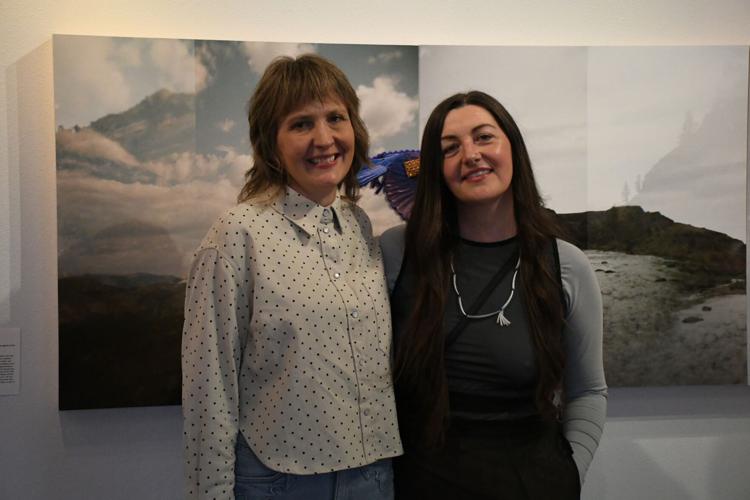
When Hopkins started Carnation Contemporary, a co-op gallery in Portland designed for underrepresented and emerging artists, Couch became a member. The two bonded over their artistic overlaps, specifically their attention to identity, and what it means to belong in or pass through a place. “Belonging Otherwise” was born from that bond.
The gallery features a plethora of selected works from both artists, ranging across different creative media, including photography, sculpture, film, collage, and beadwork.
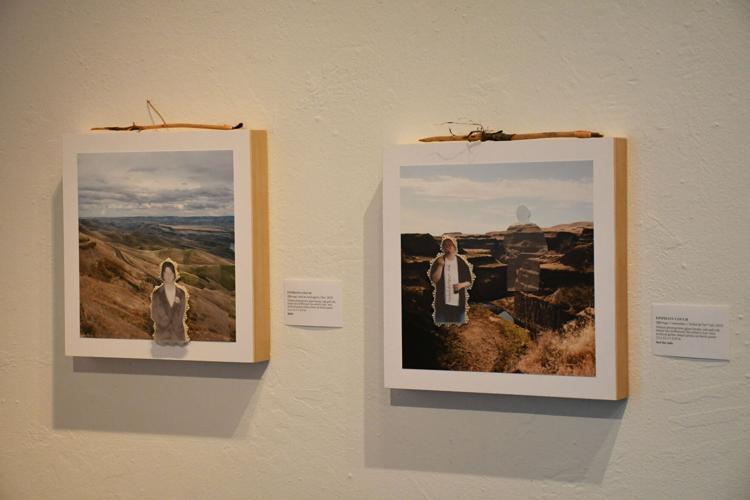
Couch’s double-exposure works, a technique that overlays an unadvanced frame with a second capture, splice gorgeous landscapes with portraits. “It feels like I’m collaborating with the natural world,” she said.
Couch's "Offerings."
Blending photography and collage, Couch’s series “Offerings” depicts people in her life who have passed away against scenic backdrops, confronting how we consider what one gives us after they’re physically gone. “The land is a huge part of that for me,” Couch said. “The earth can teach us a lot, just like someone’s memory.”
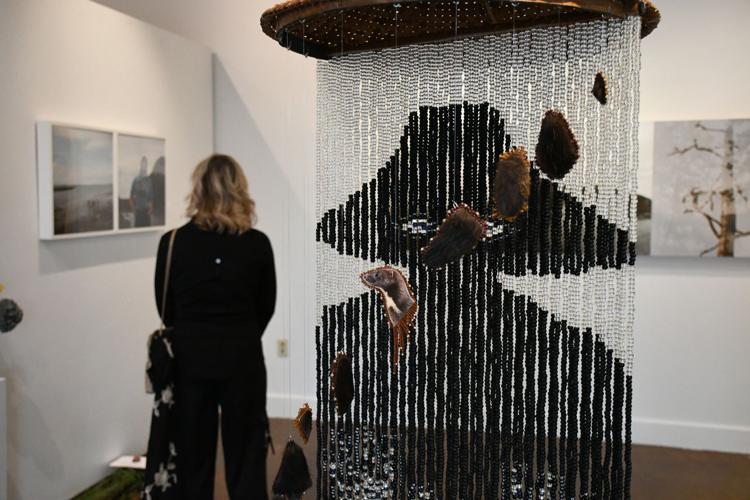
A gallery centerpiece, Couch’s collaborative beadwork project, made alongside her family members, explores the Coastal Salish creation story of Mink.
Couch's collaborative beadwork project draws on the Coastal Salish story of Mink.
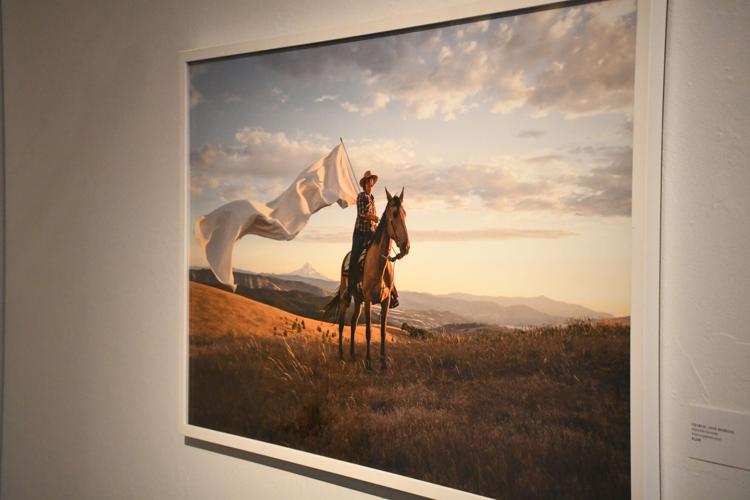
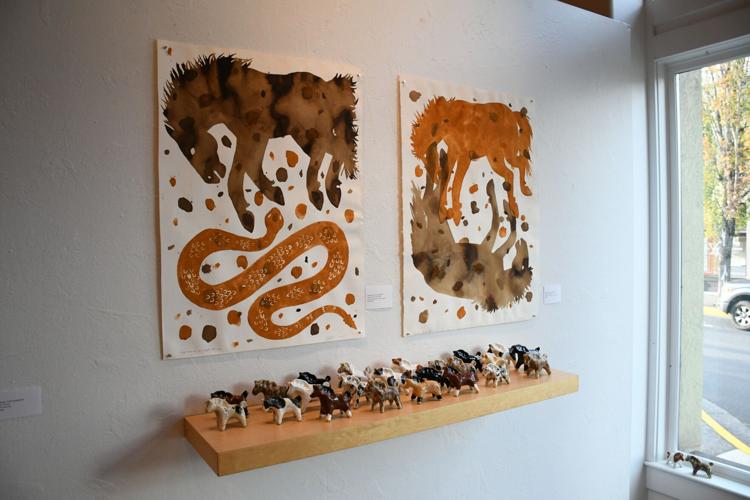
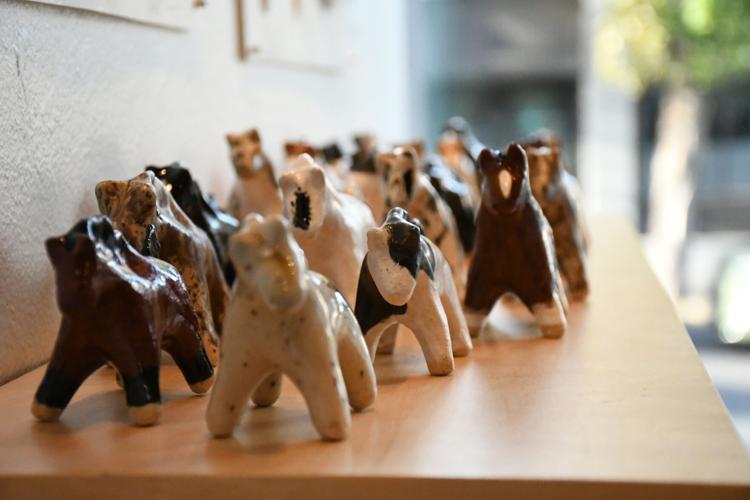
Hopkins’ sculpture work includes “One Hand Horses,” a collection of small horse figures that shift the animal from “an icon of conquest, dominance, and freedom, into something intimate, vulnerable, and held,” according to a plaque.
Hopkins' "One Hand Horses."
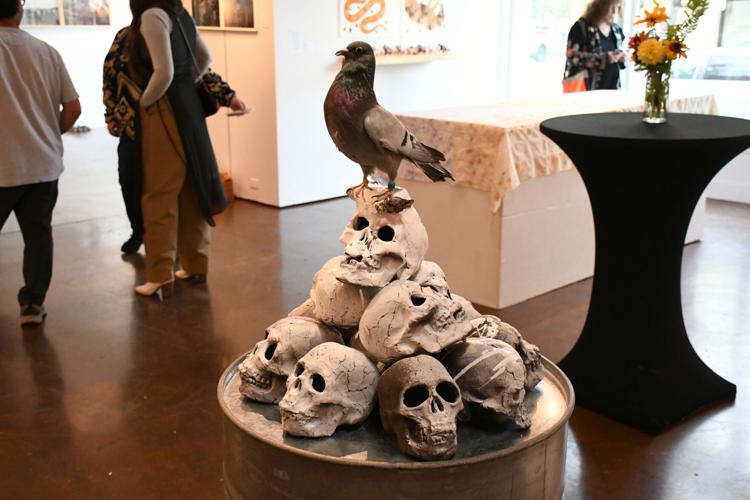
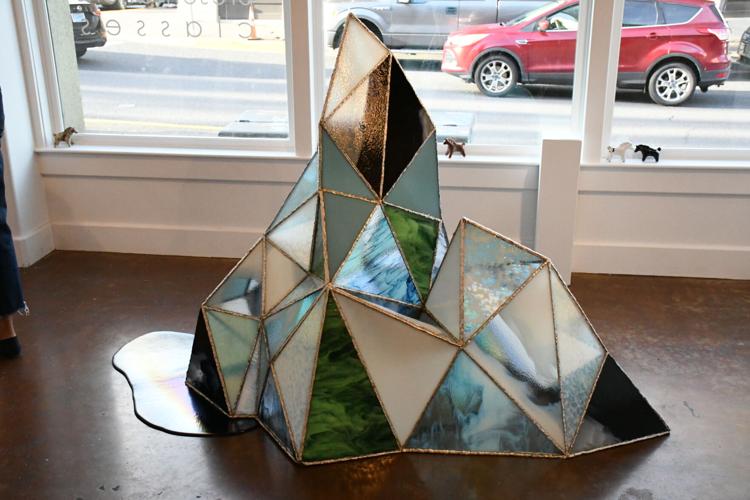
Also featured are a glass piece resembling an iceberg melting, archival pigment prints, and textile work. Hopkins’ “Homeland” was made over the course of several seasons foraging wildflowers in the Lyle area and using them to dye an American flag; encompassing a flag the same size as one they were given for their father’s burial site, draped over a table, the piece resembles a coffin.
Melting iceberg sculpture by Hopkins.
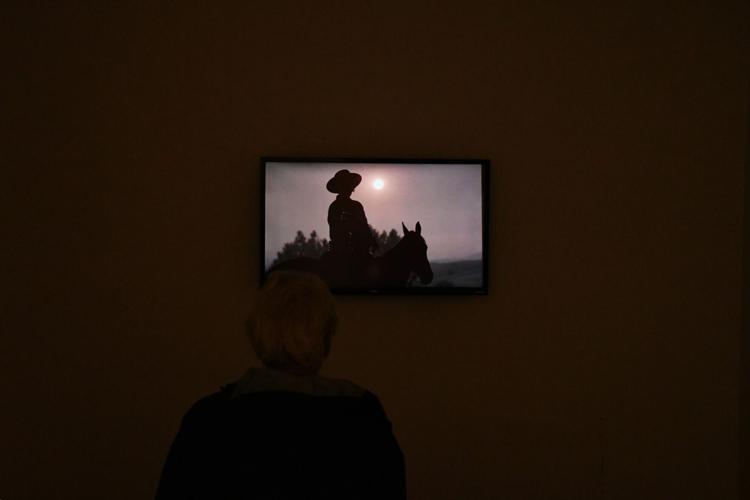
Finally, a short film playing on a television in the gallery’s back corner displays a 25-year-old hay barn with an active wildfire raging outside. The piece calls on Hopkins’ experience evacuating from the Burdoin Fire last year.
A viewer watched Hopkins' film.
After viewing the exhibit, Hopkins hopes viewers “contemplate their own relationship with place and the spaces they inhabit.”
“I’m hopeful that it will get people asking questions about what they believe,” Couch added. “Maybe encourage a new perspective on what they think.”
Columbia River in VI Sections
A Pacific Northwest native, Strasen grew up in the Olympia area before launching a successful, 30-year career as a textile designer and colorist in New York.
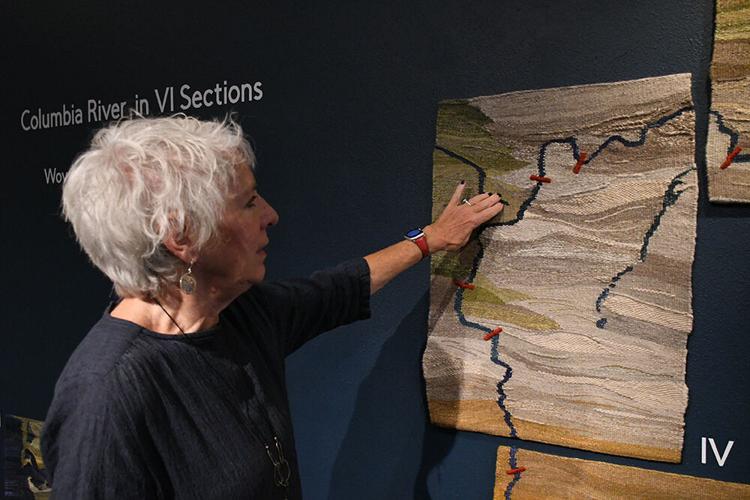
Kristie Strasen points to a section of her fragmented woven tapestry, “Columbia River in VI sections.” Sean Avery photo.
Her eventual return to the region stemmed from a desire to re-immerse herself in the world of weaving — her medium of choice in grad school. “The thing that I discovered moving back here is how much the environment has influenced my whole life,” Strasen said. “I realized I wanted my pieces to tell a story, not art for art’s sake, but to hopefully communicate a message.”
With “Columbia River in VI Sections,” Strasen expresses her passion for Native American history, aiming to artistically illuminate the displacement and attempted cultural erosion of indigenous communities at the hands of the federal government.
In reading about the many hydropower dams constructed along the Columbia — a river she holds tight to her heart — Strasen felt obligated to weave a piece depicting the waterway’s entirety, from its mouth to its source in British Columbia.
All federal dams along the river, including the Bonneville, John Day, and Grand Coulee, were built on sites where Native Americans had lived for thousands of years, flooding villages, sacred fishing sites, and ancestral burial grounds while disrupting salmon migration. “These are marvels of engineering, but they could have been built in other places,” she said.
In June 2024, the U.S. Department of the Interior issued a “Tribal Circumstances Analysis,” which documented in detail the historic, ongoing, and cumulative impact of dams on Columbia Basin tribes. The report was a first step in acknowledging the damage done and exploring ways to mitigate the harm caused. However, a year later, President Trump signed a memorandum, forgoing all funding — a $1 billion agreement — designated for reparations. The withdrawal came during Strasen’s eight-month weaving process, strengthening motivation to drive home a plea for acknowledgment.
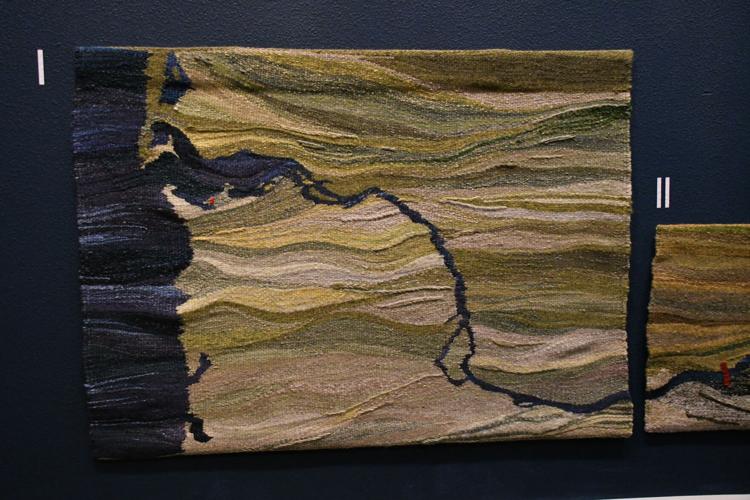
The wall-spanning tapestry, comprising six fragments of the Columbia’s path, gorgeously transitions in color, flowing through dark greens in the region’s forested west and rich browns of its arid east. No landmarks are included intentionally to accentuate the dams, which are depicted in bright red.
Section 1 of "Columbia River in VI Sections."
“I hope people recognize how important the river is,” Strasen said. “What’s done is done. But we can at least acknowledge it and not do it again.”
CCA is located at 215 Cascade Ave. For more information on “Belonging Otherwise” and “Columbia in VI Section,” visit columbiaarts.org.



Commented