

By Sean Avery
Columbia Gorge News
HOOD RIVER — How did the Columbia River Gorge — a wind-swept region known for pears and water sports — evolve into a hotspot for unmanned aerial vehicles (UAVs), commonly known as drones? Jason Hartman, project manager of the Gorge Tech Alliance (GTA), has the answers.
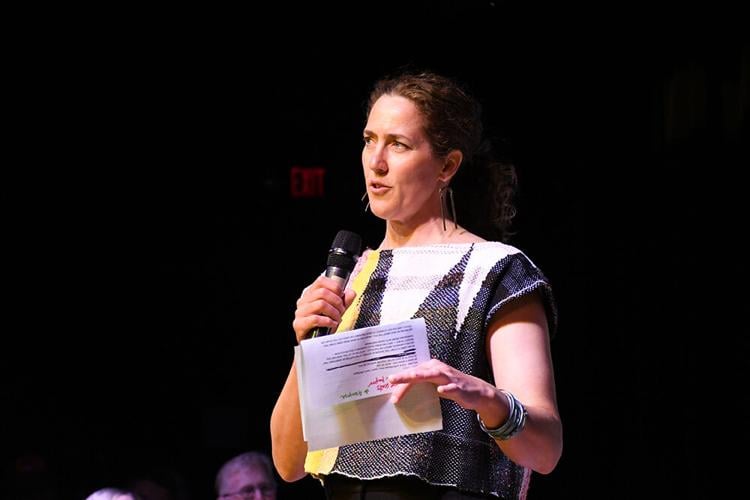
Hartman traced the exploding industry’s timeline, from its coincidental beginnings to its fast-approaching future, at Columbia Center of the Arts on Oct. 14 — the first lecture of Sense of Place Season 17, hosted and curated by Sarah Fox.
A Gorge resident for the last 25 years, Hartman has spent a decade working in the drone industry, also serving as a city councilor in White Salmon for eight years. He currently works for the Mid-Columbia Economic Development District (MCEDD) in industry engagement, simultaneously managing GTA, a nonprofit that helps support tech businesses throughout the region.
The UAV industry’s path to the Gorge began in 1992, when aeronautical engineer Tad McGeer co-authored a paper in the Bulletin of the American Meteorological Society. The piece proposed a small autonomous aircraft called Aerosonde, which could collect atmospheric data over the ocean, measuring conditions such as air pressure, temperature, and wind. Critical for forecasting weather, the technology posed a cheaper alternative to weather balloons.
In 1994, McGeer co-founded Insitu in California, alongside fellow engineer Andy von Flotow, who later relocated to the Gorge to pursue windsurfing and started Hood Technology Corporation. Von Flotow would convince McGeer and other aeronautics engineers to follow suit, thereby resettling Insitu in the area and launching the local scene, which presently encompasses around 30 companies and 1,200 employees.
Coincidentally, the region already possessed experts in carbon fiber and advanced composites, used to make windsurfing equipment and UAVs. Thus, the two industries cooperated well, with established individuals able to help engineers iterate on their designs.
In 1998, the Aerosonde idea finally materialized: Insitu’s small, 13kg autonomous aircraft called Laima, flying a route stored in its memory, flew for nearly 27 hours from Newfoundland to Scotland, using four kilograms of fuel.
Thought up inside a Hood River Valley home and flight-tested from a private airstrip in White Salmon Valley, the aircraft proved UAVs’ potential for long-range missions. “The industry was built on people who were willing to try and try, fail, and try again,” Hartman said.
The technology evolved past just weather forecasting, later used to spot schools of tuna. After 9/11, however, everything shifted: the Department of Defense needed what Insitu was building — a lightweight, long-endurance aircraft that had full motion video. And in 2008, Boeing purchased the company, placing it on the global aerospace and defense map.
“The modern era of Gorge unmanned aerial systems was born,” Hartman said.
The majority of funding and sales for local manufacturers come from military customers, the core use being intelligence, surveillance, and reconnaissance, observing ships, bases, borders, and shorelines. The Coast Guard, for example, uses Insitu aircrafts to find and inundate drug smugglers. A Bingen-built drone (ScanEagle) was even used to plan and practice the rescue of Captain Phillips. “Gorge companies have a worldwide footprint,” Hartman said. “And their products are considered gold standard.”
While the region does not specialize in consumer products — the quadcopters one imagines when they hear the word drone — there are civilian uses of the technology. Wildfire mapping, for example, is a fast-growing market. They’re also used for pollution abatement, mapping oil spills, and search-and-rescue.
Gorge-based companies have also advanced or developed several key technologies — “the eyes and brains of the drones,” Hartman said — including launch and recovery systems like Insitu’s patented SkyHook; transponder tech like CloudCap’s Piccolo Autopilot; and other imaging and sensing systems.
In August of this year, Archer Aviation purchased Insitu from Boeing, as many local companies have been acquired or merged with non-local companies over the last several years. Hartman noted that while these acquisitions bring capital and help the companies grow, many decisions will now be made outside of the Gorge, a region that poses workforces shortages, steep housing and industrial space costs, and regulatory hurdles.
Continued growth is predicted within the industry, which is considered larger than both agriculture and tourism in the region in terms of revenue (though not all the money lands back in the area). Air taxis may appear within the next 10 years, but are likely to be extremely expensive and niche.
Hartman concluded with several questions: “What’s the next opportunity? What’s the next convergence? How do we make sure that it happens here in the Gorge?” he asked. “Anyway, we want to be here for it.”


Commented