
By Nathan Wilson
Columbia Gorge News
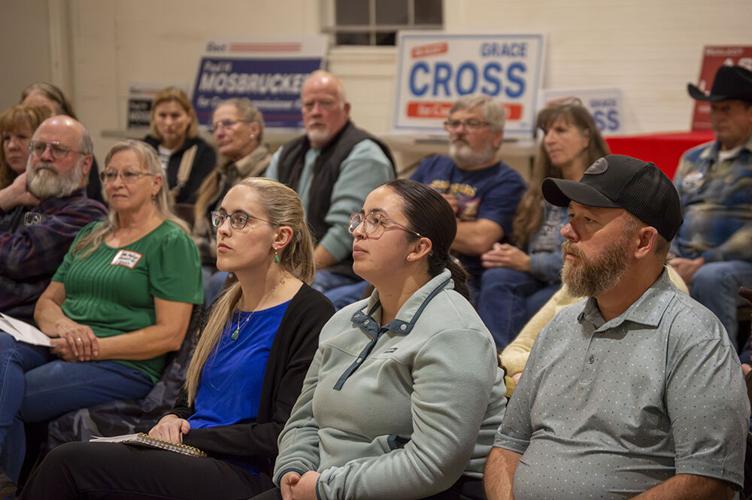
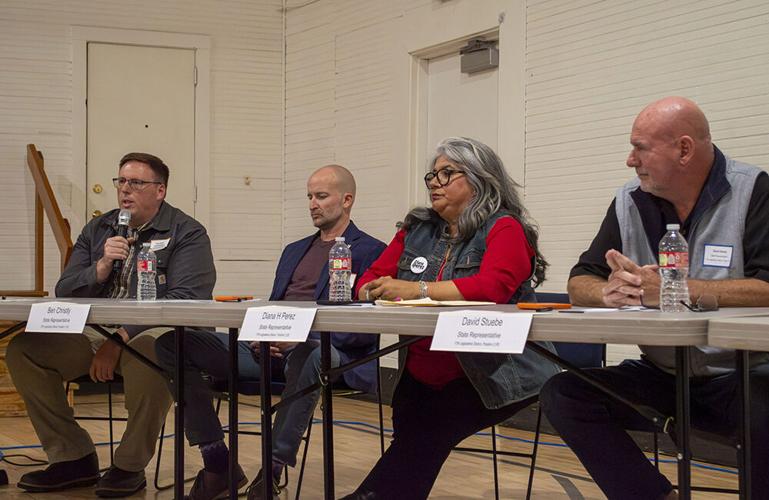
SKAMANIA CO. — As ballots start arriving in mailboxes for the upcoming general election, 14 candidates across 10 county and state races took questions from local residents at the Underwood Community Center on Friday, Oct. 9.
Below are responses, which have been edited for length and clarity, from the candidates for Washington’s 17th Legislative District, positions 1 and 2. To watch a recording of the entire forum, visit Columbia Gorge News on Facebook, and read responses from candidates for Skamania County Commissioner District 3 on columbiagorgenews.com
17th Legislative District, Position 1
Incumbent Rep. Kevin Waters (R), who is a fourth-generation Skamania County resident, entrepreneur, and the county’s economic development manager, is looking to secure his third term in Washington’s House this November. In his opening statement, Waters emphasized the funding he’s brought back from Olympia, including for the Hood River-White Salmon Bridge, White Salmon Valley Pool, Skyline Health and resilience upgrades after Underwood’s Tunnel 5 Fire.
His opponent is Democrat Ben Christly, a Navy veteran, flight nurse, small business founder and youth football coach who serves on the Clark County Charter Review Commission. Christly encouraged listeners to vote for someone who will be in the majority, because he wants everyone to be successful, regardless of party.
Q: Do you support vote by mail?
WATERS: I do support vote by mail. You might hear that I signed onto a bill that got rid of vote by mail, but the issue is that we need to expand voting areas. Bonds and levies have been failing for our schools and firehouses, especially in the Southwest Washington area, and so I tried to come up with a hybrid attempt to expand that.
CHRISTLY: I support vote by mail, and in case anybody missed it, Waters co-sponsored ending vote by mail. I don’t agree with that, and the reason why bonds and levies are failing is because people are struggling more than ever just to pay their own bills. In Olympia, we have to do a better job of prioritizing what is important to the state.
Q: How will you get Olympia to listen to Skamania County’s need regarding infrastructure concerns, particularly our bridges?
CHRISTLY: It’s clear that we have a lot of issues with these bridges down here. I don’t know what Olympia is waiting on. Are they waiting until the bridge falls down? That’s certainly not what I’m going to wait on. I know Waters and Stuebe were showing the chair of the Transportation Committee around recently, and if I win, he’s going to hear from me every day. I won’t quit fighting until we get these bridges replaced because we need them.
WATERS: We did have the chair of the Transportation Committee down. Right now, it’s taken a lot of bandwidth, and when you ask for a project, they’ll say, “Well, you’re getting the Hood River Bridge.” We also have the Bridge of the Gods and the Cape Point Bridge, which is not set up in the Washington Department of Transportation’s 20-year plan. That means people will die if that bridge fails, and it’s not acceptable.
Q: Parking and sanitation at Drano Lake and some of the areas to the west are unsafe, especially during peak fishing season. What can be done to rectify these conditions?
WATERS: I actually have the legislative director of Washington’s Recreation and Conservation Office (RCO) coming out next week to look at Drano Lake because we do have a number of issues. This is a really complicated thing — it involves the Department of Fish and Wildlife, the county and RCO. The parking is terrible, and we’re looking at that, but let’s talk about something else: fishery cuts. We’ve seen a number of fishery cuts across the state, and it’s driving all the commercial folks, all the guides, down here to come and only fish here.
CHRISTLY: I think Waters hit on a really important issue when we’re talking about the Department of Fish and Wildlife. We’ve seen not only the taking away of some of that recreation, but the costs to go out and enjoy recreating rise as well. I’d like to take a look at that, especially for folks who are residents of the county. I’d like to make sure that we have a Discover Pass that isn’t cost-prohibitive for people to get out and enjoy their backyard.
17th Legislative District, Position 2
Like Waters, Rep. David Stuebe (R) is seeking reelection, but for his second term. A Marine veteran and former mayor of Washougal, Stuebe stressed that all the issues topping his priority list — housing, healthcare, childcare, infrastructure — circle back to affordability and money not being spent properly. “I’m trying to keep Seattle politics out of Southwest Washington,” Stuebe said during his introduction.
Diana Perez (D) is a career civil servant who spent 35 years with the United States Forest Service as a wildland firefighter, fisheries biologist and public lands manager. She currently serves on Washington’s Housing and Finance Commission and Vancouver’s City Council. “I’m going to focus on the fundamentals of affordability, reliable infrastructure, public safety and an economy that works for everyone,” Perez said.
Q: What is your position on women’s healthcare, including women’s right to choose?
PEREZ: That’s an easy answer for me. I believe women should have the only decision-making authority over their bodies, and I am a full women’s rights supporter. They can love who they want, plain and simple.
STUEBE: As a father with two daughters, I agree with all of that. It should be that way.
Q: What’s your current relationship working with tribal entities, whether they are federally recognized or not?
STUEBE: I don’t have that much of a relationship with the tribes from the things I’m working on, which is mostly transportation and a lot of healthcare. Being up in Olympia for only two years with the committees I’m serving on, my focus is on building these roads and bridges.
PEREZ: I love working with tribal entities. I have experience in government-to-government consultation. I have worked on stewardship contracts when I worked up in Alaska. As a fish biologist, I worked with tribal fish biologists to plan and implement salmon recovery projects. I am looking forward to working with the tribes here. Tribal sovereignty is really important to me, and that’s a value I will carry forward.
Q: Parking and sanitation at Drano Lake and some of the areas to the west are unsafe, especially during peak fishing season. What can be done to rectify these conditions?
PEREZ: First, I would request some capital planning to address the parking issues and the broader impact on water quality in the area, alongside vehicle damage. Second, I think a seasonal sanitation program could be beneficial if it’s cost-effective, and third would be seeing what else we can do to sustain the area so that we aren’t addressing these problems long term.
STUEBE: It’s a zoo up there — it’s not even fun. You just have 80 boats going in a circle trying to catch fish, and there aren’t fish. They’ve closed a lot of hatcheries and are trying to save money. They’ve raised the ramp fees, the parking fees and the cost of a fishing license, and it’s making it really hard for the guides. This state brings in over $2 billion from our recreational fishing; if they’re closing hatcheries, what’s our return on investment? It’s a bad thing to close hatcheries.


Commented