
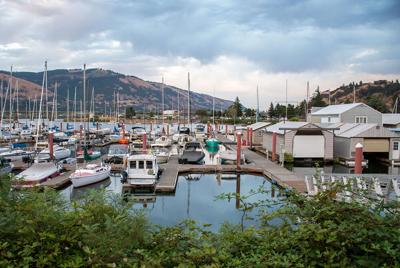
HOOD RIVER — The Port of Hood River hopes to proceed this winter with long-planned removal of nine privately-owned boathouses in the Hood River Marina.
Port commissioners’ decision last month to issue a request for proposals (RFP) for boathouse removal could close the chapter on a four-year-old policy move. In 2022, previous commissioners decided private boathouses were not appropriate for a public marina, directing that the five-year, rolling leases not be renewed. Those leases expire at the end of this year.
There were also concerns over potential liability, insurance coverage and pollution risk, explained Kevin Greenwood, the port’s executive director.
Megan Channell, the port’s capital development and planning director, presented the issue to commissioners Aug. 18 and received permission to issue the RFP. This is not a formal invitation to bid, since the port has yet to identify the most cost-effective way of fulfilling the earlier policy decision, Greenwood noted. Instead, the RFP invites contractors to offer prospective solutions.
The RFP “will allow the port to consider both cost and the proposer’s approach to safely and efficiently complete the work,” Channell wrote in her staff memo. Nine of 10 boathouses would be removed. The 10th, housing a sheriff’s vessel, will remain.
The RFP was published in Columbia Gorge News as a legal notice on Aug. 26, with proposals due Sept. 18.
The boathouses are owned by private individuals who lease port moorage space. Combined lease revenue last fiscal year was $40,000, which also covers utilities.
While the leases call for removal at owners’ expense, final assignment of costs has not yet been clearly established.
“We are looking at what it would cost for them to be removed,” Greenwood said. “This is an exploratory process.” If a cost-effective solution is identified, the project could start in January with completion by March 3. Port commissioners will review status at their October and November meetings, with a contract award possible in November.
Port operations
Hood River Marina operations are emblematic of a larger challenge facing the port, as the port balances its dual roles in economic development and public recreation. Marina operations essentially break even for the port, with an audited negative ending balance of $50,000 in 2025-26. (That’s much better than the anticipated budgeted loss of $505,000. The port expects to further trim the marina deficit in 2027.)
The greater challenge is loss of toll revenues. Historically, the port allocated 50 cents from every toll to non-bridge related uses in the general fund. That generated $2 million in 2026. But the general fund subsidy stopped July 1, when all toll revenues became dedicated to bridge maintenance, repairs and ultimate replacement.
The port must now make up the difference.
The challenge was highlighted at the Aug. 18 meeting, when port commissioners received a status report on the port’s strategic business plan update. Oregon law mandates periodic business plan revisions for all port districts.
Points Consulting, based in Moscow, Idaho, was retained this past spring to update the business plan, including a summer-long public survey to learn what people expect of the port. The results show keen public interest in waterfront recreation and public facilities, with less enthusiasm for commercial property development, the airport, and economic development in general. Yet the port hopes that commercial properties, such as Big 7, other for-mer industrial properties downtown, and the airport, will drive future revenue. Waterfront recreation, albeit popular with the public, loses money.
While the port is a taxing district, annual tax revenues are only about $100,000 a year. That’s a small fraction of revenue needed to cover about $4.6 million in total operational costs (general and bridge funds combined). With the marina at break-even, that means the port must rely primarily upon commercial property and airport leases to cover expenses.
“If we’re going to keep these world-class waterfront facilities operating and potentially becoming better by investing in them, it’s going to be those real estate assets that help fund that activity, in addition to other economic development opportunities like cleaning up property and finding dilapidated property similar to what we did at Lower Mill,” Greenwood said, referring to the port’s recent $3,251,000 sale of the former Hanel site at Odell to Dominguez Family Enterprises. That sale follows years of clean-up to make the former industrial property suitable for redevelopment.
“The point being that with tolls no longer available, it’s going to mean looking at our commercial assets in a way where positive net income can benefit a whole list of economic development opportunities, including waterfront recreation,” Greenwood said.
One such prospect was also on the Aug. 18 agenda, as port commissioners approved an exclusive negotiating agreement (ENA) with CMLK Development Corporation for long-term redevelopment of the Marina East and Marina West parcels, where two aging structures are currently occupied by Oregon DMV and an acupuncture clinic.
Given their proximity to bridge traffic and the marina itself, the port hopes to sell the Marina East and Marina West parcels, although timing will hinge upon Hood River Bridge replacement. Anticipated to begin as early as October 2027, replacement will significantly alter nearby traffic flow as the new bridge’s south terminus displaces the port’s administrative and facility buildings as well as the toll booth itself.
CMLK is locally-based, and submitted preliminary concepts to the port earlier this year. The ENA establishes a six-month negotiation period to conclude in February, including required public engagement. Eventual development agreements will be subject to later approval by the port commission.


Commented
Sorry, there are no recent results for popular commented articles.