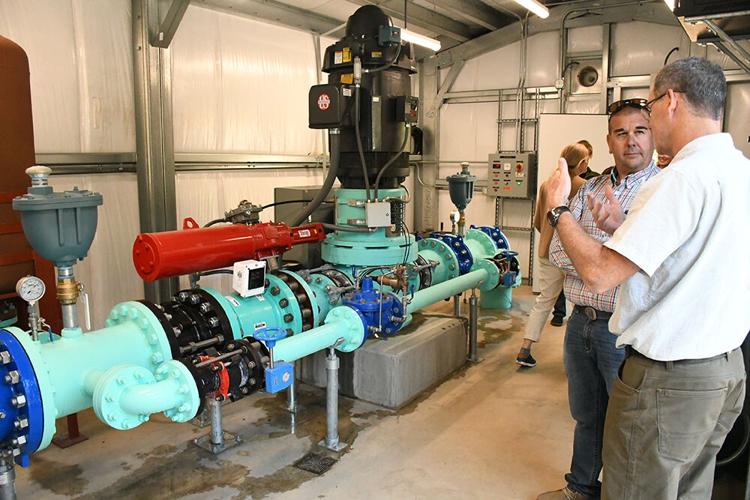
Hood River Public Works Director Adam Schmid talks with Energy Trust of Oregon Program Manager Dave Moldal at the Dee Hydro ribbon-cutting on Aug. 27. Sean Avery photo.
Hood River Public Works Director Adam Schmid talks with Energy Trust of Oregon Program Manager Dave Moldal at the Dee Hydro ribbon-cutting on Aug. 27. Sean Avery photo.
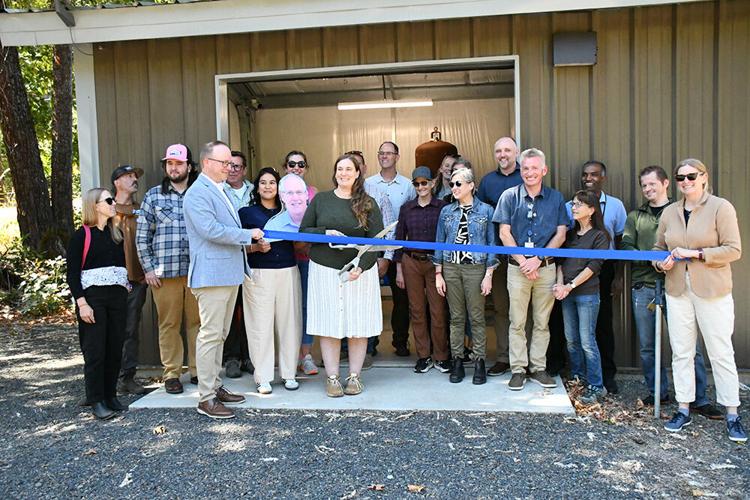
DEE — City leaders and staff gathered 11 miles south of Hood River on Aug. 27 for a ribbon-cutting seven years in the making, unveiling the Dee Hydro in-line renewable energy project.
The installation, which appears above ground as a large, colorful pipe and turbine, taps an existing pressurized municipal pipeline and makes the water multifunctional, capturing energy that would otherwise be wasted in the system while continuing distribution of high-quality drinking water. The future-forward project is set to generate roughly 16 million kilowatt-hours of electricity over its first 30 years.
“Dee Hydro demonstrates that sustainability and good municipal stewardship can go hand-in-hand to reduce emissions, increase resilience, and save money for our ratepayers all at the same time,” said Hood River City Manager Abigail Elder.
The project began in 2019, a year after the city adopted the Hood River County Energy Plan (HRCEP): a community-driven blueprint aiming to generate 50% of the county’s energy needs from local diversified sources by 2050.
HRCEP has lead to several projects, including solar power installations on the fire station and wastewater treatment plant. According to Elder, Dee Hydro has been the city’s most challenging and high-profile endeavor yet — a textbook example of putting the initiative into action, which specifically identifies in-conduit hydropower as a strategy.
City leaders, staff, and partners officially unveil the Dee Hydro renewable energy project. Sean Avery photo
The planning stage began when Hood River Public Works Director Adam Schmid stood above the city’s pressurized pipeline, brainstorming a way to capture that energy and convert it into electricity.
The Energy Trust of Oregon (ETO) signed on early, funding a feasibility study. Two potential sites were identified; the Dee location emerged due to its proximity to existing electrical infrastructure and high water pressure.
The project moved into grant-development and funding mode. Through the Oregon Department of Energy’s (ODE) Community Renewable Energy Grant Program, which launched in 2022, the city secured $500,000 to greenlight construction. ODE Energy Development Services Assistant Director Pandian Krishnaswamy explained that Dee Hydro is the first project in program history that implements in-line hydropower at a pressure-reducing station, adding, “We hope to see this project throughout Oregon.”
Even with funding in place, however, the project required navigating a private property easement, water rights approvals, pressure surge analysis, electrical interconnection, and a host of other technical and regulatory details.
“It’s a good reminder that innovative municipal projects rarely happen in a straight line,” Schmid said. “They require persistence, good partners, and a willingness to keep looking for a path forward when the first path doesn’t work. We hope our success can be a model for other small and rural communities to look at their current infrastructure and see what might be possible.”
Hood River City Council President Gladys Rivera said the project puts the city in a position where it can meet long-term energy and water demands that justify the council’s investment, clearing pathways for more innovative opportunities down the road. Dee Hydro is currently projected at a 15-year payback horizon, but since the system is producing more power than initially anticipated, the city is hopeful for a shorter window.
“We have to think about the future always,” Rivera said. “This will be here for a very long time.”
In-depth project description
A 24-inch transmission main brings high-pressure water (300 psi) down from a spring. Normally, pressure-reducing valves in the street drop that pressure to about 117 psi for delivery to town, essentially “burning off” the excess energy as heat and turbulence.
With Dee Hydro, instead of letting the valves do all the work, the high-pressure water is routed into a small building, where it passes through a Y-strainer that protects the equipment from any debris.
From there, the flow is controlled by hydraulic components and directed through wicket gates inside the turbine; by turning and “cupping” the water, these gates slow it down and use the pressure drop to spin the turbine.
That turbine works as a motor being driven in reverse by moving water. As the water drives the turbine, the mechanical energy is converted into electricity, which is then fed back to the grid using three-phase power infrastructure already available at the site.
After passing through the turbine, the water exits at a lower pressure and returns to the downstream side of the pressure-reducing valves, still serving the town’s needs.
The system is designed to handle a range of flows (roughly 800-3,000 gallons per minute) to accommodate a large 5-million-gallon reservoir that is constantly filling and draining to allow for future growth in water demand. Simply put, the project turns a necessary pressure-reduction step in the water system into a source of renewable energy.




Commented