
The crypto industry has just suffered a paradoxical defeat: Its biggest backer, President Donald Trump, inadvertently helped scuttle chances for a major legislative win thanks to revelations of the riches he and his family have made off of their crypto ventures.
The industry is now scrambling to advance its agenda through crypto-friendly regulation instead of legislation. But the prospect of Democratic control of one or both chambers of Congress after the November 2026 midterm elections, as well as potentially winning the White House in 2028, leaves the long-term durability of those gains uncertain.
At stake was legislation that would have provided light-touch regulation over crypto assets. The industry, which had enjoyed a series of wins since Trump started his second term, had secured bipartisan support for the measure, dubbed the Clarity Act, and poured hundreds of millions into lobbying.
But the steady drip of news in the spring and summer of 2026 about the Trump family’s lucrative crypto businesses ultimately undermined those efforts. Democratic support in the Senate faltered, and after several attempts at a compromise, the bill died on a procedural vote on Sept. 15, 2026, falling short of the required 60-vote majority.
As a scholar of financial regulation, I believe the growing backlash against Trump’s conflicts of interest surrounding his crypto wealth changed the political calculus. The Senate Democrats who had initially supported the measure increasingly feared they would be seen as voting to further enrich Trump. While the final bill contained some ethics provisions, they didn’t suffice to keep those Democrats on board.
This outcome leaves the industry in limbo and unsure of how to spend its considerable campaign war chest ahead of the midterms. If it decides to invest heavily to defeat crypto-skeptical Democrats, I believe it could risk a backlash should Democrats retake the House, the Senate, or both.
Under that scenario, Democrats could launch congressional investigations or introduce legislation to impose stringent oversight over the industry. Furthermore, if voters see the industry as overly partisan, that perception could further erode trust in a sector that has desperately tried to repair its image since the collapse of crypto exchange FTX in 2022.
Crypto interests seize an opening
The Clarity Act was designed to answer a long-standing question: Should crypto assets be regulated as securities, like stocks, or commodities, like gold?
Companies that sell securities face more scrutiny, as they’re required to register with the Securities and Exchange Commission and disclose detailed information to investors. But commodity trading follows looser rules. There’s another agency, the Commodity Futures Trading Commission, that oversees markets for commodity derivatives. But it doesn’t supervise the markets where people buy and sell commodities directly, known as “spot” markets.
Under President Joe Biden, SEC Chairman Gary Gensler took a stringent approach. He treated most crypto tokens as securities and brought dozens of enforcement cases against crypto issuers and exchanges. Many of those cases involved charges of fraud or unregistered offering of securities.
The industry fought back, arguing that many tokens were decentralized, meaning that no single company controlled them. The implication, in turn, was that there was no one who could make the required disclosures to regulators.
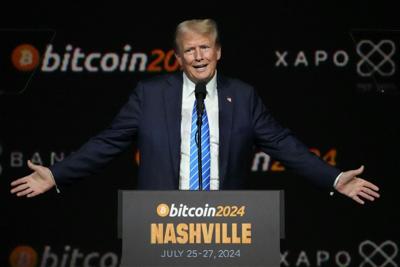
The industry saw a major opening with the 2024 election, prompting hopes of a more crypto-friendly administration and Congress. It spent unprecedented sums – over US$119 million – to back pro-crypto candidates in both parties. Trump also sensed an opportunity, reversing earlier criticism. At one bitcoin conference, he told the crowd that he would fire Gensler “on day one” of his administration and make the United States “the crypto capital of the planet.”
But Trump’s victory didn’t end the industry’s political spending. The crypto exchange Coinbase sponsored the U.S. Army’s 250th anniversary parade and joined several other crypto companies and executives in donating funds to the White House ballroom.
That lobbying blitz secured some immediate wins for the industry. In July 2025, Trump signed the GENIUS Act, establishing a federal regulatory framework for stablecoins – digital tokens designed to hold a steady value of one dollar and backed by liquid reserves like Treasury bills.
Revelations of riches
The biggest prize for the crypto industry was the prospect of legislation that would permanently impose light-touch regulation over crypto trading. That framework, in my view, would also have legalized a business model laden with conflicts of interest.
The Clarity Act was the vehicle for this push. It would have permanently placed most crypto trading under the Commodity Futures Trading Commission and no longer treat most tokens as securities. This means investors in cryptocurrencies wouldn’t have had the same rights and protections that exist in securities markets.
At first, the bill’s prospects looked good. In the summer of 2025, the House of Representatives passed its version 294-134, with 78 Democrats, including former Speaker Nancy Pelosi, voting in favor.
The bill’s chances in the Senate, while less certain, still seemed likely at that point, with multiple Senate Democrats expressing support. But just before the Senate Banking Committee was set to vote on its draft in January 2026, Coinbase CEO Brian Armstrong posted on the social media platform X that his company wouldn’t support the measure.

Coming from the chief of the largest U.S. crypto exchange, that opposition would have doomed the bill. That unexpected wrinkle forced a postponement of the vote, followed by more rounds of revisions.
The panel finally approved the rewrite in May, but the delay proved costly. In those intervening months, new reports shed light on the Trump family’s crypto businesses, including World Liberty Financial and its stablecoin USD1, the $TRUMP memecoin and a bitcoin mining company, among others.
Then came Trump’s own financial disclosures in June, which reported more than $1.4 billion in crypto-related income for 2025. Separately, a Reuters investigation put the Trump family’s take from four crypto ventures at about $2.3 billion since the 2024 election.
Headwinds from banks
The growing backlash against Trump’s crypto conflicts quickly changed the political calculus. Once-supportive Senate Democrats insisted that the final bill contain ethics provisions barring the president and other government officials from profiting off crypto while in office.
The new draft required officials to either sell significant crypto interests or place them in a qualified blind trust. It also barred them from issuing cryptocurrencies while in office. But those protections fell short of Senate Democratic demands, in part because Trump’s sons would be excluded from those requirements.
Meanwhile, the crypto lobby also ran into strong opposition from banks. At issue was the fact that the crypto exchanges were paying customers interest, or what they called “rewards,” on their stablecoin balances. That loophole came through the GENIUS Act, which prohibits stablecoin issuers from paying interest to stablecoin holders but doesn’t expressly extend that prohibition to crypto exchanges. That’s why Coinbase offers rewards on customers’ stablecoin balances and receives a share of the reserve income from stablecoin issuer Circle.
Banks wanted Congress to close this loophole, fearing customers would move savings into stablecoins in search of higher yields and leave banks with less deposit funding. In response, the final text of the Clarity Act included a compromise, letting the Treasury Department restrict stablecoin rewards – but only if significant deposit flight had already occurred. Banking groups vehemently rejected that language.
In the end, the compromise on ethics language failed to win over any Democrats, while the opposition from banks prompted an additional defection of three Republicans, dooming the bill.
This article is republished from The Conversation, a nonprofit, independent news organization bringing you facts and trustworthy analysis to help you make sense of our complex world. It was written by: Lee Reiners, Duke University
Read more:
Lee Reiners does not work for, consult, own shares in or receive funding from any company or organization that would benefit from this article, and has disclosed no relevant affiliations beyond their academic appointment.


Commented