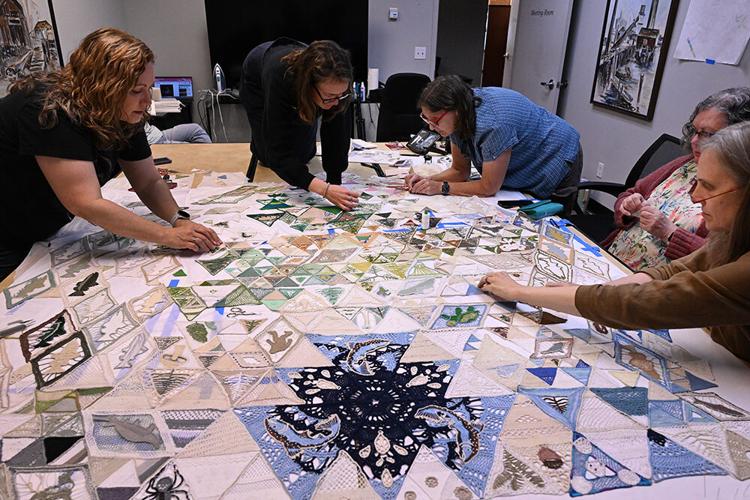
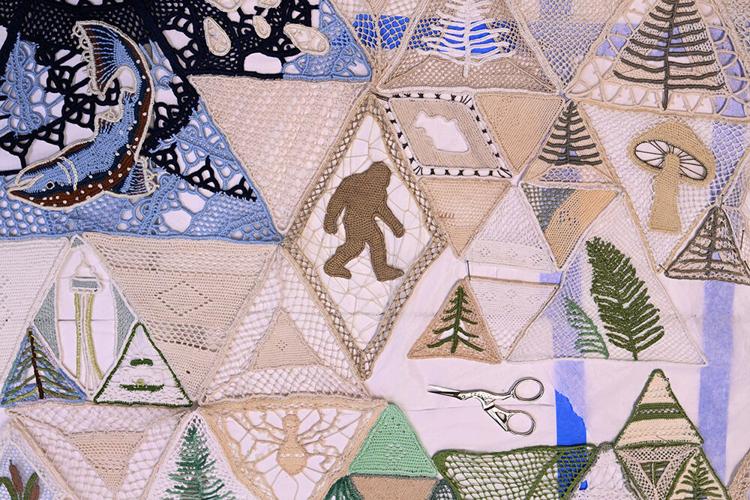
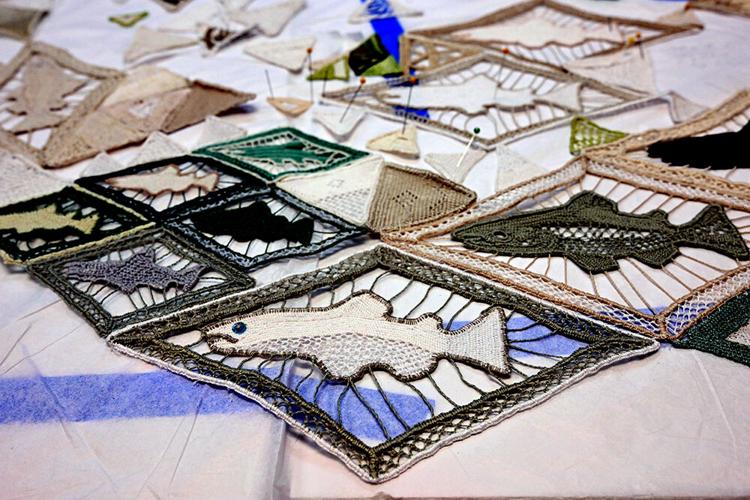
“A Sense of Place” reflects iconography of the Pacific Northwest, including the area’s staple salmon and, of course, Bigfoot. Helen H. Richardson photos
“A Sense of Place” reflects iconography of the Pacific Northwest, including the area’s staple salmon and, of course, Bigfoot. Helen H. Richardson photos
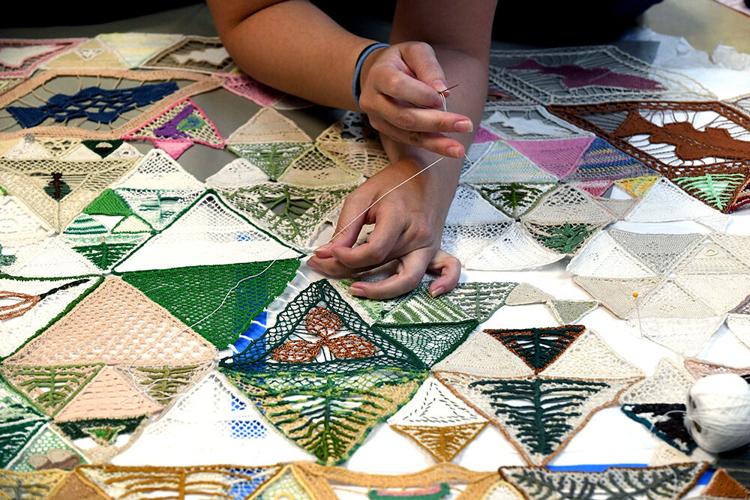
STEVENSON — A group of women chat amongst themselves, circling a tapestry of lace designs. They each tend to their own designated triangles, weaving them into the collection one at a time.
What they are piecing together is a display of hundreds of lace art pieces submitted from around the world, in celebration of the Pacific Northwest.
The Lacing Communities Together project presented its final piece on Sept. 11 at the Columbia Gorge Museum, unveiling more than 540 individual triangles of lacework stitched together into a large installation that will be temporarily on display. Maggie Hensel-Brown, an Australian lace artist, oversaw the project, which is aptly named “A Sense of PLace” — an emphasis on the “lace.”
The theme is a celebration of the landscapes of the Pacific Northwest, and the technique mirrors the Italian “punto in aria” style. The culmination of triangles blend earthy tones and the area’s staple flora and fauna together, including acorns, pine cones, Sasquatch and mushrooms. Patches of salmon are placed together in a school, swimming across the bottom of the piece.
The Lacing Communities Together project has been in development for more than a year and was officially launched in early June, followed by several summer workshops hosted by the museum. Lace makers across 14 countries and 16 U.S. states submitted their work to be included in the collection.
“I like to go in at having as little of an idea as I can of what the finished product is gonna be,” Hensel-Brown said about the installation. “So many people come in with so many different ideas and inspirations, and you end up with so many different pieces. It all grows as it comes.”
The idea began when Louise Palermo, executive director of the Columbia Gorge Museum, was sorting through the museum’s collections storage area. She stumbled across a bobbin pillow with an unfinished lace piece on top, a detailed work she hadn’t seen before.
The history of lacemaking
“I started to look up great lacemakers,” Palermo said. “I wanted to know ‘What is the history of lacemaking?’ And there were no names.”
She referred to how women were not allowed to form guilds during the height of lace’s influence, ultimately being forced to surrender their intellectual and physical property to middlemen.
“Go to any great museum and look at people from the 15th, 16th, 17th, 18th century,” Palermo said. “What are the powerful people wearing? And who made it?”
In doing that research, Palermo stumbled across Hensel-Brown’s work. Inspired by her previous community lace project, “Radiance,” which is currently on display at the Columbia Gorge Museum, she contacted Hensel-Brown with a proposition to collaborate.
Stitching across seas
Coordinating the project meant communicating through video calls until Hensel-Brown arrived to the States, which proved to be difficult when putting the final piece together.
“We did amazingly with the hand we were dealt. And then the fact that we all actually get to be together now, and I get to be here with all of these amazing volunteers who have been tirelessly working all of this time ... It’s amazing,” Hensel-Brown said.
As for structuring the piece, “The triangles decide,” said Hensel-Brown. “I think there’s like a little moment when you sort of see them fall and go, ‘Oh, that’s the spot.’ But then again, it has been really difficult for us all to do from two different continents.”
When asked how many hours went into creating the piece, Hensel-Brown wryly asked, “How many hours are there in a century?”
During the long brainstorming sessions, she has been grateful for the group’s input and the variety of the individual pieces. While the museum provided a color palette and subject suggestions to artists, participants were encouraged to experiment on this community piece. Amongst the mosaic of blues and greens, “there are other little stories.”
“The trees, all of the forest coming up here, we’ve got the fish coming down,” Hensel-Brown said, tracing her finger along the piece. “That, to me, was really exciting about the community aspect of that too, because that wouldn’t necessarily have occurred to me ... I love feeling the way that people are getting attached to little moments that are happening within the piece, and I want to incorporate those as much as possible.”
An art form crafted by women
After starting the Lacing Communities Together project, Palermo pieced together an exhibit to showcase some of the lacework she found in the museum’s storage. Her hope was to spotlight the work of Gorge women from the past and how they aided the local economy, a fact that has often been overlooked by male-led industries.
“The lumber industry is a big part of the story of Skamania County. We love and honor the lumber industry, but [during that time] women were at home making money doing this. They were adding to the economy of Skamania County, but no one talked about it. I just wanted to give women their moment,” Palermo said. “This is part of our collection that’s been unseen. I wanted to take things off the shelves and from the mount and tell their stories also.”
The museum’s lace exhibit, “Threads of Time: Lacemaking,” features several lace pieces, including a handsewn French haute couture dress from 1905. Next to several small designs is a card that reads “An industry built by women,” explaining the taxing process of learning the craft. It was common for girls to attend a specialized lacemaking school from ages 5-16, after which they would have to complete a final piece using 1,000 bobbins (spindles for holding thread) in order to graduate.
Traditional style, modern day
As a modern artist, Hensel-Brown upholds a strict “nothing practical” rule for her practice, saying, “I will not make you a wedding dress, I will not make you a tablecloth.” After years of traveling abroad to study lacemaking, she discovered the further intricacies of the craft. Each region had its own specific style and technique, which she has utilized as inspiration in her own artwork. Her mission is to bring a centuries-old practice back into the mainstream of today, including its influences internationally.
“It’s an art form and it has been for centuries,” Hensel-Brown said. “We’ve got this enormously long history of some of the most incredible artists, whose names we don’t know. We know the rich person who bought it, but we don’t know the name of the maker.”
“It’s an exciting medium, and I think there are a bunch of us who work in it. It’s having a small but powerful resurgence, and I’m so thrilled to be within that,” Hensel-Brown said.
The future of lace in the Gorge
“Lace is the kind of thing that’s a lot harder than it looks. That’s why I think I’m really excited about the Lace Project, which taught me how hard it was, but it’s doable. You can start your journey, and it’s a journey, not a destination,” Palermo said.
Palermo wants to highlight community projects like this with more museum events in the future.
“That’s what museums should be doing,” she said. “Museums should be a reflection of the community, not just in the past, but in the present, and helping give the future a place to go.”
The art of lacemaking is one dependent on patience and precision. “A Sense of Place” reflects both the unique beauty of the area alongside the powerful dedication amongst dozens of people who came together to create a large-scale culmination of art. “A Sense of Place” will be on display at the Columbia Gorge Museum through Jan. 30, and tickets for general admission can be purchased at the front desk.



Commented