
By Nathan Wilson
Columbia Gorge News
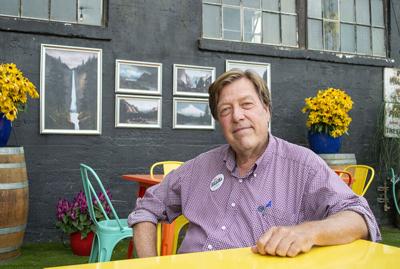
THE DALLES — Chris Beck, the Democratic and Independent candidate challenging Rep. Cliff Bentz for Oregon’s massive 2nd Congressional District, held an informal meet-and-greet at Sunshine Mill Artisan Plaza and Winery last Thursday.
Now living in Phoenix, Beck served as one of Portland’s lawmakers in the Oregon House from 1997-2003, followed by a brief stint in New Orleans with the Mercy Corps to help rebuild after Hurricane Katrina. Afterwards, he shaped rural economic development as a policy advisor based at the U.S. Department of Agriculture’s (USDA) national headquarters, then spent time internationally observing elections.
When the COVID-19 pandemic hit, however, Beck stepped back from public service. Growing disillusionment with the Trump administration, particularly his firing of federal employees and dismantling of longstanding institutions, motivated Beck to join the race, alongside Bentz’s voting record and what he sees as poor responsiveness.
“My goal is to deny Trump a seat in Congress,” Beck said during an interview. “I think the people deserve better representation than they’re getting, and I have long ties to the landscape of Eastern Oregon and rural towns. I have the background that qualifies me to do this, and so I’m doing something. I needed to do something.”
He has an uphill battle. Spanning 20 counties, Oregon’s 2nd Congressional District is the only one with more registered Republicans than Democrats, and Bentz won the last election in 2024 with 64% of the vote. Bentz also has $1.42 million in cash on hand, as of the most recent federal election filings, compared to $53,777 held by Beck’s campaign.
Beck is banking that voter frustration with Bentz, like over his support of the “Big Beautiful Bill’s” cuts to Medicaid and food assistance, will propel him into office.
“Bentz just doesn’t show up — doesn’t hold town halls, doesn’t speak up against any of the worst and egregious policies that Trump is pursuing,” Beck said. “That is really galling.”
Prior to his stint in the state Legislature, Beck worked for then-Senate President and future Gov. John Kitzhaber, who has endorsed Beck, as an assistant. Beck admirers former Gov. Tom McCall, calling his signature land use legislation “the best thing Oregon’s done in 50 years,” and practiced those principles during his 14 years of nonprofit land conservation beginning in 1990.
The idea of supporting agriculture, timber and grazing while promoting dense development and limiting sprawl is one he would carry to the federal level.
If elected, for instance, Beck wants to focus the USDA’s Rural Housing Services on supporting development and lending assistance in town centers. To help rebuild the federal workforce, support young people and mitigate gaps that stretch beyond local capacity, he also envisions multi-skilled rural service teams in every county across the district, clearing out forests, providing in-home healthcare and lending a hand in classrooms.
Such a program would require significant investment, however, and Beck sees major tax reform as the answer. He hearkened back to the rates under President Eisenhower, emphasizing that higher earners need to contribute more, and that the entire system needs to catch up with the modern economy by taking another look at capital gains and stepped-up basis in particular.
More locally, Beck didn’t take a stance on The Dalles Watershed Development Act, legislation sponsored by Bentz that would give the city 150 acres of national forest to expand Crow Creek Reservoir and bolster municipal water supply. But he said any transfer, and why it’s necessary, deserves the same transparency as data center development, which he supports a moratorium on.
“Communities should know how much water the company is going to use, where it’s coming from and what they’re going to do with it when they’re done with it,” Beck said. “The tax breaks that were originally approved these companies may have made sense 15 or 20 years ago; doesn’t seem to make sense now.”
As for other policy pursuits, Beck wants to repeal the “Big Beautiful Bill,” bolster assistance programs for new farmers and ranchers, create a public healthcare option and enable land-grant universities to fund senior housing facilities on or near campuses, among others.
•••
Our journalism needs your support. Subscribe and read more at columbiagorgenews.com.


Commented