
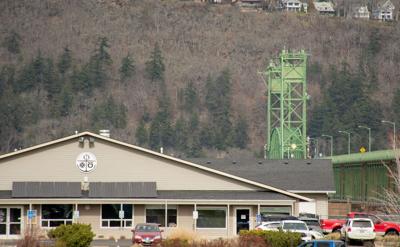
HOOD RIVER — Although it was posted as a routine “consent agenda” item — typically where non-controversial, fairly boring items are adopted at public meetings — Port of Hood River commissioners made a key policy decision Oct. 20 allowing a property transfer needed for Hood River Bridge replacement.
The decision took the form of a resolution affirming the port’s support for bridge replacement and authorizing transfer of port-owned land to the Hood River–White Salmon Bridge Authority once funding for the new bridge is secured.
The bridge authority is a bi-state entity responsible for bridge replacement and long-term maintenance of the new structure. It’s separate from the port district, with representatives from both states.
Contingent on still-pending federal construction funding, the new bridge’s southern terminus will land on an acre-and-a-half parcel where the port’s administrative offices and toll booth are now located. Adjacent property will be used for materials storage during construction, after which it will return to recreational uses.
While it does not formally transfer property yet, the resolution establishes a policy that “effectively donates port property to the bridge project when the bridge receives funding and needs the property,” said Tor Bieker, the port commission’s vice president. “I think that’s an important thing to say publicly. That’s also another important sign to state parks, the National Parks Service and Federal Highways that we are supportive of the project.”
Bieker was referring to the various roles those state and federal agencies have in allowing bridge replacement to move forward: the Federal Highway Administration as a key funding source, and Oregon State Parks and the National Parks Service because of another, closely related issue that had first to be resolved. This is an obscure section of the federal Land and Water Conservation Fund (LWCF) known as “Section 6(f).”
The port received several small LWCF grants in the 1970s, totaling $32,145, to develop recreational lands at the port marina. Section 6(f) precluded any other uses unless the port could secure comparable recreational properties elsewhere. Mitigation (“conversion”) must still occur, but the amount of land would now be reduced to about an acre and a half, down from nearly four acres. Port commissioners approved the conversion area as proposed by the bridge authority, which will take up the issue when it meets Oct. 29. The proposal would next go to Oregon State Parks and the National Park Service, which have the final say.
Meanwhile, final federal funding is still elusive. A $532 million “Bridge Investment Program” grant is essential to allow start of construction in one year. It’s a highly competitive national program, and there’s still no assurance of an award. Should the grant not be awarded, the bridge authority will need to piece together multiple other, smaller sources — a time-consuming and administratively complex challenge.
In other business Oct. 20:
Commissioners amended the port’s employment agreement with Kevin Greenwood, executive director, extending his term through September 2029. The decision follows an annual performance evaluation through contracted assistance from Special Districts of Oregon, including a “360-degree” review with Greenwood’s direct reports. (Such reviews provide feedback in both directions between supervisors and reporting staff.)
Approved the port’s Strategic Business Plan six-year update, a process that began this past spring with selection of Idaho-based Points Consulting. Oregon statute requires periodic updates of port business plans, addressing economic development, fiscal sustainability, infrastructure and other management issues. Points Consulting led a series of commission workshops, stakeholder interviews and public engagement including a community survey, all focused on fiscal sustainability now that the port’s general operating fund no longer draws upon bridge tolling revenue. (The port still collects tolls, but as of July 1, 2026, all those funds are directed to bridge repairs, maintenance and a replacement setaside). The updated, 2026-32 plan is posted on the port’s website.
In conjunction with the business plan update, the port is contracting with another Idaho firm, J-U-B Engineers, to update the port’s marina master plan. This began with a community survey in December 2025, followed by a stakeholder meeting Oct. 12. Commissioners reviewed the draft marina master plan at their Oct. 20 meeting, with final presentation scheduled for the commission’s Nov. 17 meeting. (This will also be a fall planning session.) That meeting will also include Points Consulting’s presentation of an economic impact analysis, also designed to complement the business plan update.
Reviewed results of an Oregon Department of Transportation bridge inspection conducted in July. Burgess & Niple, Inc., an engineering firm, conducted the biannual inspection, which reviewed structural integrity and documented current condition of the century-old bridge. There were several recommendations, which are being reviewed by the port’s internal bridge committee in preparation for the port commission’s next meeting Nov. 17.
Approved a contract with Adams Restoration to repair the port’s marina restroom, which was extensively damaged in a fire this past June. It’s been closed since then.
Approved notice of intend to award contract for marina boathouse removal. A request for proposals in August garnered nine responses. HME Construction, Inc., received the highest score, with proposed cost of $387,250. Nine privately-owned boathouses would be removed; a sheriff’s department boathouse will remain but might later be relocated. Contract approval is scheduled at the port’s Nov. 17 meeting.
Amended a professional services agreement with Precision Approach Engineering, Inc., extending terms of an agreement to complete engineering for upgrades at Ken Jernstedt Airfield. Work will include widening an airplane parking area (“apron”), taxiway maintenance and reconfiguration, and replacing obsolete helicopter markings. Engineering cost is not to exceed $89,850. Construction would occur next summer or fall, contingent on federal funding.
Deferred engineering to redesign the port’s property at 200 North Wasco Court as future home of the port’s administrative offices once the current offices are demolished when bridge construction starts. Renovation costs are escalating. Instead, the port may look to an interim facility, such as the port’s former administrative offices near the marina.


Commented