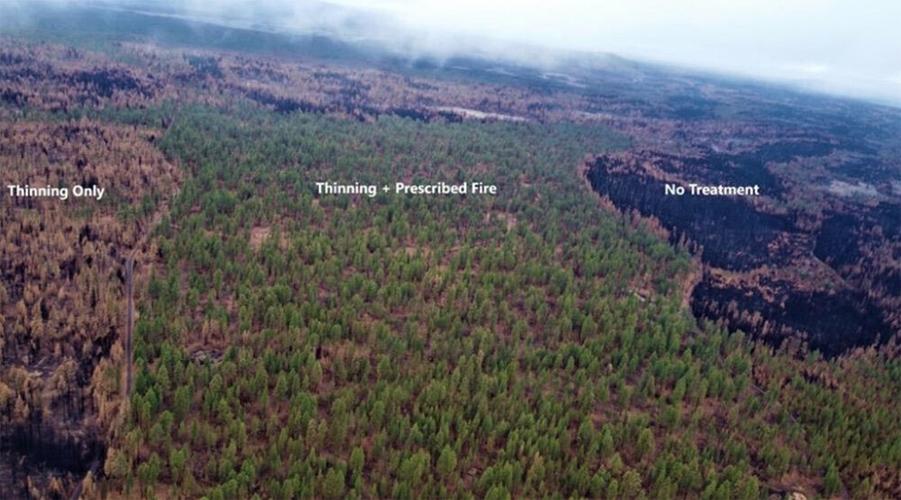
This photo of the Bootleg Fire in July 2021 shows the most dramatic example of how both thinning and prescribed fire is the most effective strategy for reducing a fire’s severity. The work on the land was done by the Klamath Tribes.
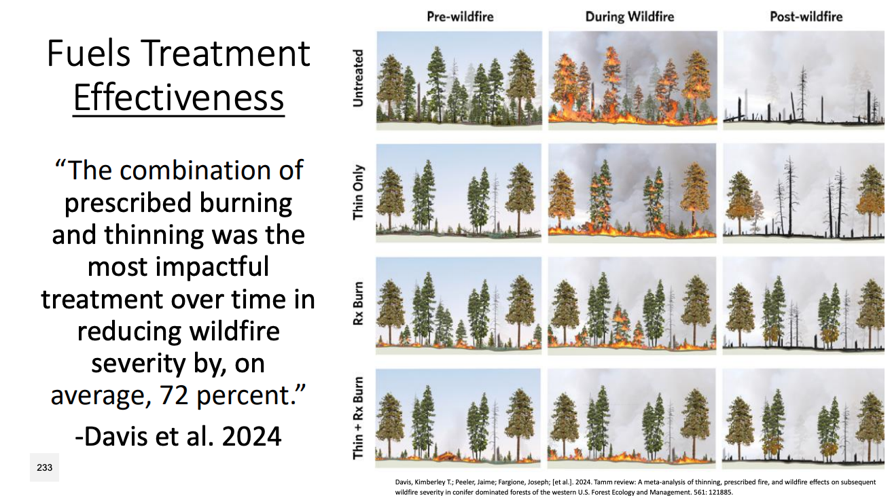
Wildfire resiliency research from University of California Davis shows a combination of thinning and prescribed fires has the greatest resiliency outcomes of any single treatment or untreated option.
THE DALLES—The connection between federal funding uncertainty and wildfire-related projects in Wasco County came up multiple times during a county board meeting on April 16.
The Wasco County Board of Commissioners repealed an intergovernmental agreement (IGA) with the Wamic Rural Fire Protection District, redirecting $891,000 through the Wasco County Soil and Water Conservation District.
Despite the repeal, Planning Division Director Daniel Dougherty assured the commissioners, “This path forward will continue to provide those defensible space services to the Wamic community, so there should be no significant interference with the project itself.”
Dougherty explained the reasons behind terminating the agreement with Wamic “include federal funding uncertainty, as well as difficulties with reimbursement of funds scheduling.”
The former agreement was initially part of the Community Wildfire Defense Grant, a program aimed at enhancing wildfire mitigation efforts across fire-vulnerable areas of Oregon.
Commissioner Jeff Justesen sought clarification about potential local impacts, to which Dougherty responded, “The work is going to remain the same. The scope that was originally proposed and approved by the federal government is still planned.”
He noted that he does not expect the funding to be canceled, and the department has already received two reimbursements for defensible space projects in Wamic under the new administration.
“The fear of performing that amount of work, and not necessarily being able to get reimbursed … created an untenable situation for both parties,” Dougherty said.
Dougherty highlighted that the change of funding going to the county’s conservation district would enable the purchase of equipment, such as a $75,000 wood chipper and trailer, benefiting broader community efforts beyond Wamic.
“Originally it was scoped to essentially be only used in the Wamic area of work, but now we’ll be able to use that for all of our sub-recipients,” Dougherty stated.
Later in the county board meeting, the Wasco County Forest Collaborative (WCFC) stressed the critical need for fuels reduction and prescribed burning amid the tumultuous federal impacts on local wildfire mitigation projects.
Established in 2015, WCFC highlighted the urgency of these measures to ensure ecological resilience and community safety through the development of 10 wildfire resiliency projects covering more than 30,000 acres within the Mt. Hood National Forest and surrounding area.
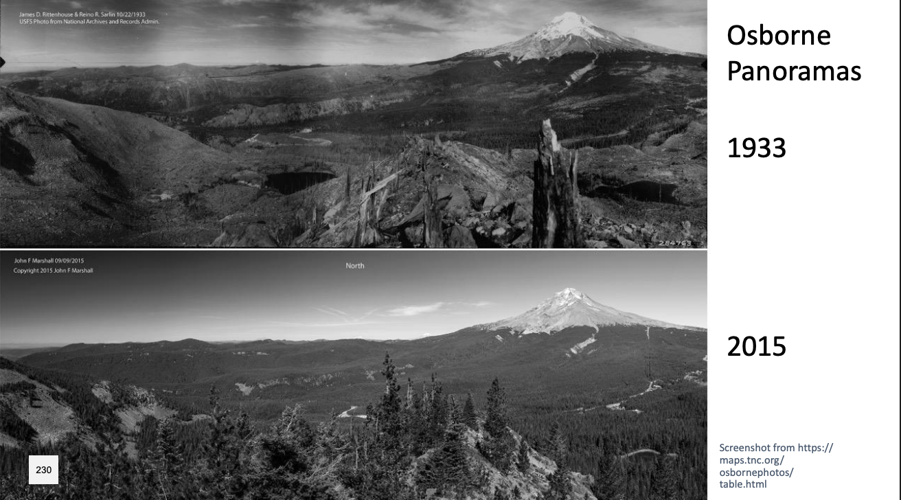
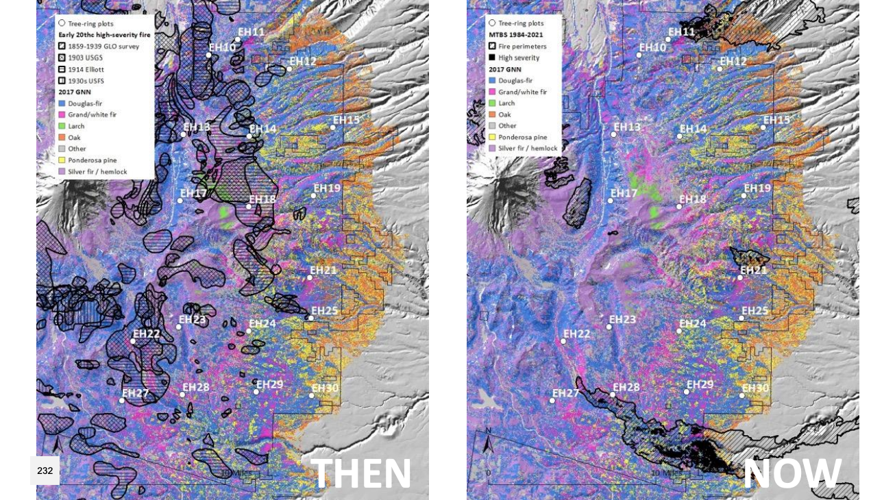
In their presentation, the collaborative showed compelling visuals detailing the outcomes of their regional fire history research, which demonstrated how a combination of thinning and prescribed burning create the best outcomes in the event of a fire.
Wildfire resiliency research from University of California Davis shows a combination of thinning and prescribed fires has the greatest resiliency outcomes of any single treatment or untreated option.
Wasco County Forest Collaborative image
“Funding is going to be a key barrier,” said Andrew Spaeth, facilitator for the collaborative. “We were on pace to probably implement a bunch of that work I described over a five-year period. If we see decreases in availability of federal funding to implement the work, it could take 10 years to implement it, right?”
“We need the Forest Service to be fully funded if we’re going to be successful,” he said.
Justesen remarked on a dramatic photo of the Bootleg Fire in 2021, which provided a compelling visualization of how different treatments determined the forest’s survival following a wildfire. Justesen pointed to the picture, saying this evidence alone should be enough to convince officials and the public just how important thinning and prescribed burn projects are for optimizing wildfire resilience.
This photo of the Bootleg Fire in July 2021 shows the most dramatic example of how both thinning and prescribed fire is the most effective strategy for reducing a fire’s severity. The work on the land was done by the Klamath Tribes.
Steve Rondeu photo
“I know it’s far more complicated than in order to protect the forest, but that’s just an incredible visual that I think lots of people need to see,” Justesen said.
The collaborative also has a role in coordinating timber harvest that provides economic value while thinning tree species like Douglas Fir and Grand Fir, which are commercially desirable but would not have been a part of the forest if wildfires continued to burn according to historic levels. Removing these fuels pans out to a win-win for future fire mitigation, but only if the collaborative can continue their work.
“If those federal funding streams turn off, it will take us longer to do the work, which is concerning, because we feel like there’s a lot of urgency to do this as quickly as possible,” Spaeth said.
Impending state wildfire map repeal
While the state senate has repealed the official wildfire hazard map developed by Oregon State University and the Oregon Department of Agriculture in the week after the board meeting, the commissioners noted they were anticipating this potential change.
Resident Steve Ronfield spoke to the commissioners during the public comment period, noting he was disappointed not to see Wasco County among Grant and Harney county’s support of the Oregon Property Owners Association lawsuit aimed at repealing the maps.
Commissioner Scott Hege replied that this would have been a waste of county resources, given what appeared to be the inevitability of this repeal.
Later, Hege asked the Wasco County Forest Collaborative leadership for their perspective on the wildfire maps and their potential repeal. He spoke about the maps in a more positive light.
“When I think about the fire maps and the ratings, I think of it more in a positive way that I want people to know that we live in a really hazardous area, and we really need to do a lot of work to take care of and create this defensible space and harden our structures and all that kind of stuff,” Hege said.
“We take the information from the state that’s been developed and make it part of our strategy,” said collaborative member Kameron Sam, district ranger for the Mt. Hood National Forest Area.
Sam emphasized that community education on defensible space is an important part of their work. “We may be more focused on the carrot model as the best thing. We see that voluntary actions, educating people is a great place to focus.”



Commented