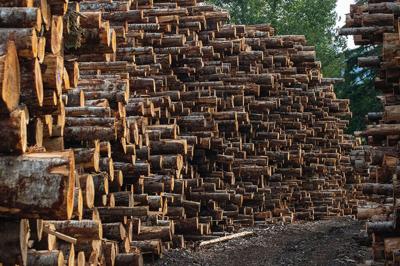
The timber yard at Wilkins, Kaiser and Olsen (WKO) Inc. in Carson, Washington. Since 1980, Skamania County has lost six of its seven mills and more than 500 timber jobs, in large part due to the Northwest Forest Plan.
The timber yard at Wilkins, Kaiser and Olsen (WKO) Inc. in Carson, Washington. Since 1980, Skamania County has lost six of its seven mills and more than 500 timber jobs, in large part due to the Northwest Forest Plan.
THE GORGE — A committee tasked with overhauling the Northwest Forest Plan (NWFP), the land management strategy governing more than 24 million acres of forests and 17 national parks in Oregon, Washington and Northern California, may not get to finish its work.
Earlier this month, the 20-person Federal Advisory Committee (FAC) comprised of scientists, environmental advocates, timber officials and Indigenous representatives received word that the United States Forest Service (USFS) is preparing to dissolve it before completing the amendment process.
“Everybody was prepped for it, but obviously very disappointed — not surprised, but very disappointed,” said Susan Jane Brown, FAC co-director and principal legal counsel for Silvix Resources. “There was more advice that we could provide to the Forest Service, especially now, given all of the chaos that the agency is facing.”
In summer 2023, USFS convened the FAC to address those pitfalls and help direct regional forest management for decades to come. As previously reported by Columbia Gorge News, the FAC’s 193 recommendations boldly departed from USFS’s legacy in two critical ways: engaging in meaningful co-stewardship with Tribal partners and harnessing healthy fire to improve ecological resilience.
“That’s a historic achievement,” said Brown. “That’s something nobody, anywhere else, has ever been able to do.”
While USFS isn’t required to adopt any of the recommendations, now it’s unlikely the committee can have a dialogue about them — to push for changes — with the agency, which released its draft plan last November. The draft incorporates language about Tribal inclusion and prescribed fire, but conservationists are arguing it lacks adequate protections for old-growth forests, according to Oregon Public Broadcasting.
What’s more, Brown said she’s uncertain whether USFS will formally amend the NWFP, as expected in spring 2026, at all, particularly because many of the FAC’s recommendations use vocabulary no longer deemed admissible by President Donald Trump.
In an effort to scrub “wokeness” from the government, words such as “race, “woman,” “inequality” and many others have vanished from government websites, according to the New York Times. Brown reported that she’s been told not to use “climate change,” “wildfire crisis strategy” and “Tribal,” terminology essential to problems the FAC sought to remediate
“It’s setting up the agencies to fail so this administration has a tolerable argument that we should divest ourselves of federal public lands — we should sell them off to the highest bidder,” said Brown. “The whole thing disgusts me and makes me really angry as a taxpayer.”
“I think it’s going to get a lot worse. I think this summer’s fire season is going to be atrocious,” she continued. “I think we’re going to kill people, and that blood is on this administration’s hands. It’s not on the Forest Service ... it’s on the leadership.”
Regardless of the outcome, Brown said the FAC feels proud of its work and encouraged folks to contact their local USFS offices to express support for an amended, more just NWFP.



Commented