
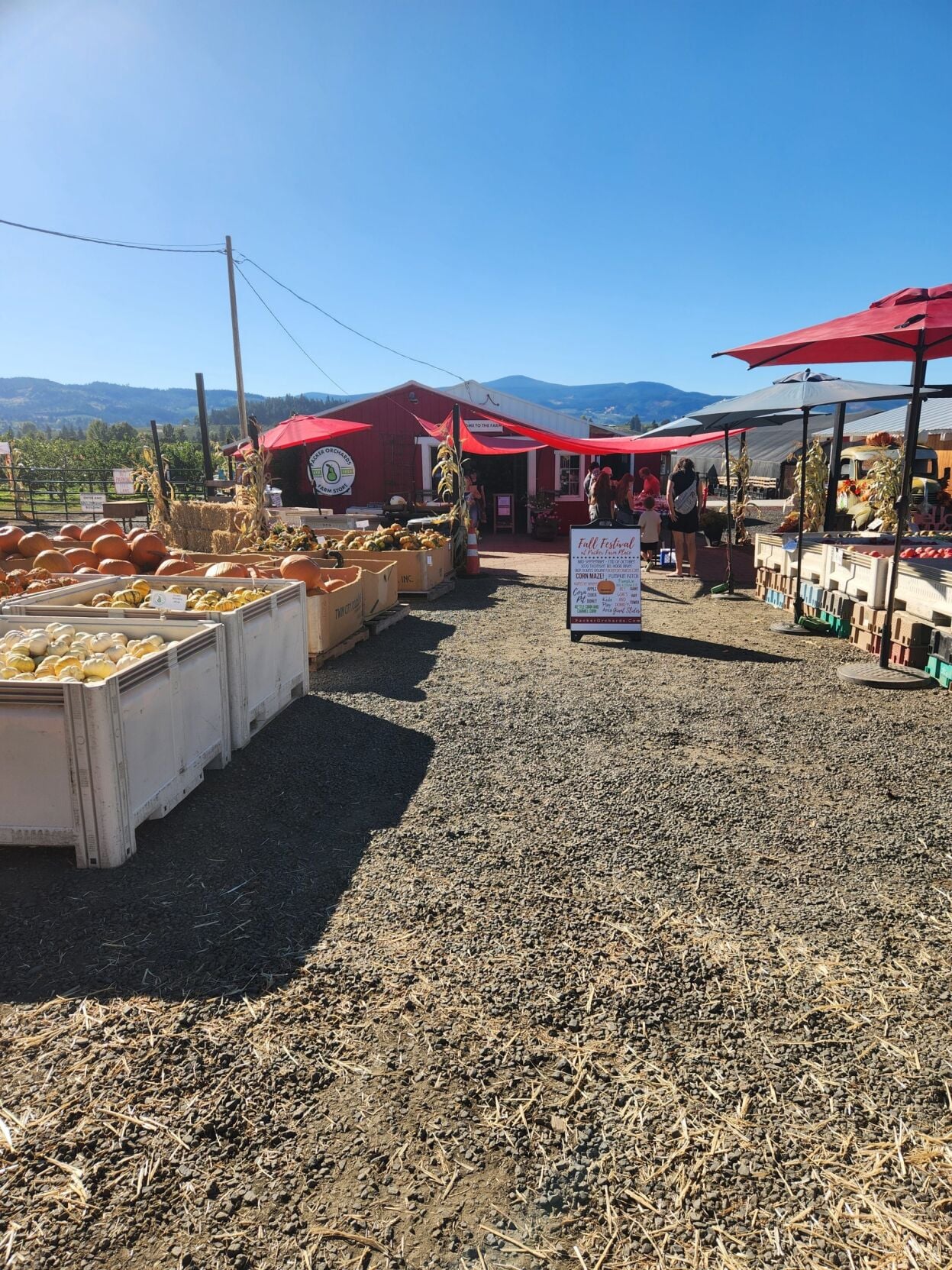
HOOD RIVER CO. — A years-long land use dispute in the Hood River Valley over what types of sales and activities are allowed at Packer Orchards farm stand is set to come to a head at a public hearing this week.
Gorge locals and visitors alike frequent the farm to pick and buy seasonal fruit, vegetables and flowers, as well as baked goods and other food and drinks. Many also attend seasonal events and activities like the farm stand’s annual pumpkin patch, tulip and sunflower festivals.
Packer Orchards has operated its farm and farm stand on Thomsen Road since buying it from the Rasmussen family in 2015. But the property is in an area zoned for “exclusive farm use,” which limits the kinds of activities it can offer, as well as the amount of money the farm can earn from sales not directly connected to local agricultural products.
In July, Hood River County’s planning department issued a permit for the farm stand to operate, if it met more than two dozen conditions. On Wednesday, Dec. 10, the county planning commission is scheduled to hold a public hearing on Packer Orchards’ appeal of 10 of those restrictions.
“These appealed conditions are untenable and, if upheld, would force Packer Orchards to close,” lawyer Elaine Albrich wrote in the farm’s appeal.
She also wrote that the decision “misconstrued or improperly applied” local and state laws.
But Thrive Hood River, a land-use advocacy nonprofit founded in 1977, documented multiple concerns with activities at Packer Orchards over the years and opposes the farm stand’s appeal. Thrive has urged county planners to uphold strict limits to protect farmland and comply with state law.
In a letter to the county planning commission supporting the conditional permit, Thrive wrote: “The staff decision on the Packer farm stand is the result of meticulous research and thorough analysis. It is a necessary interpretation of the minutiae of the county code, state law and administrative rule, and case law.”
The dispute has put the Packer’s farm stand under extensive scrutiny, down to where the butter in the chocolate chip cookies comes from, whether visitors would more likely eat baked goods on site if they’re sold in packs of three or of eight, and whether wooden buildings in a children’s play area are “structures” or “equipment.”
The “75/25” rule at the heart of the dispute
A central issue is whether Packer Orchards is in compliance with a state law known as the 75/25 rule. That requires farm stands in areas designated exclusively for farming to earn at least 75% of their income from livestock or agricultural products, such as fruits, vegetables or flowers, raised on the farm or in the local agricultural region, which in this case is the rest of Oregon, plus Klickitat and Skamania counties in Washington.
Only 25% of farm stand income is allowed from “incidental” goods or activities, such as gift shop items not locally grown, baked goods or other food designed to be eaten on site — even if they are sourced from local farms — and fees from events or activities.
In a Dec. 1 social media post,Packer Orchards argues that admissions to seasonal events such as U-picks, the sunflower festival, and pumpkin patch should count toward the 75% farm-product side because they directly promote crops grown on site.
But in the county planning department’s July 2025 decision, those admission fees are classified as incidental, placing them under the 25% cap.
“That means that events built around the crops we grow — tulips, pumpkins, apples, pears, sunflowers — are classified as ‘non-farm income’ even though they are directly tied to our agricultural production,” Packer said in the post.
In an interview with Uplift Local, co-owner Tammi Packer said this is a “major item” separating Hood River County from “most, if not all” other Oregon counties.
She said it first came up during a 2024 site visit with a county planner, who she says initially suggested admissions might count toward the 75% if the farm included equal or partial value in farm products with the ticket price — such as sunflower stems or tulip bouquets.
“In our conversation, he said he understood the need to charge for admission, because they [county] have set a limit on how many people can attend our farm at any given time,” she said. “To allow, in his opinion, the admission to be put into the 75% we would have to give an equal amount, dollar-wise or partially dollar-wise, of farm product, inclusive with that admission.”
So the farm went in that direction. Last summer, Packer charged $25 in admission fee to the U-pick sunflower fields last summer, and included in the ticket price a number of sunflowers.
“We charged $2 per stem for people who picked extras,” Packer said. “We did the same for the tulip fields, where we included a bouquet of tulips with their admission.”
But Thrive Hood River argued to the county that because a customer couldn’t get into the event without buying a ticket, the whole ticket price should count as non-farm income.
“For example, there’s the Tulip Festival where the admissions fee is $25. Packer would like to say that $5 of that is the admission fee, and $20 is the sale of tulips, because the customer is going to be given a certain number of tulips,” Chris Robuck, treasurer of the Thrive Hood River board, told Uplift Local. “Those are not separable — a person who wants to attend the event doesn’t have the option of saying, ‘yeah, I don’t want to buy $20 worth of tulips,’ let me just pay the $5 admission fee.”
County planners agreed, requiring Packer to count “all admissions, passes, and annual membership fees” toward the 25% limit of incidental sales, “whether farm products are provided with admissions or not.”
That is one of the conditions Packer Orchards is appealing.
Tammi Packer says it felt like a reversal.
“We were just really thrown a big blow on that,” she said.
But Robuck warned that bundling farm products into event admission fees could open the door for people without actual farms to set up a farm stand and put on events.
“The thing to be aware of here is that you don’t have to have a farm to have a farm stand,” Robuck said. “You’re setting up a situation where anybody can buy exclusive farm use land, set up a farm stand and do pretty much anything they want in terms of events and promotions.”
Catering to young farm visitors
A second issue that Packer plans to appeal at the Dec. 10 hearing involves play areas at the farm stand.
In its July decision, the county planning department classified a range of items, from small wooden buildings to a slide built from hay bales as “play structures designed for public entertainment,” and cited arguments from Thrive Hood River that local zoning rules that say structures designed for that purpose aren’t allowed.
In the farm’s appeal, it calls the items play “equipment,” and in a Dec. 4 social media post Packer argues the county’s stance conflicts with state law and past legal precedent.
“Our position is simple: play equipment is not a ‘structure’ as defined by Hood River County and Thrive Hood River … These small structures help families connect with the farm in a natural and authentic way,” reads the post.
It also said removing the play items would “reshape the farm stand experience” and could affect the farm’s long-term viability.
A long regulatory path
The Dec. 10 hearing follows nearly a decade of county review:
- 2015–2016: Tammi and Larry Packer buy the Rasmussen property on Thomsen Road in Hood River County, receiving approval to re-establish the farm stand, with 16 conditions.
- 2021–2022: Packer Orchards seeks to consolidate two properties — the farm stand on Thomsen Road and its bakery on Highway 35. The company submits building plans in early 2021. The process grows more complex after a neighboring landowner objects and the county advises the Packers to hire an attorney and rework their application, launching a multi-year review that continues through 2022 and beyond.
- 2022: Two complaints are filed against Packer Orchards, alleging unauthorized events, noise, unpermitted structures, and parking overflow. The planning department says the Packers made efforts to correct most problems but some disputes remained.
- 2023–2024: Multiple applications and conditional-use permits are filed and withdrawn; county staff cite problems, such as an outdated site map. Packer works to address those issues.
- March 2025: Packer submits the revised application.
- July 2025: County planning staff issues a temporary land-use permit, with more than 28 conditions, 10 of which are now under appeal.
Community appeals and statewide implications
Packer Orchards is rallying supporters via social media, saying the issues it is appealing will impact the wider community.
“The proposed limitations would impact not only our family farm, but the families, students, neighbors and local businesses who rely on and enjoy what we do,” Packer said in a Nov. 29 social media post.
The post also urged community members to testify at the upcoming planning commission hearing about what the farm means to them.
“If our farm has been part of your life, your childhood, your traditions, or your connection to local agriculture, your voice helps the commissioners understand the bigger picture: what a farm means to the community,” it read.
Thrive Hood River has also put a call out for people to testify. Mike McCarthy, a farmer and another member of Thrive Hood River’s board, told Uplift Local that too many allowances are being made in farm zones, and that the focus needs to return to farm products.
“We believe there are plenty of opportunities,” McCarthy said. “ We just want those activities in the farm zone to stay directly related to farming and farm production and the sale of farm crops.”
Packer said the community’s support has been “fabulous” and that other Hood River farm stands are closely watching for the outcome.
“It’s going to affect many farm stands here in Hood River,” she said.
What Hood River County planning commissioners decide could play into a state-wide debate as well. After a failed bill this year amid high-profile debates, new statewide farm stand legislation is expected in 2026. But Packer said the Dec. 10 decision will set the tone until then.
•••
Ken Park grew up in the Columbia River Gorge and has worked in journalism on and off for about 10 years.


Commented