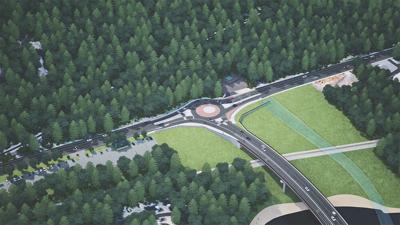
A rendering of the proposed Highway 14 roundabout on the Washington side shows the current bridge location as a light green strip, parallel to the new structure.
A rendering of the proposed Highway 14 roundabout on the Washington side shows the current bridge location as a light green strip, parallel to the new structure.
HOOD RIVER — Preparatory work leading to replacement of the Hood River Bridge is under way this month, as contractors conduct riverbed borings from barges anchored near the Oregon shore.
This is the second round of core sampling to ensure a solid foundation for the new bridge piers, which under the current schedule will be placed starting in October 2027. Drillings were to have started this past October, only to be postponed because of a permitting delay.
Core drillings were nearly delayed again last month, as the looming partial federal shutdown threatened to postpone a U.S. Army Corps of Engineers drilling permit. Corps funding was included in the appropriations measures approved by Congress on Feb. 3, avoiding a delay. A federal shutdown this month, if one occurs, will not affect the project.
The drilling contractor will work steadily toward the Washington shore, drilling two-inch test cores at each of 12 future pier locations; each core will reach bedrock. (An unwelcome surprise in the replacement project came a few years ago, when engineers learned the current piers never reached solid rock, creating a seismic hazard.)
The core drillings are funded through earlier appropriations by the Oregon and Washington legislatures, which have jointly committed a total of $250 million to bridge replacement. But much of the new bridge’s anticipated $1.12 billion cost depends upon four federal sources: an $8 million Congressional appropriation, secured in 2024 but not yet transmitted; $200 million infrastructure grant awarded in 2024 but still pending grant agreement; $532 million federal Bridge Investment Program (BIP) grant pending approval in 2027-28; and a federal loan to be repaid by future tolling revenues.
Timing on all of those awards is critical. Members of the Hood River–White Salmon Bridge Authority, the bi-state entity responsible for bridge replacement and long-term operations, received some encouraging news last week, with word that the infrastructure grant agreement needs no further federal legal review, which should expedite the award.
“That’ll be a big step,” noted Mike Shannon, project manager, since legal review at the federal level can take months or longer.
With bridge design to reach 60% of completion this summer, assurance of federal funding becomes increasingly important. For instance, as noted by Mike Fox, a Parkdale resident and bridge commissioner, the BIP grant needs to be awarded in time for the 2027-28 “in-water window” next winter, when construction activities can occur in the river without disrupting fisheries. Missing that window would add $40 million in project costs, Fox noted, an amount not included in the BIP application.
While bridge commissioners monitor status of these various funding sources, progress continues on other fronts:
• The first of four anticipated Memoranda of Agreement with the Columbia River treaty tribes arrived this month, following approval by the Confederated Tribes of the Umatilla Indian Reservation. Negotiations with the Umatilla, Warm Springs, Yakama and Nez Perce have been on-going for more than four years. The Memoranda provide assurance of mitigation measures to protect fisheries, minimize environmental impact, and other conditions associated with bridge replacement.
• As part of its work in designing the new bridge, general contractor Kiewit Corporation is developing plans for a temporary trestle needed for construction on the Washington shore. The bridge authority is also negotiating with BNSF Railway for a related access route adjacent to the main rail line, which runs just south of Washington Highway 14. Several options are being explored.
• As final bridge designs are completed this year, these will be posted to the bridge project website, hoodriverbridge.org. (The bridge authority itself has a linked website, hrwsba.gov, reflecting the authority’s long-term role in operating and maintaining the new bridge.) One design just released a few weeks ago is for a roundabout at the bridge’s northern terminus on Highway 14.
• Outreach is underway to the region’s school districts in an initiative to engage students in the construction industry, anticipating the jobs that would be generated by this upcoming project.



Commented
Sorry, there are no recent results for popular commented articles.