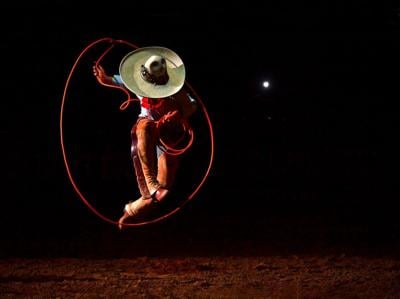
This photo encapuslates what Richardson spoke about: eye-catching composition, good timing, using the lighting in a dark coliseum to her advantage, and high shutter speed to "freeze time" and avoid motion blur. A Mexican charro performs with his lasso during the National Western Stock Shows Mexican Rodeo Extravaganza 2022 at the Denver Coliseum on January 9, 2022 in Denver, Colorado. The show is a display of Mexican heritage and history. Photo by Helen H. Richardson, The Denver Post.
Contributed Photo by Helen H. Richardson, The Denver Post.
This photo encapuslates what Richardson spoke about: eye-catching composition, good timing, using the lighting in a dark coliseum to her advantage, and high shutter speed to "freeze time" and avoid motion blur. A Mexican charro performs with his lasso during the National Western Stock Shows Mexican Rodeo Extravaganza 2022 at the Denver Coliseum on January 9, 2022 in Denver, Colorado. The show is a display of Mexican heritage and history. Photo by Helen H. Richardson, The Denver Post.
Contributed Photo by Helen H. Richardson, The Denver Post.
I am a firm believer that everyone is an expert in something. It might be changing a tire, Olympic curling stats, or alpine tree species. This is a new column where I find community members to teach me about their expertise.
My first expert is Helen Richardson, an award-winning photojournalist who recently relocated from Colorado after 33 years as a staff photographer with the Denver Post. She has been working with Columbia Gorge News in recent months to share her expertise with our editorial staff.
I asked Richardson to tell me about what she sees through her camera lens that she knows makes a good photo. “It’s an art that people don’t often respect,” said Richardson, saying that with the ubiquity of smartphones and their cameras, everyone has the ability to take pictures, creating the impression that photography is easy. But phones can only do so much, said Richardson.
Higher-end cameras are capable of producing high quality images because of their larger sensors and interchangeable lenses. They can capture more light, detail, and dynamic range while allowing greater creative control over focus, exposure, and depth of field. Those are all elements honed through practicing photography as an art, and as a beginner myself, knowing how to make the camera produce what I want it to is no small feat.
Richardson explained that many elements in photography help to make a good photograph. Understanding the technical aspects of a camera are the first steps. This includes shutter speed, aperture and ISO. As well as the aspects within the photo which includes well composed subjects, correct exposure so it’s not too bright or too dark, use of aperture for depth of field, and the proper lens choices help create a beautiful photograph. A potentially overwhelming amount of choices to say the least! In my experience, there is TON of technical know-how that goes in to a good shot.
Composition is also hugely important. “Look through the lens,” is a frequent refrain Richardson uses while teaching us how to improve our work. “Don’t just point and shoot,” she explains. “Really look at what you are shooting. Ask yourself why it’s important and what makes it worth photographing. With one picture you’re telling a story, so what is that story that you’re telling, and how are you showing it?” You can tell a whole story with a good picture, she said.
Last but certainly not least is the content of the photo. Richardson said what’s important is getting emotional connection in the content of the photo. “Make it pop out for people and catch their eye,” she said. “Photographs have the ability to draw someone into a different place. It’s a powerful artistic medium that we all share.”
Richardson also reiterated that “the best camera is the one in your hand,” and the ability to capture the moment in the moment is powerful. When I asked her if she had any take-homes for people working on their own photography she said to think about light — one of the first lessons she gave us at the paper as well. Finding people in the light and capturing that moment. “Photography is light. It’s all about light and shadows and light exposing correctly.” Her other piece of advice was to get closer. “If you don’t have a telephoto lens, your feet then become your telephoto lens,” she said. “So get closer, get closer to your subjects, get more intimate with your subject,” concluded Richardson.
Richardson’s photographs can be found throughout the pages of this paper, as well as through many years of the Denver Post’s catalogue, and on Instagram at Helenhrichardson.
If you’re interested in being a featured expert, reach out at azizac@gorgenew.com



Commented