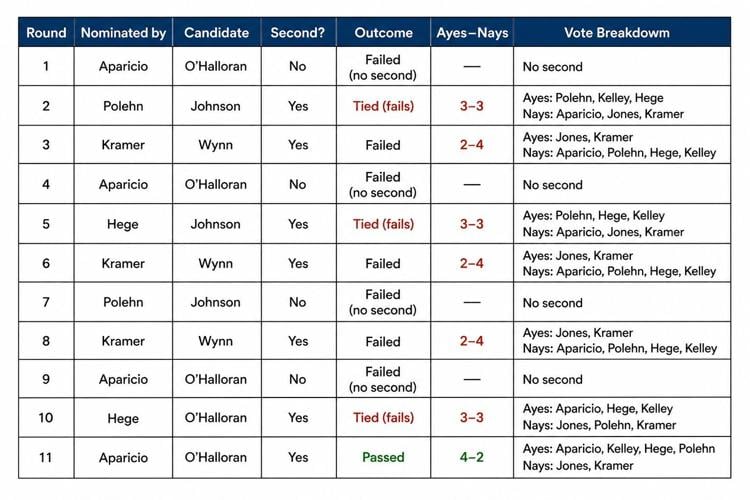
Over the course of 11 rounds of voting, directors stuck to their votes through two 3-3 votes for Johnson, three 4-2 votes for Wynn, a 3-3 vote for O’Halloran and four motions for Johnson and O’Halloran that failed to get a second. The deadlock prompted discussion about whether to postpone the decision, and even questions about a runoff vote between Johnson and O’Halloran.
Over the course of 11 rounds of voting, directors stuck to their votes through two 3-3 votes for Johnson, three 4-2 votes for Wynn, a 3-3 vote for O’Halloran and four motions for Johnson and O’Halloran that failed to get a second. The deadlock prompted discussion about whether to postpone the decision, and even questions about a runoff vote between Johnson and O’Halloran.
Siobhan O’Halloran, newly appointed NWCSD board member
THE DALLES — After multiple split votes and extended deliberation, the North Wasco County School Board appointed Siobhan O’Halloran to fill a vacant seat, breaking a deadlock that had divided the board over competing strengths among candidates.
O’Halloran will hold the Zone 2 board member position previously held by Dana Wynne‑Elledge until June 30.
The April 23 regular board meeting centered on interviews with four finalists, O’Halloran, Greg Johnson, Elwyn (Al) Wynn, and Mike Holeman, followed by deliberation over who was best positioned to help guide the district through ongoing challenges tied to attendance, funding and student outcomes.
Holeman thanked the board and withdrew his application before the voting process.
Initial motions to appoint Johnson, Wynn and O’Halloran either tied or failed with not enough votes, forcing the board into further discussion before a subsequent motion in favor of O’Halloran secured a majority.
“This is a very difficult choice, we have three outstanding applicants,” Director Kevin Kramer said during deliberations.
Board weighs experience, perspective
O’Halloran, who works in finance and nonprofit leadership, framed her candidacy around governance, budgeting and policy experience, telling the board she views public education as “a public service not only to students and their families, but the broader community.”
She pointed to attendance and funding as key issues facing the district.
“Attendance is a persistent challenge not just for our district, but statewide,” she said, adding that rural districts face added strain under Oregon’s funding model. “A strong district has strong connections to the community, with a high level of community trust in the district and the role of the board in building that trust is to act with integrity and stay grounded in the mission of educating children.”
Her vision for the district emphasized safety, academic standards and “multiple avenues for success,” including programs like Innovations Academy.
Johnson described his two decades as a teacher at St. Mary’s Academy, a private Catholic school in The Dalles. He highlighted his education background and community leadership ties, pointing to the district as central to attracting families and workers to the region.
“The biggest challenge I see is improving outcomes in the education system without lowering standards,” he said. “My vision of an outstanding school district is a district that people tell positive stories about and one that parents are excited to enroll their students in.”
He characterized the board’s role as focused on governance and oversight, including hiring and evaluating the superintendent and ensuring fiscal responsibility.
Wynn, broadcaster and past school board member, emphasized communication, accountability and business experience. In describing the school district’s communication needs, he indicated the prevalence of a problem he calls “vicious compliance.”
“Vicious compliance is where if someone asks you a question about what you’re doing, you do the job so bad that they would never ask you again,” he explained. “I’m a big believer in accountability and transparency.”
Questions and reservations
Betsy Hege, NWCSD board chair
Chair Betsy Hege noted reservations about Wynn’s candidacy.
“I will be transparent, there is history between the administration and the district that would make it hard for our administrator and their team, so for that reason I can’t support this nomination,” she said.
When nominating Wynn again, Kramer appeared to acknowledge this tension saying, “We shouldn’t be afraid of conflict.”
Later, Wynn spoke from the audience addressing Hege’s comment, asking why she had described his interaction with the district as negative. Hege apologized, saying the comment was “poor judgment.”
On his KODL program “Coffee Talk” the next morning, April 24, Wynn, who regularly shares opinions about the school board and administrators, said Hege’s statement cost him the Zone 2 position. He described Hege as “unfit” for her role and called for her resignation from the school board.
“The action by her was out of bounds, and I guess the only thing left for me to wonder is, is her position indicative of what her husband’s position is in life, or his now running for state rep? I told her there would be consequences for her behavior, and so we’re getting some today. Step aside,” he said.
ORS 260.432(3)(b) allows public officials to opine during a public appointment deliberation about the perceived strengths and weaknesses of candidates that relate specifically to the furtherance of the recipient’s official duties.
Board members weighed the candidates’ backgrounds against the district’s current needs, with some emphasizing Johnson’s experience in education and prior board service, with others noting Wynn’s business and community connections, while still others pointed to O’Halloran’s financial and policy expertise.
Deadlock and resolution
Over the course of 11 rounds of voting, directors stuck to their votes through two 3-3 votes for Johnson, three 4-2 votes for Wynn, a 3-3 vote for O’Halloran and four motions for Johnson and O’Halloran that failed to get a second. The deadlock prompted discussion about whether to postpone the decision, and even questions about a runoff vote between Johnson and O’Halloran.
Board members instead continued deliberating. Director Jose Aparicio emphasized the importance of financial oversight and scaling experience, referencing O’Halloran’s work presenting budgets and managing organizational growth.
The board ultimately shifted support to O’Halloran and approved her appointment later in the meeting with Directors Katie Kelley, Hege, David Polehn, and Aparicio voting “Aye” and Directors Kramer and David Jones voting “Nay.” O’Halloran was sworn in shortly after.
Public comment later in the evening underscored the stakes of the decision, with multiple speakers pointing to the district’s alternative programs as critical support for struggling students.
“[My student] has made an absolutely amazing turnaround,” Title I Reading Assistant Corenne Stewart said of Innovations Academy, crediting “extraordinary mentorship” and flexibility for helping a student re-engage.
Parent Rebekah Smith described a similar experience, saying a teacher “showed up and made all the difference.”





Commented