
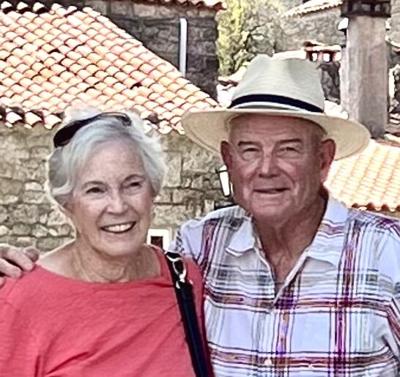
THE DALLES — Having over 150 years of a continuous family farm operation is a rare milestone, an achievement that belongs to Northwest Cherry Festival Parade Grand Marshals Dave and Karen Cooper.
They will lead the parade, which begins Saturday, April 25 at 10 a.m. in The Dalles.
To give a sense of the longevity of Cooper Family Orchards, Karen described her house as the newer of the two on the family farm — and it dates to 1898.
The older house, now occupied by daughter Stacey, who now manages the family orchards, dates to 1869, when Dave’s great-great-grandparents started the orchard.
Dave spent a few years after college teaching in The Dalles while also helping his dad with the orchard. But it got to be too much to do both, and his dad was getting older and wanting to retire, so Dave took over the orchard full-time.
It wasn’t that long ago that their daughter took over the family business.
“I didn’t give her that ultimatum that my dad gave me,” Dave said. His own dad flatly said if he didn’t take over, he’d sell the farm.
But Dave does allow that if she hadn’t come back to take over a few years ago, “we probably would’ve sold by this time.”
He is both proud and humbled to be part of such a longstanding family business. “It’s not easy to do. There’s not a lot of century farms in Oregon and there’s even fewer that have made it to sesquicentennial status, 150 years.”
Some of it is just whether people want to follow in the family business and do the same kind of work. “It’s something you just have to want to do.”
While there is a definite pride in having such a longstanding family farm, it also carries the pressure of maintaining continuity. There’s the “’Is it gonna go out on my watch?’ kind of thinking,” Dave said. “Maybe, maybe not. Beyond Stacey there is another family member that may be interested.”
Karen worked to keep the books, tracking the amount of cherries each worker had picked and earned, but she has also stepped away from that now.
She noted that relationships with year-round and seasonal workers are important. While it was more families who came to do harvest years ago, now it’s mostly single men.
“Getting pickers to come is harder. If you can make a longer season it helps with getting them to want to stay,” she said.
“You’ve got to have good relationships with the workers, you’ve got to make them feel needed, which they are,” she said.
Last year, a man who once worked at their orchard as a youth came to visit the Coopers and he brought his own son to show him where he once worked. The man is now an engineer in California, Karen said.
In his decades running the orchard, Dave has seen massive changes. He and his dad used to hand-load 50-pound boxes of cherries onto a truck to take them to town.
Now huge bins that hold up to 1,200 pounds of cherries are fork-lifted onto a truck for the trip to town.
Cherry pickers used to be paid by the pound of cherries picked. Now they’re paid by the bucket, each one having an assumed poundage.
And tracking buckets picked has also changed. It used to be punch cards for each picker, which were tallied by hand in the evening. Then it was a hand-held device that would count buckets, with the information uploaded each night. Now, a phone-based system instantly downloads the tally.
The kind of cherry Cooper Orchards grows used to be 80 percent for the brine or maraschino market, and just 20 percent was fresh cherries. Now it’s the opposite.
Fresh cherries have a more volatile market and higher risk, but also better prices.
Growers use different varietals to lengthen their harvest season, which is a way to attract pickers, who want the maximal season possible, he said.
Like all agriculture, cherry growing operates under a set of uncontrollable variables, from weather to markets.
No two cherry seasons are alike, Dave said.
“It seems like every one throws you a new wrinkle,” he said. “You’re either dealing with rain, or cold weather freezing them out, or high fertilizer prices. Things you just can’t hardly do anything about. You just have to figure out how to work through it and keep on rolling.”
Something the Cooper family has done for over 150 years.


Commented