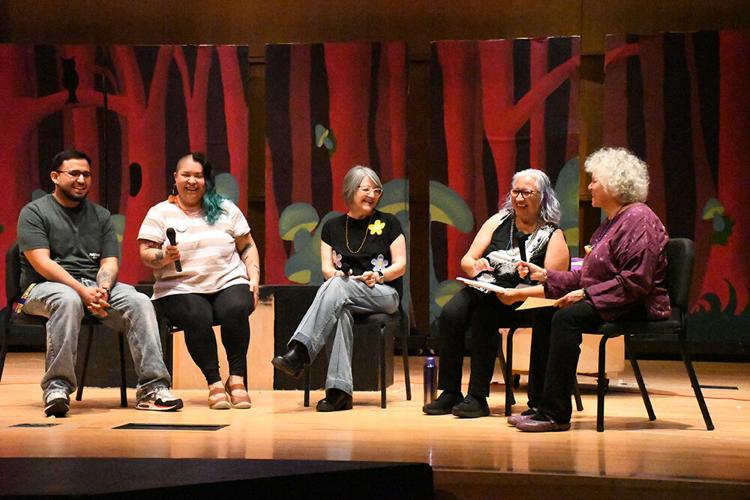
From left to right, community health workers Chris Cazares, Rosie Strange, Maria Peña, Tere Campos-Dominguez, and Tina Castañares on stage at Wy’east Middle School following the world premiere of “Corazon.” Sean Avery photos.
From left to right, community health workers Chris Cazares, Rosie Strange, Maria Peña, Tere Campos-Dominguez, and Tina Castañares on stage at Wy’east Middle School following the world premiere of “Corazon.” Sean Avery photos.
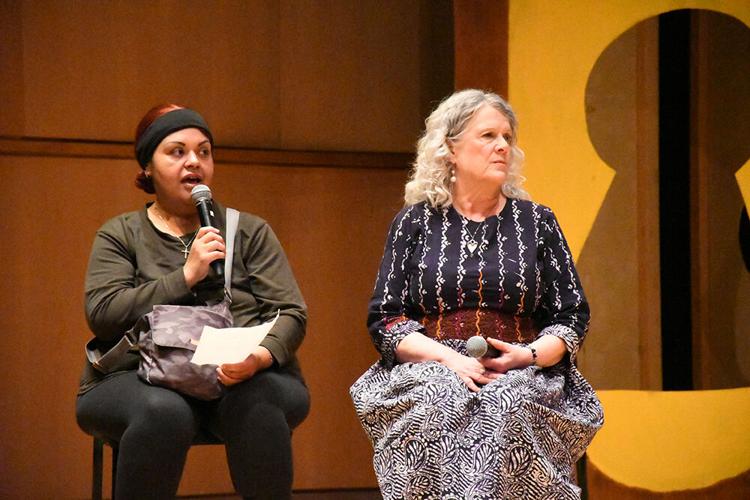
Language interpreters Lisa Preciado (Spanish to English) and Lorena Sprager (English to Spanish) translated the bilingual panel.
ODELL — For the Columbia River Gorge’s 150-plus community health workers (CHWs), helping people isn’t a job, but a necessity. Every client, every mission, is part of a broad, decades-long movement to bridge the divide between underserved communities and institutionalized health care.
In celebration of Gorge CHWs past and present, over 250 people gathered at the Wy’east Middle School Performing Arts Center on April 11 for the world premiere of “Corazón: The Legacy of Community Health Workers in the Columbia Gorge” — a bilingual documentary from prominent social service organization The Next Door Inc. (TNDI) and directors Michael and David Hanson.
Following the screening, a group of local CHWs, some of whom were featured in the film, united on stage for a panel discussion to debrief their experiences, honor those who came before, and raise awareness of present industry challenges.
Corazón
Although it’s impossible to capture the scope of the region’s community health movement, considered at the forefront of a statewide effort, “Corazón” paints a concise and comprehensive picture of the Gorge’s CHW story.
In the 1980s, a small group of healthcare professionals from a Hood River clinic recognized a hole in health care: a sizeable portion of the community — particularly low-income families and migrant orchard workers — lacked access to or awareness of necessary care, either because they were hesitant or unable to engage with the system.
Due to language and class divisions, many of their peers — fellow doctors and nurses — knew very little about such communities or how to help them. The Gorge needed trusted intermediaries to facilitate access to services and improve the cultural competence of service delivery.
Thus, they sought and received a federal grant to launch an innovative program called El Niño Sano (A Healthy Child), hiring and training seven women from the farming community to serve as health promoters.
The program served over 3,000 farmworker families during its first three years, providing many with an introduction to parental, health, and dental care. In the film, spotlighted voices included immigrant workers-turned stalwart CHWs Graciela Gomez and Maria Atonia “Toña” Sanchez.
After its initial success, El Niño Sano flowered into an interconnected network of local CHW programs, including La Familia Sana, the youth-violence-focused La Comunidad Sana, and organic food resource Raíces Cooperative Farm. By the late 1990s, Gorge-based CHWs and Oregon allies became the subject of the National Community Health Advisor Study — the first of its kind.
Today, services like TNDI continue to expand the Gorge’s historic CHW network, offering health education, home visits, mental health programs, food delivery, and specialized outreach to marginalized communities, including Native Americans and queer youth.
After the credits rolled, “Corazón” project-leader Claire Wagner invited present CHWs to stand for recognition. “Thank you all for your work on this project and in this movement,” she said. “The heart that you have brought to the CHW movement has changed our region, our state, and our country.”
Panel
The subsequent panel discussion, moderated by veteran CHW Dr. Tina Castañares, featured Chris Cázares, Education and Engagement Coordinator at Washington Gorge Action Programs (WAGAP); Rosie Strange, project coordinator for Áqwłtpwisha Chúushna, a Native American support program of the Columbia Gorge Health Council; María Peña, 33-year-veteran CHW with North Central Public Health District; and Teresa “Tere” Campos-Domínguez, a 30-plus-year CHW and National Association of Community Health Workers board member.
CASTAÑARES: How has the CHW movement changed over the last 35 years?
CAMPOS-DOMINGUEZ: This movement didn’t start 35 years ago. It started way before, with our grandmothers, with the healers and with every person who would help without a title, who had a good heart. What has changed is the way we get recognized. We are united more. There’s more space and visibility in the work we do.
CASTAÑARES: What concerns, anxieties, or worries do you have about the profession and the community?
STRANGE: We are facing a very tough political climate. We have many challenges coming to our community over the next couple of years. If it’s not ICE in our community, if it’s not access to healthcare, if it’s not access to education in our community, it’s the overall mental health of our people. But CHWs have been at the edge of revolutionary work since the beginning of time. We are the helpers who show up when systems fail. We build for nothing, and we will always continue to.
PEÑA: This new administration. Because every day, he wakes up and makes stupid choices. I hope he does not take away any funding that would allow us to continue working, but I’m sure all of us here will continue working without pay.
CASTAÑARES: How can community members support CHWs?
PEÑA: I think the most important thing for doctors, nurses, or any person in higher-level positions is to educate themselves as to what a CHW does. In the 33 years that I have been working, I have never felt like I’m a professional. I have more experience than some of the people I work with, and I have never felt respected. The next step is educating the community.
CAZARES: Learning about other people, learning about the work they do, educating yourself, and figuring out how you can be a part of the community we serve. Be willing to come together and collaborate.



Commented