Local roasters feel the squeeze as global markets, tariffs and climate disruptions drive up costs
THE GORGE — For White Salmon resident William Griffith, coffee is part of his daily ritual, from morning to night. He’ll grind the beans, boil the water and use a glass pour-over to make himself coffee, consuming five to six cups a day.
“It’s one of my fixes,” Griffith said.
But he’s noticed at the grocery store that prices for a bag of coffee have gone up at a rate that doesn’t match the overall inflation, and he’s not wrong. According to the U.S. Bureau of Labor Statistics, inflation is up 2.8% since Jan. 2025, but retail coffee is up 30.5%.
“It’s causing roommates to drink each other’s coffee more so than before,” Griffith explained. “At times, I’ll even run a few batches of water through the grounds to recycle it and prevent having to buy coffee as often.”
On average, a pound of coffee increased from $7.25 in February 2025 to $9.46 in February 2026.
Despite the prices, Griffith still plans to buy coffee, but will select cheaper options at the grocery store, even if it means getting ground over whole beans.
He’s not the only one who’s noticed prices jump — local roasters have already been carefully tracking the changes.
Michael Margotta, who co-owns Hood River Coffee Roasters with his wife Susie, said he’s seen a tectonic shift in the coffee market in the last couple of years.
“All coffee’s expanded dramatically in price, but especially great coffee,” Margotta said.
Coffee, a commodity, follows the C-price, which reflects the global price for green, unroasted coffee.
In January 2025, the C-price doubled from around $2 per pound to $4, and stayed in that higher range for a year. As of early April 2026, the cost leveled out at $3, according to tradingeconomics.com.
Even with the new market, Margotta wants to maintain a level of quality without major price changes to buyers. He says two large volume accounts — Skamania Lodge and Mt. Hood Meadows — help offset the costs to keep it affordable.
For walk-in customers, he’s increased the price of a pound of roasted coffee by $1 since the cost jump, even though it cuts into the business’s margins.
“I don’t want to do multiple price increases a year if I can help it,” Margotta said.
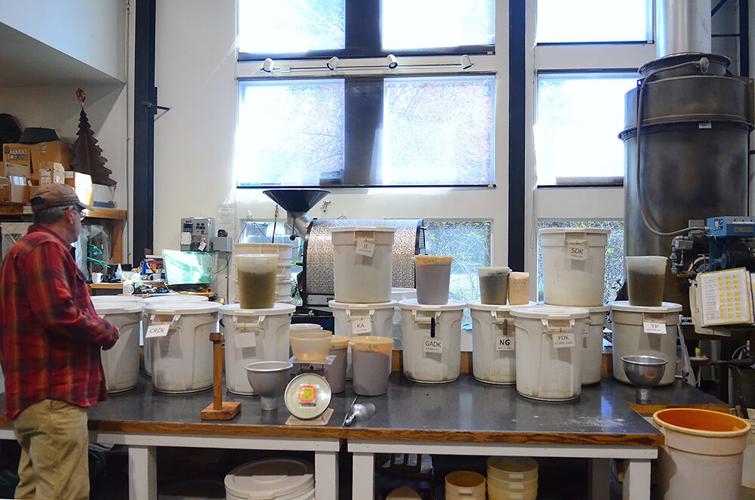
Inside their store, operations remain the same. Buckets of roasted beans are sorted by country of origins, 13 in total. In the corner is an old-school cast-iron drum roaster, which Margotta calls the “Cadillac of roasters.”
But outside their storefront, sourcing these beans has become increasingly difficult since purchasing the company five years ago.
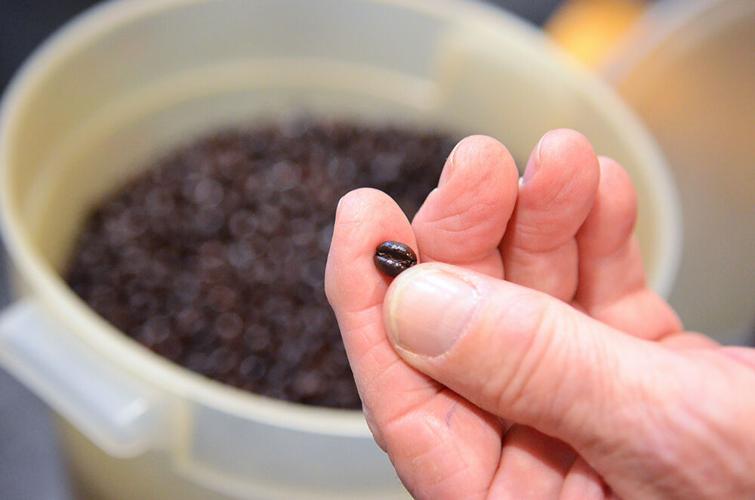
Tanzania Peaberry from Hood River Coffee Roasters.
Emma Renly photo
For example, Margotta pointed to Sumatra, an island in Indonesia, which produces a sweet, nutty flavor profile. In late November 2025, parts of the region faced destructive floods from a cyclone, wiping out their agricultural exports, including coffee trees that take years to mature.
In other coffee-exporting countries, rising temperatures, droughts, and more flooding contribute to the reduced availability of an already tricky plant to grow.
Climate change is one of the biggest drivers in the price fluctuations over the past two years, according to Dylan Clancy, the Director of Coffee at Nativ Cafe in White Salmon.
At Nativ, he selects the drinks menu, pricing structure and roasters. Since the cafe doesn’t roast its own beans or have a large stockpile, he said the business is reactive to industry price changes.
Another cause of the fluctuations was the 40% tariff on goods from Brazil, including coffee, which took effect in late July 2025. This was on top of the broader 10% reciprocal tax already applied globally.
“With that tariff, our espresso blend almost doubled in price for us,” Clancy said. “That then impacts all of our drinks, because that’s our backbone of a latte or anything else we make.”
The 40% tariffs on Brazilian agricultural products were modified in November 2025, but Clancy speculates that coffee won’t go back to previous prices.
“I would be very surprised,” he said. “Those tariffs will continue to impact the cost of coffee, even after they no longer are necessarily applied.”
In addition, the recent surge in gas prices due to the War in Iran and restricted shipping through the Strait of Hormuz has impacted all aspects of the industry — from farming operations to transportation to the cafe’s stoves and heat costs.
“All of that’s going to start getting more expensive,” Clancy said.
Despite the challenges, he remains passionate about coffee, in part, because of the community it creates at Nativ Cafe.
“It’s a central hub for people to come together,” Clancy said. “In the Gorge, people often do a sport or activity together, but don’t talk. But if you say — hey, want to go grab a coffee? — It’s an opportunity to talk with friends.”
Clancy also believes that when people drink products from diverse regions, it might pique their curiosity about different cultures.
He still remembers tasting a fruity-blueberry coffee from Ethiopia, which has such a compelling, unique flavor that he then decided to step into the coffee industry to learn where it came from.
•••
Our journalism needs your support. Visit columbiagorgenews.com to read more and subscribe.



Commented