
By Aziza Cooper-Hovland
Columbia Gorge News
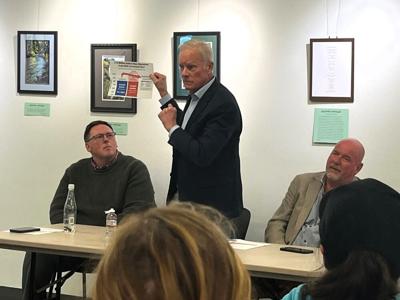
WHITE SALMON — With Washington state’s short session in the books, Republican legislators Rep. Kevin Waters, Sen. Paul Harris, and Rep. David Stuebe came to hear from their constituents in District 17 during a town hall at the White Salmon Library on April 7.
There, the debate grew heated over childcare, especially the Transition to Kindergarten (TK) program, which serves more than 7,000 students across Washington and recently saw a 25% reduction in funding. TK helps 4-year-olds who need additional preparation to be successful in kindergarten, and state data consistently demonstrate that TK kids outperform non-TK kids across six key academic metrics. Now, 2,000 fewer children will have access to the program.
“I do not think TK is coming back,” said Waters. When asked why it was cut from the budget, Harris said, “It was overutilized. We had too many kids take advantage of TK ... They were spending too much money on it, so they reigned it in.”
One resident questioned how a program for children could be “taken advantage of” before Harris clarified that was the reason the majority party gave for the budget cut.
“I am pissed that 35-40 years of democratic rule hasn’t given me universal childcare. Pissed to the max,” said Gabrielle Gilbert, a nanny who has organized a series of childcare workshops for elected officials and lives outside of White Salmon. She challenged the legislators to “give me a funded, core function mandate across this state. Tell me what language looks like for universal childcare that you would agree to.”
Harris replied that the reason for the lack of childcare was the overspending in other areas. “The real problem in our state is spending,” he said. “We are spending $14 billion more than Idaho. I don’t want to be Idaho, but maybe I’m wasting $4 billion.” As a solution, Harris encouraged a comprehensive audit and sticking to the proposed budget.
‘Millionaire tax’
Waters, Harris, and Steube also spoke about how the millionaire tax, which passed despite them voting against it, was going to back-fill childcare funding rather than going directly to schools, as it had been branded by Democrats.
“If the millionaires move, we might need more money, so it might be the 500-aires next,” Harris said, explaining his vote was to stave off financial creep. If the majority, however, had agreed to put it in writing that it would only be for the millionaires, Harris would have signed off on it.
When asked where tax dollars were going, they spoke about the Clean Climate Act, and how one example of what they considered wasted resources was converting the ferries on Puget Sound to run on electricity.
As a member of the Energy and Environment committee, Steuben said he was concerned that the ferries were already very efficient, and didn’t cost much to maintain. Making them electric would be expensive, and rather than building them in Washington, they would be built in Florida and then taken through the Panama Canal to the Sound because that was cheaper.
“That doesn’t make sense to me,” Stuebe said. “Why are we taking Washington money and giving it to Florida? Because we want to have electric ferries.”
Minority party representation
Throughout the town hall, Waters, Harris, and Steuben emphasized how governing as the minority party is difficult, especially without access to the big budget committee, where legislative priorities and funding for local projects are often set. “It’s a one-party rule,” said Harris, “We’re not in the room at all.”
Harris sponsored four bills that were passed, including a state healthcare technical assessment, which updated the procedures that insurance would cover for the first time in 20 years. But all three said rural needs and projects are being overlooked for the urban centers, partially because they don’t have input on the general budget.
“It’s been really important for myself,” said Waters, a self-proclaimed Skamania County boy, “to bring home the projects for White Salmon.” Stuebe said his fix was making friends across the aisle and creating relationships so that rural needs will be taken into account, and legislation will have bipartisan support.
Waters spent this legislative session getting a bill related to fire breaks passed, which has been historically difficult due to the state’s reticence to cut timber, he said. And even though the state confirmed the 2023 Tunnel Five Fire was caused by a Burlington Northern Santa Fe (BNSF) train, he stressed how the railroad company has been unwilling to collaborate on wildfire mitigation efforts. “They are their own mafia and government, and they tell you what they are doing,” said Waters.
“It’s hard for me to look at BNSF when I feel like we’re not managing our part very well,” Harris countered, explaining that a lot of the state at wildfire risk, especially along highways, is not being properly managed with clearing and fire breaks.
There will be another town hall on April 28 in Stevenson.


Commented
Sorry, there are no recent results for popular commented articles.