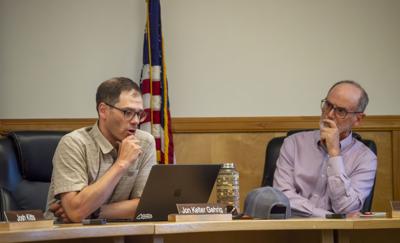
Commissioner Jon Kelter Gehrig speaks at the final public hearing held by Hood River County’s Planning Commission for Amazon’s proposal to build a 49,000 square-foot warehouse and distribution center off Neal Creek Mill Road and Highway 35, just outside of Odell.
Commissioner Jon Kelter Gehrig speaks at the final public hearing held by Hood River County’s Planning Commission for Amazon’s proposal to build a 49,000 square-foot warehouse and distribution center off Neal Creek Mill Road and Highway 35, just outside of Odell.
HOOD RIVER CO. — On May 27, Hood River County’s Planning Commission was poised to greenlight Amazon’s proposed 49,000 square-foot warehouse and distribution center outside Odell until Commissioner Jon Kelter Gehrig spoke.
County staff tentatively approved Amazon’s last-mile facility, located off Highway 35 on port-owned property sold for $3.41 million, in late February, which land use advocacy group Thrive Hood River subsequently appealed. Commissioners heard additional testimony from the applicant, Thrive and the public on April 22, as previously reported by Columbia Gorge News, followed by another written comment period.
With the record closed, Wednesday’s public hearing was only for commissioner deliberation, and they went down the line.
Commissioner Jamie Loomis didn’t have anything to add, and Commissioner Ryland Moore hearkened back to House Bill 2691, an effort to jumpstart industrial development on sites just like the Lower Hanel Mill land where statewide planning goals might otherwise apply. While appreciative of the persistent public concern over road safety, Commissioner Kira Guisto noted that Oregon’s Department of Transportation affirmed the applicant’s traffic impact study multiple times and felt their hands were tied.
An average of 8 box trucks, 24 semis, 134 delivery vans and 382 passenger vehicles are expected to enter or exit the facility daily, totaling 548 trips. That figure may jump anywhere from 33-50% during peak online shopping season from mid-November through December, and a couple of other times per year, according to additional analysis by NV5 Engineers and Consultants.
The study itself examined four nearby intersections and used data collected during the height of morning and evening travel on a single day in September. Commissioner Jay Lyman requested that NV5 also gather data during harvest and ski surges for a more representative sample, but only as a condition of approval. Then, Gehrig launched into his prepared remarks.
“Consistency in the statutory construction is not merely a logical preference; it’s a fundamental principle of our code interpretation,” he said. “An applicant who has benefited from a broad reading of one provision cannot credibly demand a narrow reading of another.”
“Site access is the subject that generates the trips, and those trips cause congestion. The causal chain does not stop at the property line,” Gehrig continued.
During the prior hearing, one resident argued that Amazon’s proposal didn’t meet the definition of a wholesale distribution or outlet facility, which are permitted outright in industrial zones, since the corporation would be serving retail customers as opposed to other merchants.
That reading doesn’t track with local precedent, as county staff later pointed out. Four operations adjacent to the site, some with showrooms and direct-to-consumer sales, hadn’t been subject to a conditional use permit. Gehrig didn’t dispute the county’s position; however, he did contend that the same wide scope of what’s characterized as wholesale should apply to the associated design standards for outright uses.
Hood River County’s Zoning Ordinance requires applicants to demonstrate that “site access will not cause dangerous intersections or traffic congestion.”
So, in Gehrig’s view, the traffic study was inadequate because it failed to address the network-wide impacts of increased truck travel on Highway 35, only analyzing the facility’s four entry and exit points that provide direct site access. Any study omitting peak data — either from Amazon or tourists, growers and skiers — can’t serve as the standard for compliance either, he added.
Commissioner Josh Kitts, the last in line, agreed. What followed was procedural back-and-forth over whether to have Amazon furnish an expanded traffic study that captures more intersections based on peak flows, or deny the proposal entirely.
“The applicant has responded to all of the testimony that has been received and done additional studies as opponents raised concerns in the record,” said Carrie Richter, the attorney representing Amazon. “I am open to extending the record to provide even more analysis.”
She also emphasized that NV5 had modeled a scenario with double the traffic running and found no evidence of complete failure at those same four intersections. Nevertheless, Gehrig moved to sustain Thrive’s appeal.
With Moore and Chair Erick von Lubken against, the motion passed, 5-2.
County staff will have the decision reduced to writing in a few weeks, which Amazon can then appeal. Richter didn’t provide any inclination about what the applicant intends to do, but if appealed, Hood River County’s Board of Commissioners will have the final say.



Commented