
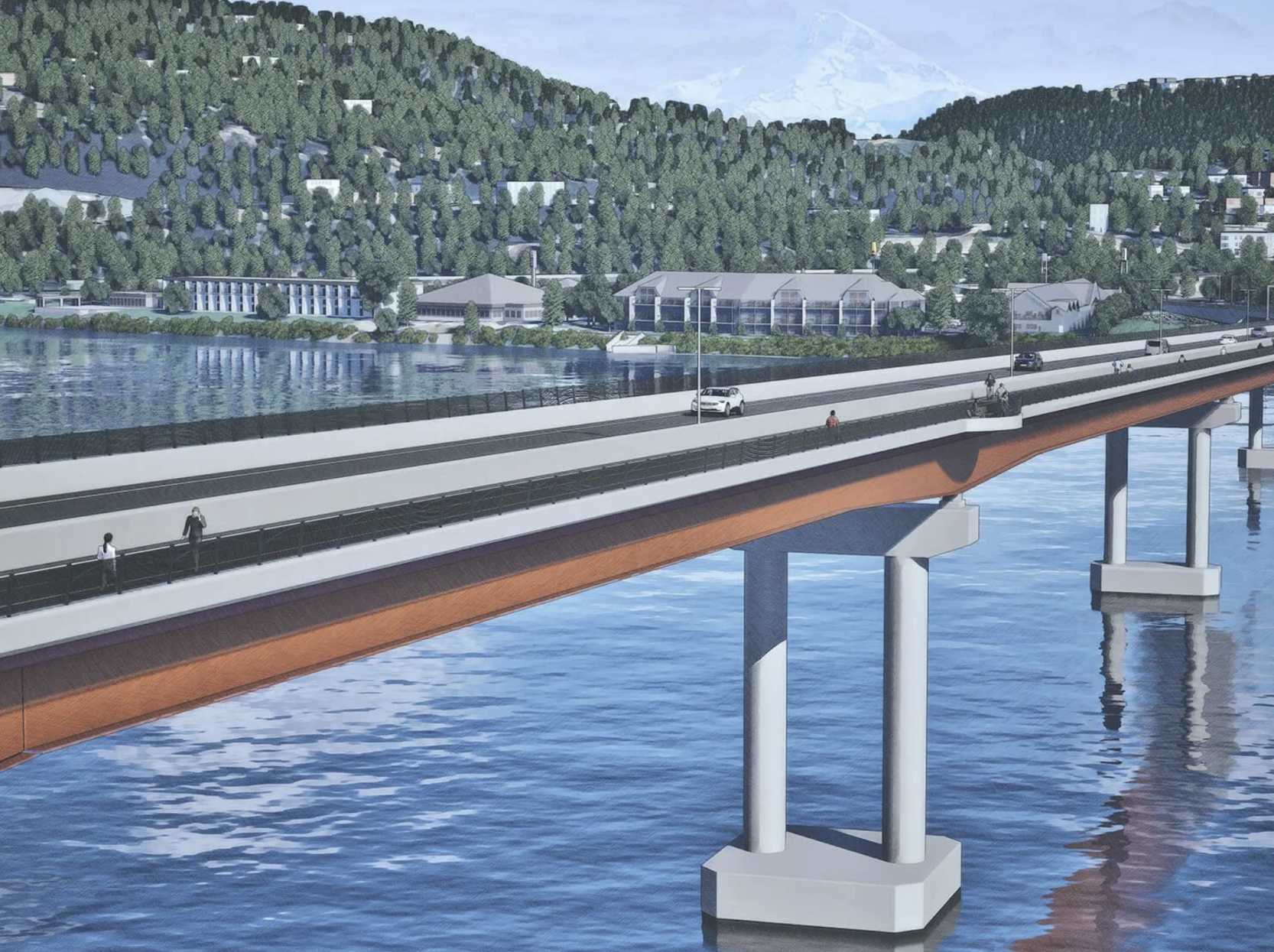
HOOD RIVER — Now it’s all up to BIP.
Having crossed multiple roadblocks over the past decade, local officials seeking to replace the aging Hood River-White Salmon Bridge are awaiting word on a critical funding request to the federal Bridge Investment Program (BIP). But time is running short as summer wanes and construction deadlines draw near.
Following Port of Hood River discussions beginning around 2014, city and county officials on both sides of the river created a new, bi-state public entity to build and operate a new bridge after state transportation agencies declined the challenge in July 2023. It’s called the Hood River-White Salmon Bridge Authority, entirely separate from the port.
Those local officials surmounted environmental hurdles, most recently this past fall with a favorable record of decision from the Federal Highway Administration (FHWA). They’ve hired a national engineering firm to design the structure. Final plans will be ready by late winter.
Crucially, they overcame a 2024 funding challenge, when engineers determined bridge piers would need to go much deeper than anticipated, essentially doubling replacement cost. The pier discovery was an unwelcome surprise, as officials scrambled to close a more than half-billion-dollar shortfall.
Their solution: close the gap through a $532 million BIP federal grant request.
The request is made. Will it be awarded? And if it is, will it come on time to keep this project on track?
There’s no word so far. If days and weeks of waiting extend into late summer or early fall, the project could miss a brief “in-water” period next winter (2027-28) when fisheries restrictions allow work to take place in the Columbia River. That’s between October and March. New bridge piers must be placed during that window, but work can’t begin until materials are ordered and arrive, rights-of-way acquired, and a construction contractor selected — just a few of myriad tasks, all contingent on assured funding.
BIP is a Biden-era effort to upgrade the nation’s myriad failing bridges. It’s a competitive program with limited resources, and there are lots of failing bridges (see sidebar). The Hood River Bridge, built in 1924 for Model T’s and wagons, is a case in point. Combined with sources already secured, and a loan to be repaid through future toll revenue, BIP would fully secure the $1.12 billion needed for construction, engineering, permits and other replacement costs. Construction would begin in October 2027 with completion anticipated in 2031.
Total construction is estimated at $775 million, with engineering and other “soft costs” adding up to the $1.12 billion total. The construction budget includes a dedicated bike and pedestrian lane, wide enough for emergency traffic. Designs are available at this link.
The Port of Hood River received a $5 million BUILD grant in 2020 for initial design (Klickitat County was a co-applicant) and also committed $1.25 million worth of its own funds. Congress approved an $8 million appropriation in 2024, followed by a $200 million federal infrastructure grant that same year. Oregon and Washington committed $250 million in 2025.
Now it’s a waiting game for BIP. And that’s not the only delay.
The Congressional appropriation and the infrastructure grant have been held up for months by federal contract review, exacerbated by federal staff turnover. The BUILD grant awarded six years ago has yet to release its final reimbursement of about $400,000. The highway administration lost more than a quarter of its workforce through reductions driven by the White House, according to ENO Center for Transportation, a non-partisan group based in Washington, D.C.
While such delays are frustrating now, they could prove far worse during construction.
Federal funds are reimbursed following expenditure, presenting a cash flow issue. Although it has adequate reserves now, thanks largely to that $250 million from Oregon and Washington legislators, the bridge authority would be hard-pressed to maintain cash flow should reimbursements be delayed during construction, when contractor invoices must be covered immediately to avoid costly schedule disruption.
As a safeguard, project management firm HNTB hopes to secure a written agreement with highway administration, detailing in advance all information needed to assure timely reimbursements.
“If contractors aren’t paid on schedule, crews and equipment could sit idle, work may have to be remobilized, and the project could face delays costing additional overhead and financing costs,” Grant Polson, bridge authority co-chair, explained during its July 27 meeting. “Payment on invoice would allow the authority to pay contractors promptly, protect the construction schedule and avoid unnecessary costs to taxpayers.”
Yet securing next winter’s “in-water” window isn’t the only time crunch. The federal Surface Transportation Act (STA) needs to be either extended or “reauthorized” through new legislation prior to the end of the current fiscal year. BIP is funded through the Surface Transportation Act. If the bridge authority receives formal notice of a BIP award while the current STA remains in force, the funding is secured since funds would be drawn from the current fiscal year’s allocation. If the fiscal year concludes with no award, there’s no telling how long it will take for Congress to either extend or reauthorize the legislation.
This past May, the U.S. House of Representatives Committee on Transportation and Infrastructure released its “BUILD America 250 Act,” which would authorize $580 billion over five years for surface transportation. About $474.4 billion of that is dedicated to the Highway Trust Fund. House legislation still awaits a floor vote, and the House is now in recess until mid-September.
As of July 31, the U.S. Senate had not yet released a comparable version (four different Senate committees share responsibility for various portions of the act). On Saturday, Aug. 8, the Senate approved a bi-partisan “continuing resolution” to keep the government open until Dec. 11; the Senate is now in recess until Sept. 14.
The continuing resolution includes an extension of the Surface Transportation Act. Sen. Patty Murray (D-Washington), Senate Appropriations Committee vice-chair, emphasized roads and bridge funding in her statement on the continuing resolution. The BIP can be awarded throughout the extension to Dec. 11.
The continuing resolution itself is a stopgap measure, postponing yet another government shutdown. At some point this year or early 2027, Congress will need to pass a new fiscal year budget.
If there’s no formal BIP award before the fiscal year ends and the Surface Transportation Act is neither extended nor reauthorized, BIP itself might no longer be available. Or, an award might be made, but at less than the $532 million request. Either scenario resurrects the construction budget gap.
Finally, as bridge authority commissioners await BIP, there’s one more piece to the funding puzzle called TIFIA. This is the Transportation Infrastructure Finance Innovation Act, a Biden-era credit program administered through the U.S. Department of Transportation. This is a federal loan offering favorable interest rates for large public projects like bridges. It’s the final piece, after BIP, needed to secure the $1.12 billion replacement cost. A TIFIA loan, covering any gap between project cost and grants received, would be repaid through bridge tolls.
The bridge authority had received no updates on TIFIA availability as of their July 27 meeting. On Aug. 24, bridge commissioners will review bond market options. As Debbie Smith-Wagar, finance director for the Port of Hood River, explained to bridge commissioners, the bond market would carry a higher interest rate but might save money overall by keeping the project on schedule. (The bridge authority is a separate entity from the Port of Hood River, but the port and bridge authority share certain interim tasks, including fiscal management, through an intergovernmental agreement.)
Through all this, Hood River Bridge replacement is a high priority for the Pacific Northwest’s Congressional delegation, two of whom serve on the powerful Senate Appropriations Committee: Oregon’s Sen. Jeff Merkley, and Washington’s Sen. Murray.
Sen. Merkley emphasized the project’s importance when questioning FHWA Administrator Sean McMaster in a June 3 hearing of the Senate Environment and Public Works Committee. (Here’s a video link.)
“I have long championed the Hood River-White Salmon Bridge replacement project and continue to advocate to the highest levels of the administration for a strong federal commitment to a seismically resilient bridge that meets the diverse needs of the region, including keeping locals, visitors, and goods flowing safely throughout the Mid-Columbia region,” Merkley told Columbia Gorge News.
“The Hood River-White Salmon Bridge Replacement Project is critical for communities along the Columbia River,” Sen. Murray told Columbia Gorge News. “There’s no question we need to replace the existing one hundred-year-old bridge that’s near the end of its usable life. This replacement project is essential to local economies and the safety of residents in both Washington and Oregon — so I’m not going to stop fighting to make this replacement project a reality.”
In the future, Murray added, that could include program modifications to help bi-state connection projects compete for funding. Meanwhile, the bridge authority will continue its full-court press toward construction starting in October 2027, hoping for a BIP award.
The authority is conducting a fiscal trend analysis, tracking operational costs, revenues, design savings, inflation and other factors. Thus far, these might have shaved $30 million to $40 million from the construction budget; estimates will be reviewed in late August, now that bridge designs are well-advanced. Savings would supplement the contingency budget, set aside to address unexpected costs.
And if BIP proves elusive?
Having learned from past experience, the bridge authority and its public partners will cross that bridge before they get to it, identifying other options to keep the project alive.
It’s all about having a Plan B.
This story was updated to correct the total funding shortfall that bridge authority officials learned about in 2024 once engineering began. The new estimated cost rose by roughly half-a-billion dollars, not half-a-million.


Commented