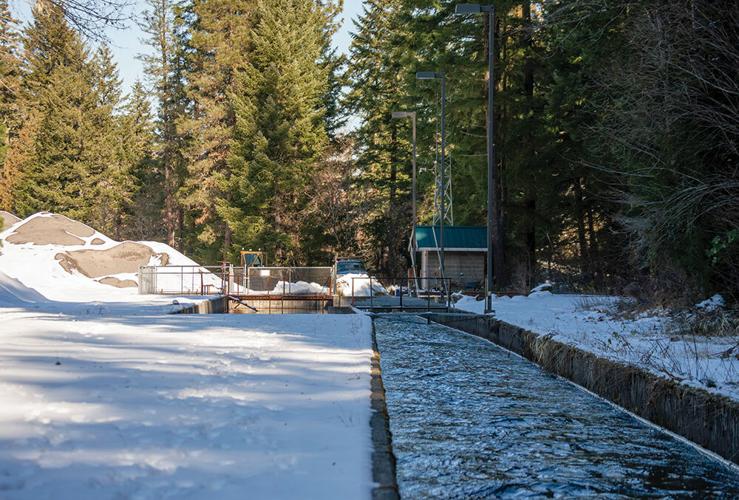
One of 11 water diversions managed by Farmers Irrigation District in the Hood River Valley, pictured in winter 2025. Water gets channeled from the mainstem Hood River, then travels through a 300-foot tunnel, a custom fish screen and finally into two pipes.
Faced with poor snowpack, two irrigation districts, a grower and a conservationist share what they expect this summer
HOOD RIVER CO. — This winter’s poor snowpack may have severe implications as orchards look to water their pears in August and September. But the difference in concern among two local irrigation districts is somewhat stark, and conservationists see the conditions as only more reason to pursue water-saving initiatives.
By now, all but one of the 10 snow test sites in the Hood-Sandy-Lower Deschutes Basin, the highest of which sits at 5,970 feet, are completely barren. Most have been for several weeks. Basin-wide snow water equivalent, or the amount of liquid water stored in snowpack, was at 51% of the historical median this time last year and is 0% now. That’s the lowest it’s been since 2015, according to the Natural Resources Conservation Service.
Dating back to 1895, Oregon’s winter was the second warmest on record, causing both less accumulation and earlier melting as high temperatures carried into part of spring, as previously reported by Columbia Gorge News.
“For those upper tributary streams that we’re feeding our reservoir with, that we’d also be passing water through for use at this point, they’re at a normal July flow level — and we’re in May,” said Megan Saunders, watershed project manager for Farmers Irrigation District, about two weeks ago.
With Dee Irrigation District under its operational purview, Farmers provides water to about 7,000 acres and 2,000 customers, roughly half being residential, living southwest of city limits.
The upper and furthest west part of Farmer’s district, reliant on Gate and Cabin creeks that feed Kingsley Reservoir, is most vulnerable during dry years. Tributaries supplying the middle section, including Oak Grove and part of Country Club Road, stay flowing for longer but still need help in late summer. Drawing entirely from the mainstem Hood River, Saunders doesn’t anticipate that lower district patrons around the high school will see extreme restrictions in the coming months.
It’s all a balancing act, though.
“We’ll be doing constant adaptive management,” Saunders said. “What’s the right amount, and where do we need to go to reach the end of the season?”
With 1,003 acre-feet of storage, Kingsley acts as a crucial bank, but it accounts for only about 10% of the total water supply for Farmers’ upper and middle sections. Saunders hopes that Kingsley won’t come into play until late June. With such dismal snowpack, that’s now dependent on intermittent precipitation, like last week’s thunderstorm, to stave off demand.
If necessary, restrictions will come, because using less water over the season is always preferable to having none in August and September.
In one study on the carry-over effects of drought stress, withholding later-season water from young pear trees caused smaller leaves with smaller stomata, pores that govern the exchange of gases between the leaf and atmosphere, the following year. Other physiological responses occurred, too, and recovery can take several years even without water limitations.
“We are in a snow drought,” said Alexis Vaivoda, Farmer’s district manager. “What’s going to create a lot of pressure is if we piggyback another bad winter on top of it. That will put a large stress on both the district and the growers.”
Across the valley, East Fork Irrigation District has a more optimistic outlook, barring something similar to 2021’s heat dome, where basin-wide snow water equivalent fell from 102% of the median down to nothing in June alone. The service area begins north of Odell and spans both sides of Highway 35 through Pine Grove, nearly reaching the interstate. In combination with Mt. Hood Irrigation District, Manager Steve Pappas waters roughly 12,000 irrigable acres.
“As long as they don’t shut my diversion, we’re going to be running the whole irrigation season,” he said. “We’ve never been in that position before, and I really just don’t see that happening.”
Where Farmers has 11 diversions and partially relies on smaller, more variable streams, Pappas serves the whole district with just one diversion on the East Fork Hood River. Backed by an old, large water right, it’s steadier, enough so that he doesn’t have a reservoir, either. The glaciers on Mount Hood serve as East Fork’s bank, and Pappas expects that melt to start muddying waters come mid-July if temperatures don’t spike.
The real reason Pappas feels confident, however, is East Fork’s consistent progress on infrastructure upgrades. With work on the final section slated to begin in fall 2027, the district’s system will soon be piped and pressurized as opposed to traveling, which requires a constant flow of water. Pappas estimated that an extra 2.7 billion gallons of water will be flowing down the East Fork every year once piping is complete.
And the results are already showing. Last Tuesday, the district was running its diversion at 62 cubic feet per second (cfs) with roughly 85% of its patrons active, and the highest Pappas expects to run is 82 cfs. East Fork can pull up to 104 cfs.
“We’d be in a mess if we hadn’t started piping five years ago,” he said. “We wouldn’t have enough water.”
Farmers has already piped most of its district, often leading the region in water efficiency and conservation practices, but paying off the loans for those upgrades has proven more difficult with hydropower revenue being unstable, as previously reported byColumbia Gorge News.
One of 11 water diversions managed by Farmers Irrigation District in the Hood River Valley, pictured in winter 2025. Water gets channeled from the mainstem Hood River, then travels through a 300-foot tunnel, a custom fish screen and finally into two pipes.
Nathan Wilson / file photo
Better streamflow starts in orchards
“Everybody’s worried about it, obviously,” said Stephen Hanners, a third-generation grower just outside Hood River proper. “Unless we hit a point where we have to do cutbacks, there’s not a whole lot that we can really do besides sit here and wait and hope.”
Hanners, who’s also a Columbia Gorge Fruit Growers board member, has 85 acres of pears in the lower section of Farmer’s district, so he’s in a better spot than some other patrons. If restrictions are needed, though, Farmers would start by having users cut back to 75% of their water right, followed by a half-week rotation.
Hanners explained how pear trees will protect their trunk area in scarcity scenarios, letting further-out limbs die, which both reduces immediate yield and future growing wood that doesn’t rebound quickly. But he’s never been completely cut off, and Farmers last implemented a rotation in 2015.
More likely is that Hanners and crew will have to run shorter sets if there isn’t enough pressure to activate a whole section of his system. That means more dial-turning, manpower and potentially overtime pay.
“All of our irrigation systems have been updated in the last two decades to fairly modern standards, so there’s not really a lot of efficiency we could squeeze out of putting in the newest, latest-and-greatest system, and I think that’s the same for most other farms I’ve spoken to,” Hanners said, which is music to Cindy Thieman’s ears.
“On-farm irrigation is the king for impact. About 90% of our overall water use in the basin is irrigation,” said Thieman, executive director of the Hood River Watershed Group. In an ideal world, every grower would be watering with micro or drip sprinklers, testing soil moisture to inform timing and all of the irrigation district infrastructure would be pressurized pipeline.
Beyond improving riparian and instream habitat for fish, her nonprofit aims to maximize flows in the basin by preventing water from unnecessarily leaving rivers wherever possible. The group, for instance, helped fundraise for East Fork’s recently-completed Eastside Lateral Pipeline project that has kept water from being wasted through previous end spills on that line.
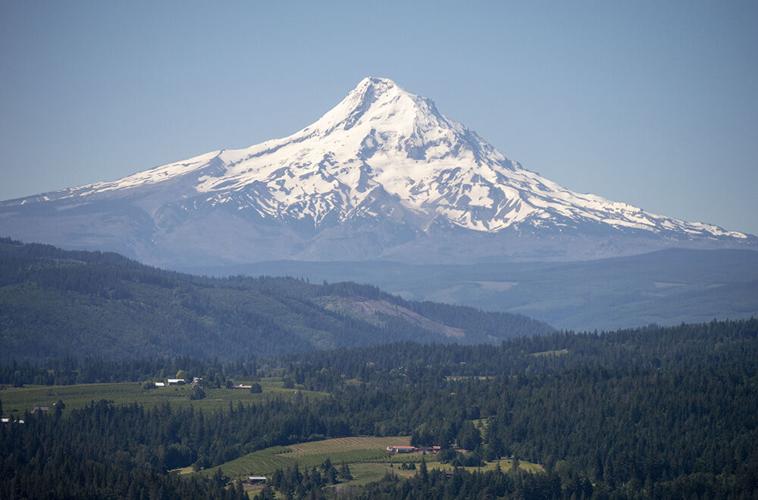
It’s an effort to prepare for a future where winters like this year’s feel more normal, where Mount Hood’s glaciers are several orders smaller.
Back in 2015, the U.S. Bureau of Reclamation led a study on how climate change will affect water availability in the Hood River Basin, subsequently informing a water conservation strategy. Under the median-severity scenario, a combination of likely, cost-effective mitigation measures — on-farm efficiency and conveyance system upgrades, but also reservoir expansions, hydropower rebalancing and voluntary fallowing — will either maintain or slightly raise current streamflow levels.
That chance to offset, or even reverse, climate-induced water losses is motivating for Thieman, because if nothing is done, there won’t just be economic consequences.
“Lower instream flows means that there’s just less available habitat as the water drops, and stream temperatures will likely be warmer this summer,” she said. “The combination of concentrating the fish and warmer temperatures puts a lot of stress on them. They’re competing for food and just space.”
Shallower streams could also reveal physical obstacles for coho, chinook and other anadromous fish migrating upstream, Thieman added. The Northwest River Forecast Center predicts that the mainstem Hood River will be flowing at 66% of its average from late May through September.
To further conservation, the Hood River Watershed Group plans to put together a booklet for residential users about efficient irrigation, filtering water, common misconceptions regarding water rights and drought-resistant, firewise plant options that native pollinators prefer, since there aren’t many resources out there.
Thieman is also working to put together a voluntary fallowing program, particularly for hay fields, that would pay people to temporarily halt irrigating, coupled with help replanting a more resilient pasture.
“I am looking at this summer as an opportunity to galvanize more options, galvanize more action,” said Thieman. “Summers like these are hard, but they also sharpen our focus on and motivate us to take the next step, whether it’s with our own farm or with our own yard.”
Saunders with Farmers had a closing message for anyone irrigating in the coming months as well.
“Water is a shared resource amongst the community, whether it’s patrons within Farmers but also everyone else in the basin,” said Saunders. “Doing your part to help means that everyone has a little less pain as we get through the summer.”




Commented