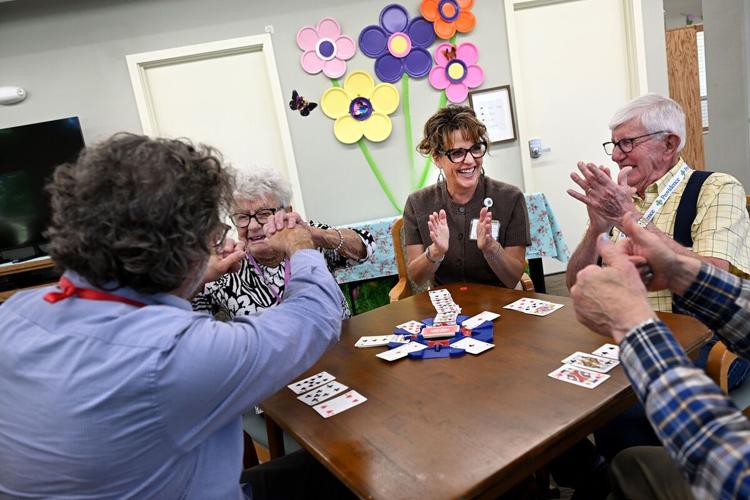
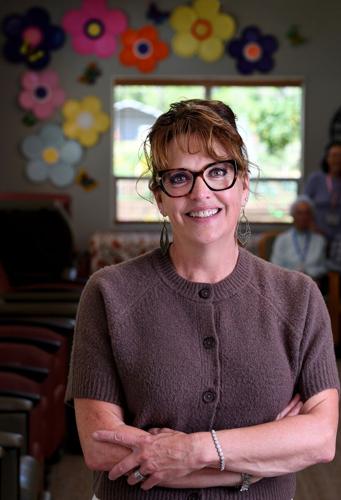
HOOD RIVER, OR: Tonya DeHart, program manager at the Sunshine Club, is pictured in the day room at the club on June 1, 2026, in Hood River, Oregon. The Sunshine Club is an adult day group for people living with dementia, Alzheimer’s or related issues. The club provides a safe and engaging space for patients with dementia and other memory loss issues. Activities during the day include music and dancing, card games and helps keep people socialized, active and given a sense of community and support. (Photo by Helen H. Richardson)
By 12:30 every afternoon, the same woman stands up and announces she needs to go home.
“Oh no,” Tonya DeHart tells the woman gently, slipping into the moment with a smile. “You’re my volunteer. You signed up to stay until four.”
The woman pauses, thinks for a moment, and settles back into her chair. Someone nearby starts to correct her, but Tonya responds differently. She doesn’t focus on the misconnection; she meets the woman where she is. She continues the conversation by looking beyond the memory loss to the person still sitting in front of her.
In a quiet building tucked inside Hood River, Tonya has built an entire world around this philosophy. Inside Sunshine Club, people with dementia are not treated like burdens, patients, or problems to manage. They are treated like human beings who deserve joy.
She has created a company culture that begins each day with a warm greeting to clients at the door.
“Oh, you’re here,” she says with a smile. “Where have you been? I’ve been waiting for you.”
For someone living with dementia, those words matter. An individual navigating their new life with memory lapses finds their world confusing, unfamiliar, and frightening. And Tonya has found a way to provide routine, purpose, and a sense of being known.
“One of my volunteers says, ‘It’s beautiful that you guys leave their disease at the door and they’re treated like real people.’ And I said, ‘They are real people.’”
Inside the bright and lively adult day program, music plays, coffee brews, and volunteers laugh alongside the participants. Fresh-baked cookies are cooling in the kitchen, music drifting through the room, and trivia games that somehow become comedy shows. Volunteers help guests onto a bus that heads toward tulip fields, ice cream shops, fishing ponds, or nowhere in particular, except for a beautiful drive through the Gorge.
Tonya has created a space where no one is rushed, corrected for forgetting, or treated like they are disappearing. People laugh here. Constantly. And most importantly, the disease stays at the door.
“There was such a need for, I call it, activity care, and to just keep people moving, not sitting and staring at them or watching TV. You know, keep them moving, volunteering, and getting going. We’re not an institution. We need a home-like environment that is happy. Just giving back purpose.”
Tonya wants families to understand that dementia is heartbreaking, exhausting, and terrifying. But the person you love is still in there.
For families living through Alzheimer’s disease or other forms of dementia, life slowly becomes a series of griefs no one prepares you for. First come the repeated stories, then the misplaced keys, the burned pans, the forgotten names, the wandering, the confusion, the accusations, the fear. Eventually, many caregivers begin losing pieces of themselves, too. Tonya has spent decades watching it happen.
Over the years, she has watched adult children care for aging parents while still raising their own children. She has seen exhausted spouses sleep lightly, afraid a loved one might wander in the middle of the night, and families stretched emotionally, physically, and financially while trying to keep someone they love safely at home. She refers to it as the “sandwich generation.” Adults who are simultaneously caring for their own children while also caring for aging parents or relatives. They are “sandwiched” between both responsibilities emotionally, financially, and physically. Tonya believes this is why Sunshine Club scholarships matter and why middle-class families often need more support.
“It’s really for that sandwich generation that are caring for their parents and caring for their children. We see that a lot like, ‘Oh, I got to run my kids to daycare, but I got to get grandma to Sunshine Club.’”
Tonya was raised in what she describes as a difficult home. “I came from a very dysfunctional home, and my great-grandma was my person. She lived till she was 98. She just loved me just as I was. She was so kind.”
After working in preschool education, Tonya found herself drawn toward the elderly. The work felt strangely familiar. In all stages of life, she realized, we all crave patience, creativity, reassurance, and someone willing to meet us where we are emotionally.
“And elder care, the doors opened, and that's where I was supposed to go.”
She began volunteering with Sunshine Club in the mid-1990s when the program was still tiny. At the time, just a handful of participants gathered for a few hours in a church basement. Tonya immediately understood the need and felt her heart tugging at the idea of not making it into institutional care. She wanted to create movement and hold space for humanity. She felt called to embrace the caregivers who desperately needed someone to say, "You do not have to do this alone."
HOOD RIVER, OR: Tonya DeHart, program manager at the Sunshine Club, is pictured in the day room at the club on June 1, 2026, in Hood River, Oregon. The Sunshine Club is an adult day group for people living with dementia, Alzheimer’s or related issues. The club provides a safe and engaging space for patients with dementia and other memory loss issues. Activities during the day include music and dancing, card games and helps keep people socialized, active and given a sense of community and support. (Photo by Helen H. Richardson)
Years later, after temporarily leaving to care for her great-uncle full-time, Tonya returned to find the original program gone. The need, however, had only grown larger. So she went to Providence and spoke with Jamie Henshaw about reopening Sunshine Club. Working with Providence and local supporters, she helped reopen Sunshine Club and slowly transformed it into one of the Gorge’s most beloved resources for families navigating dementia. Community members, families, and supporters rallied together and formed a nonprofit called Friends of Sunshine Club to raise funds for the new building. A local church, Spirit of Grace, donated land for a new facility. Through fundraising efforts, more than $750,000 was raised in approximately 10 months to build a permanent home for Sunshine Club. All of this allowed Providence Sunshine Club to move from its temporary location at Hood River Alliance to a permanent home in 2017.
Tonya loves to plan the day-to-day activities at the Sunshine Club. She and Jaime, alongside their team of volunteers, help plan menus, conduct intake assessments, schedule participants, coordinate activities, support volunteers, organize outings, build individualized care plans with families, and guide fundraising efforts.
“We could not do what we do without our team of volunteers and [my] coworker Jamie Hanshaw, and now my supervisor and all of Senior Village.”
And although Tonya gives accolades to the many who support the Sunshine Club, her presence is definitely not behind a desk; she is actively on the floor with participants, in conversations with families, and alongside volunteers in the middle of activities.
Sunshine Club typically has no more than 12 participants so that care remains intimate and individualized. Participants must be 55 or older and have a diagnosis of dementia. Tonya’s passion is a simple but powerful belief: people living with dementia are still whole people. And keeping it intimate allows them to focus more on one-on-one time.
She describes Sunshine Club as a “home-like environment” where individuals are given purpose, engagement, and connection. She focuses on what can still be experienced: laughter and relationships. She is also committed to continued engagement in life outside the building.
The program operates a 14-passenger bus funded through community support, allowing participants to go on regular outings. These include visits to farms, festivals, scenic drives, lunch trips, fishing ponds, and even “rides to nowhere.” Just simple outings designed not around a destination, but around the experience of flow, adventure, conversation, and freedom. Her goal is to keep participants connected to the world around them, not isolated from it.
Although Tonya is deeply committed to Sunshine Club, outside of her work, she is grounded in her family life. She has been married for over 40 years and is a grandmother to seven grandchildren. She speaks openly about balancing her work with time for her husband and grandchildren.
Sunshine Club runs four days a week, with nearly 20 volunteers. The philosophy feels radically compassionate in a world that often pushes against aging and memory loss. But you do not fight dementia by forcing someone back into reality. You love them where they are. “It’s all about validation,” she says. “You’re not going to fix them.”
Tonya provides free respite care for participants so caregivers can attend a support group and receive education and support. “On the first Friday of the month, I will care for your loved one, no charge, so you can go to the caregiver support group.”
Day after day, she helps families survive one of the hardest journeys life can hand them. Not by erasing the pain, but by making room for joy alongside it. Because inside Sunshine Club, people are still laughing. They are still dancing, baking, exploring the PNW, and still living fully engaged lives.
And thanks to Tonya DeHart, they are never allowed to forget it.
To learn more about Sunshine Club and its support for families living with dementia and volunteer opportunities, visit www.FriendsOfSunshineClub.org