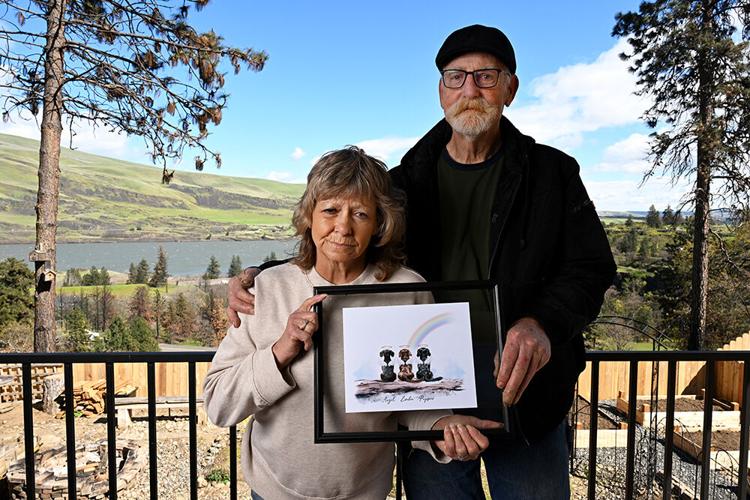
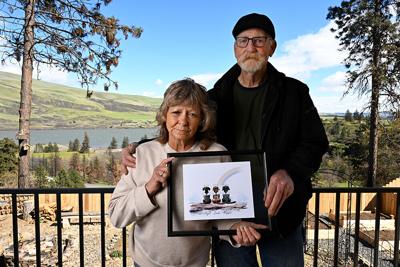
Patrick Hollander and his wife, Sue, stand with a drawing done by their daughter of the three beloved dachshunds, Angel, Zimba and Pepper, that they lost in the Rowena Fire, which also took their Tooley Terrace home, on April 2, 2026.
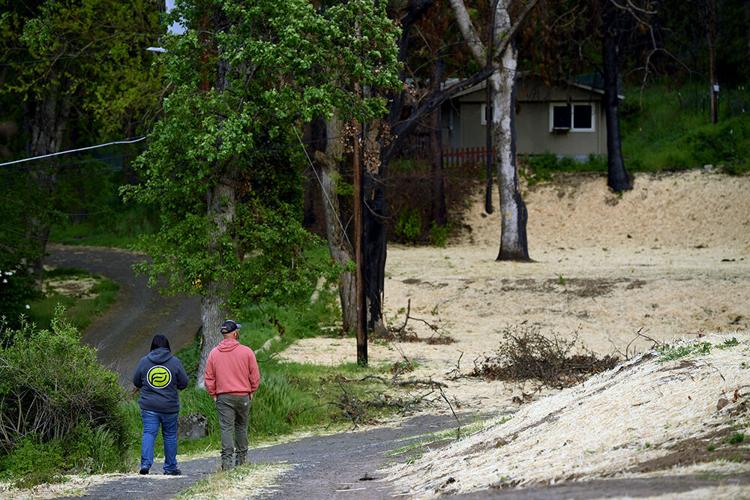
Wylesha Wilcox, left, and her business partner Jose Flores walk through Rowena Crest Manor, a 4.5-acre manufactured home community that used to house many seniors and others with a fixed income, on April 22, 2026. The co-owners saw 10 dwellings go up in flames last June.
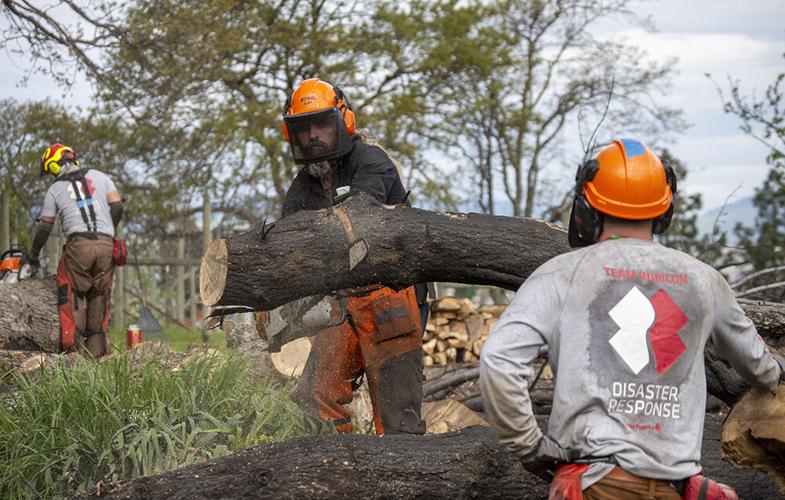
Joe Goodnough, a volunteer with the national, veteran-led disaster response organization Team Rubicon, cuts a soon-to-be-chipped hazard tree on April 10, 2026. Unlike the other volunteers, Goodnough’s grandfather lived in the unincoporated community for 40 years. “I’ve got family on the mountain right now, and these guys are helping my family,” he said.
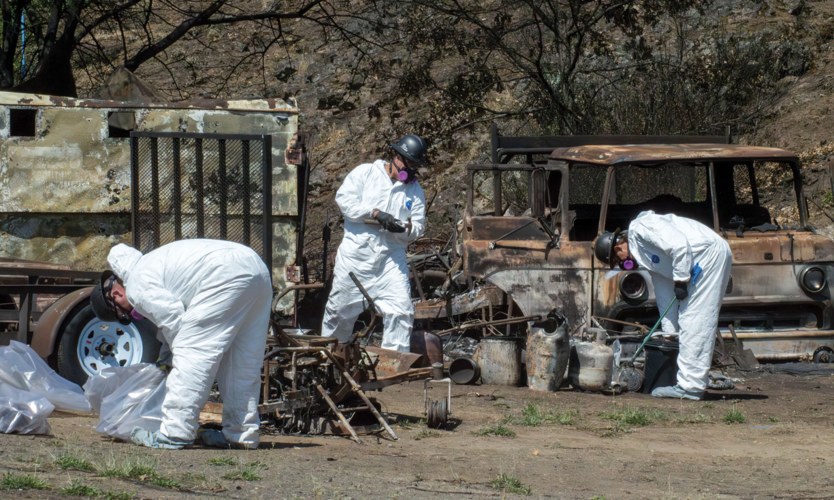
Three contractors from Northwest Firefighters Environmental sort through household hazardous waste in the Tooley Terrace neighborhood on June 15, 2026, after phase one of the Rowena Fire cleanup begins.
Patrick Hollander and his wife, Sue, stand with a drawing done by their daughter of the three beloved dachshunds, Angel, Zimba and Pepper, that they lost in the Rowena Fire, which also took their Tooley Terrace home, on April 2, 2026.
More than a year after the devastating fire, delays hindered rebuilding. Trauma and barriers remain, but residents and local organizations are hard at work.
ROWENA — “There is no understanding the loss of your parents unless you’ve gone through it. This is the same thing,” said Patrick Hollander. “There is no understanding the loss.”
Hollander and his wife, Sue, found themselves without a home, their three dachshunds, a 35-volume set of first-edition Mark Twain novels and countless other keepsakes after the Rowena Fire ripped through the unincorporated community on June 11, 2025. Only their fire pit was left unmarred, but the Hollanders were able to salvage their son’s birth certificate.
Now, a new double-wide sits atop their previously charred property, but most burned lots along Highway 30 east of The Dalles are still empty. The blaze destroyed 62 homes and 92 outbuildings, and Wasco County has processed 15 rebuilding permits for primary dwellings, three RVs and two accessory structures to date, with three more in the queue.
Wylesha Wilcox and Jose Flores have yet to secure a permit. Six years ago, they purchased Rowena Crest Manor, a former auto park established in 1925 where nearly two dozen people used to live until the fire rendered their septic and water systems unusable, and burned 10 manufactured homes. Replacing the infrastructure alone will cost almost $1 million, they estimated, and they don’t expect to start placing new homes until March 2027.
“We’ve seen devastating fires rip through our landscapes and have a lot of impact on people, but not this dense of a population with housing,” said Kelly Howsley-Glover, Wasco County’s community development director. “The scale definitely impacted how we worked through the process.”
At all levels — local, state and federal — agencies had to navigate new territory; “disaster recovery is building the plane while you’re flying,” as Howsley-Glover said. That caused months-long delays and frustration as people wanted to move forward, so residents organized to fill in the gaps. While trauma has brought Rowena closer, key barriers remain.
Cleanup and the Gorge Commission
In the immediate aftermath, support was strong. Oregon Gov. Tina Kotek declared a State of Emergency on June 21, 2025, and visited the Multi-Agency Resource Center, where residents could find representatives from the county, Red Cross, North Central Public Health District and many other entities a few days later.
Lawyers encouraged residents to join their lawsuit against Union Pacific for allegedly sparking the fire (Oregon’s Department of Forestry is still investigating its cause), and monetary donations for those impacted started to come in as Wasco County assembled the Rowena Long-Term Recovery Group. In early July, Oregon’s Department of Environmental Quality began removing hazardous waste like car batteries and propane tanks at no cost to residents.
Three contractors from Northwest Firefighters Environmental sort through household hazardous waste in the Tooley Terrace neighborhood on June 15, 2026, after phase one of the Rowena Fire cleanup begins.
Nathan Wilson photo
Come August, however, phase two of the state-funded cleanup, meant to address ash and all other non-hazardous materials, was dead in the water despite state promises, as previously guaranteed funding vanished. Oregon didn’t have a dedicated debris removal program at the time, so the Legislature, then embroiled over a transportation package, had to authorize any new money on a case-by-case basis.
“I’m very disappointed that it went like this,” Stephanie Krell, public information officer for Wasco County, said after the announcement. “We’ve been telling people that both of the phases were going to be taken care of, and now that’s changed.”
While the county and state worked to develop a new funding mechanism for cleanup, the Columbia River Gorge Commission and United States Forest Service began amending their management plan. Unlike in designated urban areas, such as Hood River or The Dalles, any building that occurs within the National Scenic Area must pass through one of these federal entities, primarily to mitigate any visual or cultural concerns.
The plan — with no provisions on temporary living or storage structures, a relatively short window to rebuild and only one avenue for permit review that could take up to four months — was not written with disasters in mind, a point that commissioners and staff largely agreed upon when they began the amendment process last September.
“Fire victims like us are stuck in limbo. We’re trying to rebuild the same home in the same place, but the rules and fees and delays make it feel impossible,” said Sylvia Crompton, whose family lost two houses, during a Sept. 9 meeting. “We are not just property owners. We are families, neighbors and longtime residents, and we deserve the chance to come home.”
Commissioners didn’t vote on the amendment during their November meeting, and again in December. The commission is required by law to consult with the four Columbia River treaty tribes on any changes to the management plan, but what consultation actually entails isn’t clearly defined. A federal government shutdown added to the gridlock, and Yakama Nation, for instance, was simultaneously contesting several renewable energy projects.
“I’m thinking about how I’m feeling if I’m in an unheated horse trailer right now, hoping to get back on my land,” said Commissioner Valerie Fowler, referring to a Rowena victim she’d spoken to during the Dec. 24 meeting. “And what I’m hearing is, I don’t know when I’ll be able to get you an answer.”
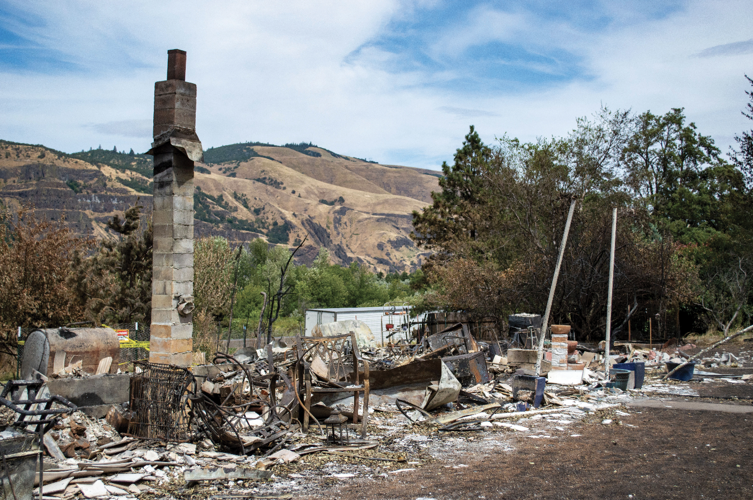
The Rowena Fire reduced many homes along Highway 30 to nothing more than chimneys and scarp metal.
Nathan Wilson photo
The new rules, which included an expedited pathway for homes rebuilt to roughly the same size, footprint and height, among other provisions, were finally implemented in late February. By then, phase two of the cleanup had begun but was still ongoing.
Even with the damage, Rowena didn’t meet the threshold for federal assistance, and Wasco County couldn’t bankroll debris removal alone. According to Erin Zysett, public information officer for Oregon’s Department of Emergency Management, funding eventually came via a request to the State Legislature’s Emergency Board.
As a result of these challenges, two new disaster recovery grant programs for both public and individual assistance were created during the 2026 legislative session, but they’ve yet to be funded.
“The people of Rowena have been incredibly patient throughout an unusually complex recovery process,” Zysett said over email. “We have made some positive strides in establishing state-level grants that we hope to have funded in the next biennium. These grants would allow the state to be more responsive and agile when communities need help.”
Ultimately, though, for a process that many residents expected to be done by the end of fall, phase two wasn’t complete until this past June.
Septic issues
Beyond debris removal and acquiring a permit to rebuild, there’s another major barrier that Rowena residents are trying to navigate: replacing or repairing their septic systems.
Oregon’s Department of Environmental Quality regulates onsite wastewater systems statewide, and the North Central Public Health District administers those rules in Wasco County. According to the district, 20 homeowners affected by the fire have completed a consultation, which is required to obtain a permit, and only two didn’t need any repairs as of Aug. 7.
Much of Rowena was established in the mid-19th century, and septic regulations have changed since then. Steel tanks, for instance, are no longer allowed, but enforcement is relatively loose. Review only comes into play when a system fails, the property is sold or some sort of expansion occurs, the Department of Environmental Quality said.
“Septic systems, even really well-maintained ones, have an average lifespan of about 30 to 40 years,” said Howsley-Glover, Wasco County’s community development director. “We’ve got folks who’ve never had to do anything with their septic, and their home was likely placed in the ‘50s or the ‘60s.”
Because of the fire, modern standards are coming down on a historic community, and its relatively small lot sizes are only increasing individual costs.
Jennifer Duarte and her husband, Justin, lost their home last June and had to relocate their drainfield in order to get a permit. The Duarte’s property, however, wasn’t large enough to accommodate a new one while the other gradually recovered, so they spent $50,000 on a tank that performs more filtration before release to reduce the discharge area’s footprint.
They had to decommission a functioning water well and install a new one to make space, which cost roughly $25,000. The Duarte’s were fully insured when the fire rolled through and acquired a U.S. Small Business Administration loan to help cover the additional expenses, but they still expect to come up short.
“Now, I’m not going to have the funds to rebuild the house to the standard that I had, unless I get another loan, but that’s more money I’m going to owe for something that was already paid off,” Jennifer said. “I’ve drained every bit of savings I had.”
Wilcox and Flores, the owners of Rowena Crest Manor, ran into the same property size issue, so they’ll have to construct a communal septic system for the mobile home park.
Wylesha Wilcox, left, and her business partner Jose Flores walk through Rowena Crest Manor, a 4.5-acre manufactured home community that used to house many seniors and others with a fixed income, on April 22, 2026. The co-owners saw 10 dwellings go up in flames last June.
“This is what’s happening to people who were fully insured and have the means,” said Sylvia Crompton, another Rowena resident. “There’s so many people who are going to lose their properties over this, and they’ll have to sell them at less than market, because whoever takes them over has to go through all of this.”
After an extensive search, Howsley-Glover and other county staff weren’t able to find assistance opportunities specifically for septic systems, and the Department of Environmental Quality also confirmed that two federal programs had expired due to lack of funding. The county also analyzed the feasibility of extending the city’s sewer services to Rowena, but the overall cost and land use obstacles made that option intractable, not to mention how long it would take.
About 29% of the roughly $196,000 provided to fire victims by the Unmet Needs Roundtable has gone toward septic replacement or repair, according to Andrew Danies. The roundtable is an arm of Wasco County’s Long-Term Recovery Group, which Danies chairs, that distributes funds donated to United Way of the Columbia Gorge on behalf of Rowena residents.
To ensure money meets the most victims, requests presented by case managers are capped at $10,000, and just over $188,000 was left as of July 29.
Taking matters into their own hands
“What motivated me was just realizing that there’s so many uninsured people and so many renters who aren’t going to be in line for a lot of the long-term services that are available if you have insurance,” Rowena resident Jack Garvin said during an interview last June. “Just trying to get the people hurt the most help, and right now, that help is information.”
Days after the fire, Garvin organized a Facebook group to share important resources, and that effort has since grown into a certified nonprofit called the Village of Rowena, which Shane Wolfe now presides over. After what his father, Richard, and other underinsured residents were going through, he has facilitated weekly Tuesday meetings for the better part of a year.
“When you lose everything, you become very isolated. You have no more neighbors, you have no more things and you’re in survival mode,” Wolfe said. “In the beginning, those meetings were to make sure that the community had a place to go consistently where they knew that people were going to show up who were going through the same thing.”
Over time, holding space eventually grew into trainings of sorts and opportunities for local partners to connect with residents, Wolfe explained. Danies regularly attends to update folks on the Long-Term Recovery Group, which soon plans to launch trauma support and permitting assistance initiatives on top of already established programs, and Mid-Columbia Fire & Rescue Division Chief Chris Grant recently spoke about fire preparedness, for instance.
Coordinating applications for the Unmet Needs Roundtable, case managers from the Mid-Columbia Community Action Council (MCCAC) are frequent faces as well. MCCAC has also rehoused 28 impacted households while 15 are still using rental assistance, which has state funding through at least June 2027.
In addition to the meetings, the nonprofit has brought in resources to address critical gaps. Wolfe described how charred, unstable trees have been falling at random since the fire, so the nonprofit contacted residents, identified properties in need and coordinated the required documentation for Team Rubicon to come in. For nine days in early April, 30 volunteers from the veteran-led organization, some coming from Alaska and Tennessee, cut down and chipped hazard trees throughout the community.
The Long-Term Recovery Group, Oregon Voluntary Organizations Active in Disaster, MCCAC and community members stepped up to provide volunteer housing, donated meals, machinery and other resources in support of the effort.
Joe Goodnough, a volunteer with the national, veteran-led disaster response organization Team Rubicon, cuts a soon-to-be-chipped hazard tree on April 10, 2026. Unlike the other volunteers, Goodnough’s grandfather lived in the unincoporated community for 40 years. “I’ve got family on the mountain right now, and these guys are helping my family,” he said.
Nathan Wilson photo
More felling is needed, though, and there simply isn’t enough financial assistance to get everyone back on their feet. Wolfe is teaching himself how to write grants and those who have rebuilt, like the Hollanders, are trying to help others navigate the various permitting processes, but Wolfe said that, overall, the emotional toll has gotten more visible since the initial shock and adrenaline wore off.
“I think it’s the sheer exhaustion. You have the trauma, but then you have all this work that needs to get done just so they can be in the walls of their own home,” he said. “Some people have shared some pretty scary things of where they’re at mentally, personally, and I’m not too sure how they’re doing right now.”
Some residents have chosen not to return, and that has changed the fabric of Rowena. However possible, Wolfe and the nonprofit aim to get every underinsured or uninsured person back on their property or in temporary housing while figuring out the utilities, the hazard trees, the now overgrown vegetation, the psychological healing that needs to happen and, ultimately, rebuilding.
Progress has been slow and complex, but where an unincorporated community stood before June 11, 2025, a village is growing in its place.
“Now that this has happened, we became a little closer — we got to know our neighbors a bit more,” Wolfe said. “The fire happened in a day, and the recovery takes years. Rowena, we’re still here, and we’re still working together.”
•••
Helen H. Richardson contributed reporting to this story.