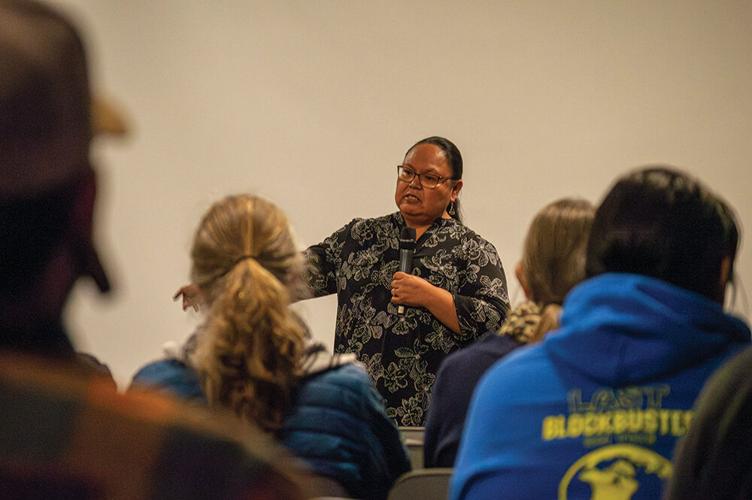
Elaine Harvey, member of the Yakama Nation’s Ḱamíłpa Band and watershed manager for the Columbia River Inter-Tribal Fish Commission, speaks about the documentary “These Sacred Hills” before a screening began at Columbia Gorge Community College on Nov. 20.
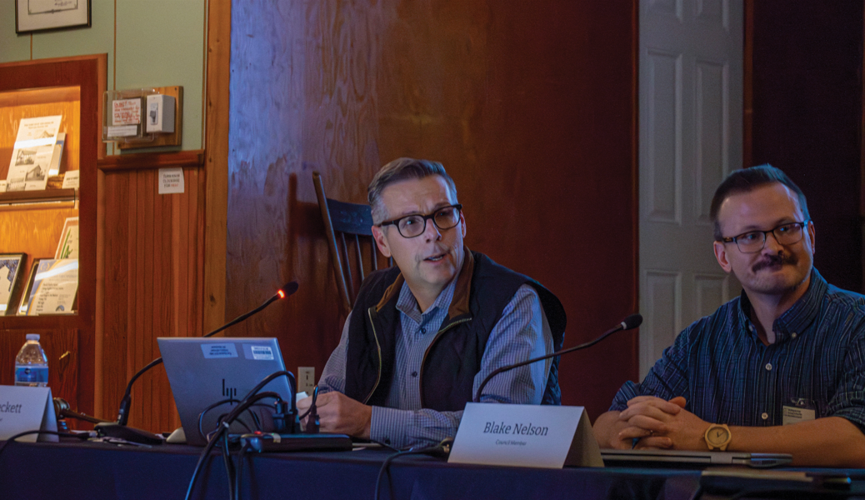
Kurt Beckett, left, chair of Washington’s Energy Facility Site Evaluation Council, opens a meeting about the proposed Cascade Renewable Transmission Project at White Salmon’s Mt. View Grange on Nov. 19, next to council member Blake Nelson.
Elaine Harvey, member of the Yakama Nation’s Ḱamíłpa Band and watershed manager for the Columbia River Inter-Tribal Fish Commission, speaks about the documentary “These Sacred Hills” before a screening began at Columbia Gorge Community College on Nov. 20.
Yakama Nation continues opposition to Goldendale project as another begins Washington’s review process
THE GORGE — Late on Nov. 20, a small crowd at Columbia Gorge Community College listened as Elaine Harvey of the Yakama Nation’s Ḱamíłpa, or Rock Creek, Band introduced “These Sacred Hills,” a documentary about the Goldendale Energy Storage Project, slated to be built on Pushpum a few miles east of Maryhill, and its potential harm to Indigenous livelihoods.
Harvey didn’t begin, however, by explaining how the privately owned but sacred mountain, which translates to “mother of roots,” holds a critical bank of traditional foods and medicines jeopardized by the project, as previously reported by Columbia Gorge News.
Rather, she felt compelled to speak on a different clean energy venture, one that may span from The Dalles to Portland, buried beneath Columbia River silt: the Cascade Renewable Transmission Project.
“Once we allow them that one transmission line, there could be 50 transmission lines in that river,” said Harvey. “Once we allow that one line, our fish could be decimated.”
Among other tribes, the Confederated Tribes of Warm Springs, the Nez Perce Tribe and the Confederated Tribes of the Umatilla Indian Reservation have publicly opposed one or both projects.
Project background
The evening prior, Washington’s Energy Facility Site Evaluation Council (EFSEC) and the lead developer, Connecticut-based PowerBridge, held a meeting detailing the portion planned for Klickitat County waters at White Salmon’s Mt. View Grange. With dozens of permits, approvals and studies yet to be completed, EFSEC staff noted the project is still early on in the review process.
“There is a very significant constraint on the current transmission system,” said Chris Hocker, project lead and a senior vice president of PowerBridge. “Our project is designed to help meet that constraint. It is not the ultimate solution to the problem, which is much larger.”
Primarily fueled by data centers, high-tech manufacturing growth and continued electrification, energy demand across Oregon, Washington, Idaho and Montana is expected to jump 30% by 2033, as previously reported by Columbia Gorge News. But the Bonneville Power Administration (BPA), which manages 75% of the Northwest’s high-voltage transmission lines, isn’t connecting renewable projects to its grid fast enough to meet demand or clean energy mandates passed in Oregon and Washington.
And it’s not for a lack of proposals. Out of 469 large renewable projects that applied for a piece of Bonneville’s transmission capacity since 2015, the agency only signed off on one, according to Oregon Public Broadcasting. The BPA erected 4,800 miles of high-voltage transmission lines between 1960 and 1990; in the past five years, it built one mile.
By linking Bonneville’s Big Eddy Substation in The Dalles with Portland General Electric’s Harborton Substation, Hockner said the $1.5 billion, 100-mile-long line would help more of those projects come online by allowing 1,100 additional megawatts of electricity to move across the Cascades.
That’s enough to power 800,000 homes along the Interstate 5 corridor, where solar and wind energy are far less abundant compared to the eastern halves of both states.
Kurt Beckett, left, chair of Washington’s Energy Facility Site Evaluation Council, opens a meeting about the proposed Cascade Renewable Transmission Project at White Salmon’s Mt. View Grange on Nov. 19, next to council member Blake Nelson.
Nathan Wilson photo
Friends of the Columbia Gorge and Columbia Riverkeeper, both environmental-focused nonprofits, expressed several shared procedural concerns during the meeting’s public comment period, and most others expressed opposition to some part of the project. A representative from the Columbia River Inter-Tribal Fish Commission, along with Harvey, also reiterated the threat to tribal fishing rights.
“This project is inconsistent with our 1855 treaty rights on the Columbia River,” Harvey said. “There are many tribal fishermen concerned with this project.”
Additionally, Columbia Riverkeeper has previously questioned whether laying the cable will stir up contaminated sediment, how any heat or electromagnetic fields generated will affect fish, the potential for seismic events or vessel strikes and what provisions for decommissioning exist once the estimated 40-to 50-year lifespan runs out.
Alongside ongoing tribal engagement, Hocker emphasized that the construction is “low-impact” and wouldn’t scar the riverbed. A specialized “hydroplow” machine would emulsify a two-foot-wide trench that’s at least 10 feet deep, laying approximately 1-1.5 miles of cable per day across two winter work periods intended to avoid important migration and spawning windows.
Due to existing law, physical constraints and the regulatory burden, Hocker also said that there’s “no available path” for an overhead transmission line through the Gorge. The only on-land portions include a 7.5-mile segment mainly underneath State Route 14 to bypass Bonneville Dam, along with 5-mile portions connecting both endpoints in Oregon.
“There’s a number of studies that we’ve either completed or are underway that talk about things like biological assessments, endangered species, sediment transport,” said Hocker. “Virtually any question you can think of will be asked and answered.”
The developers are currently submitting an application to Oregon’s siting counterpart and pursuing four permits from the U.S. Army Corps of Engineers, among other steps and agreements. Although EFSEC’s comment period has closed, there will be more in the future. You can submit comments by email (comments@efsec.wa.gov), phone (360-664-1345), mail (621 Woodland Square Loop, P.O. Box 43172 Olympia, WA 98504) and online (comments.efsec.wa.gov).
Green colonialism
Back at Columbia Gorge Community College, journalist and citizen of Oklahoma’s Choctaw Nation B. “Toastie” Oaster explained how the rush to develop green energy disproportionately impacts the tribes in “These Sacred Hills.” Out of over 50 projects proposed at the time of filmmaking, the vast majority lie in Eastern Washington, wholly or partially on lands ceded by the Yakama Nation and the Confederated Tribes of the Colville Reservation.
“We’re in a situation with climate change and the climate crisis where dominant society is saying, ‘We need green energy to save the planet,’ and Indigenous peoples don’t disagree,” Oaster said in the documentary. “What they’re objecting to, in this case and many others, is the burden of that development being placed on them and them, once again, being asked to give up something irreplaceable.”
“If tribes were empowered to do what they do best, which is protecting ecosystems, then they would be leading the green rush instead of having to fight all these instances of the green rush running afoul of their human rights,” Oaster continued.
The Yakama Nation has opposed the Goldendale Energy Storage Project since learning about it in 2017. The venture would destroy at least six known archaeological sites and three traditional cultural sites —including Pushpum, otherwise called Juniper Point — by building a 61-acre reservoir on the ridgetop that would send water through a tunnel drilled into the mountain, using that kinetic energy to produce electricity at a powerhouse down below.
The film, completed late last year, demonstrates how Harvey and the Yakama Nation still actively gather First Foods and medicines, some of which are endemic to the Gorge, in that area. Typically, the practices and knowledge depicted are held closely, but tribal leadership thought the circumstances were so dire that they felt compelled to open up.
“You won’t see it posted. You won’t see it in books. It’s our oral history. It’s sacred,” said Ḱamíłpa Chief Bronsco Jim Jr. “These things are private to us, but it’s coming to a point where we have to share.”
Rye Development, which is leading the project, has yet to announce whether the Federal Energy Regulatory Commission issued its final permit and expects a decision this year, according to the company’s website. To catch the next screening of “These Sacred Hills,” click here and sign up for email alerts.



Commented
Sorry, there are no recent results for popular commented articles.