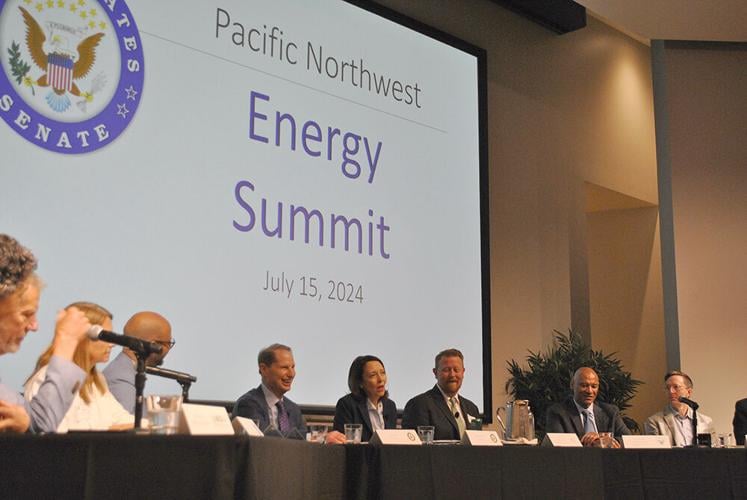
Along with seven industry leaders, U.S. Sens. Maria Cantwell (center) and Ron Wyden (center left) unpack the challenges of sustainable, secure energy in the Northwest and next steps at a meeting on July 15 in Seattle, Washington.
Along with seven industry leaders, U.S. Sens. Maria Cantwell (center) and Ron Wyden (center left) unpack the challenges of sustainable, secure energy in the Northwest and next steps at a meeting on July 15 in Seattle, Washington.
THE GORGE — U.S. Sens. Maria Cantwell, Ron Wyden and several leaders of regional energy organizations discussed the future of Northwest power during a meeting on July 15, which focused on increasing electricity demand, climate change and cleaner solutions.
Since 1983, the Northwest Power and Conservation Council (NWPCC) has developed a power plan for Idaho, Montana, Oregon and Washington. But a key metric in the 2021 Power Plan, designed to begin a renewable energy transition, was off base.
NWPCC predicted the region would require an average of 25,895 megawatts (MW) of electricity in 2041, under its highest-use scenario. However, the Pacific Northwest Utilities Conference Committee (PNUCC) estimated electricity needs will top 33,000 MW in 2033 — a 30% increase from current usage (23,700 MW) in eight fewer years. As a result, the region may not have enough power to go around without drastic action.
“That projected increase in demand is primarily due to data center development; high-tech manufacturing growth, which is driven by incentives for onshore manufacturing; and the continued trend toward electrification,” said Crystal Ball, executive director of PNUCC, in Seattle.
Oregon has the fifth-largest data center market in the country according to a report by Cushman and Wakefield, and these facilities require massive amounts of water and electricity. For instance, Google opened its first of five data centers in The Dalles in 2006, and five years later, the amount of electricity provided to primary service customers rose tenfold. In 2021, Google’s data centers sucked up 355 million gallons of water, or 29% of the city’s total water consumption, as reporting from The Oregonian shows.
KC Golden, vice chair of NWPCC, reaffirmed that electrifying technology, from home heating systems to cars, is another major driver of energy insecurity. “This is not just a power forecasting and demand forecasting uncertainty. [Electrification] is a policy. It’s a future we’ve chosen, both because it’s the only way we know how to respond to the climate crisis effectively and get our carbon emissions down fast enough.”
According to NWPCC’s recent assessment of the 2021 Power Plan, the northwest may need to develop new resources, like additional solar, wind and storage capacity, more aggressively than expected to ensure an adequate power supply by 2027. “There is currently no clear plan or set of projects underway that are sufficient to meet the overall need,” said Ball.
By causing more extreme weather, climate change makes reliable power and a strong electric grid critical. In January of this year, an ice storm that froze transmission lines and transformer boxes led to massive outages throughout the Willamette Valley and Southwestern Washington. Heatwaves and wildfires pose similar risks, but climate change also jeopardizes our electricity supply.
Largely thanks to the Columbia River Basin, PNUCC estimates that 61% of Northwest electricity comes from hydropower. In 2023, though, data from the U.S. Energy Information Association revealed that hydropower production in Oregon and Washington fell to its lowest level in over two decades. The drop was likely caused by low precipitation in fall and winter, and above average summer temperatures that rapidly melted snowpack.
Senators Maria Cantwell (WA-D) and Ron Wyden (OR-D) discuss ways to create sustainable energy.
Photo courtesy Maria Cantwell’s office
All these factors — data center growth, increased electrification, lackluster capacity building and climate change — paint a precarious picture of the Northwest’s sustainable energy future. While panelists sounded alarms, they came with a caveat: Climate-forward legislation and emerging technologies will help us catch up.
“The northwest has the ability to actually do it. We have the ability to put together a coalition and make it possible,” said Wyden who, along with Cantwell, was a key architect of the 2022 Inflation Reduction Act (IRA). Notably, the IRA allows citizens and companies to deduct up to 30% of renewable energy system costs from their federal taxes.
The Infrastructure Investment and Jobs Act (IIJA) of 2021 also provided the U.S. Department of Energy with $62 billion for new renewable energy projects and establishing a modern, resilient electric grid. Ball said that building new transmission lines is the biggest barrier to expanding the northwest’s renewable capacity.
“Here’s this moment: We’ve got the policies, we’ve got the money and we’ve got companies that are willing to take risks because the government’s going to back some of these investments,” said Chris Green, president of the Pacific Northwest Hydrogen Association.
Green’s nonprofit organization is one of seven nationwide hydrogen hubs funded by the IIJA and has eight planned projects in the northwest, including two upriver in Boardman, Oregon. Once fully operational in 2033, the projects will produce carbon-free hydrogen through electrolysis, the process of splitting water into hydrogen and oxygen rather than producing it from natural gas, and will power a range of sectors, from agriculture to transportation.
However necessary, Reuben Martinez, energy program director for the Affiliated Tribes of Northwest Indians, expressed skepticism over these large-scale projects considering the devastating effects of dams and hydropower on Indigenous peoples in the region. “We are a place-based people, and ensuring the environment, culture, health and safety of our citizens is paramount,” said Martinez, who called for meaningful tribal consultation and representation in energy planning.
Apart from expanding renewable energy capacity, officials emphasized that investing in energy efficiency measures, like upgrading heating and cooling systems or insulation in buildings, could dramatically reduce electricity demand and improve energy security. Other emerging technologies include long duration energy storage and advanced nuclear power.
Judd Virden, the associate laboratory director at Pacific Northwest National Laboratory, aptly summarized the core challenge facing regional energy organizations: “We understand the problem and solutions really well. But how do we get it and bring it together so that everyone can see it the same way and take actions quickly?”
Effective collaboration and cooperation will be key.





Commented
Sorry, there are no recent results for popular commented articles.