


THE DALLES — Caught up in a destabilizing mix of homelessness, drug use and mental illness, the man averaged seven police contacts per day.
But once he connected with LEAD Navigator Nick Smallmon, that number dropped to zero.
However, on days when Smallmon wasn’t working his job in outreach for the recently formed Law Enforcement Assisted Diversion (LEAD) program, the man was back to multiple daily police contacts.
This snippet is a direct example of what the LEAD program is all about. A joint effort of the Hood River and Wasco County sheriff’s offices, LEAD is helping reduce low-level, so-called livability crimes like trespassing and disorderly conduct, and working to stabilize people by connecting them to services.
“In the last several months, we’ve started seeing meaningful results in our communities as a result of LEAD’s work,” Hood River County Sheriff Matt English said. “There have already been several success stories where clients have experienced more stability in their lives as a result of LEAD’s work, than they have experienced in years.
“Further, the fact that community partners from a multitude of social service organizations are connecting and directly engaged with our team indicates that the program is recognized for the difference it is making, and the gap that it has filled for clients in need.”
Because the program is funded by the two sheriff’s offices, it already has law enforcement buy-in, said Rebecca Schilling, LEAD program analyst. A state grant pays for the program.
“I’m really impressed with the outcomes from a law enforcement perspective as it inserts LEAD navigators into situations where individuals are on the edge of going to jail,” Wasco County Sheriff Lane Magill said. “The ‘revolving door’ for some individuals has been reduced or completely eliminated, and that reduces costs at our local jail, as well as frees up law enforcement to handle other calls for service.”
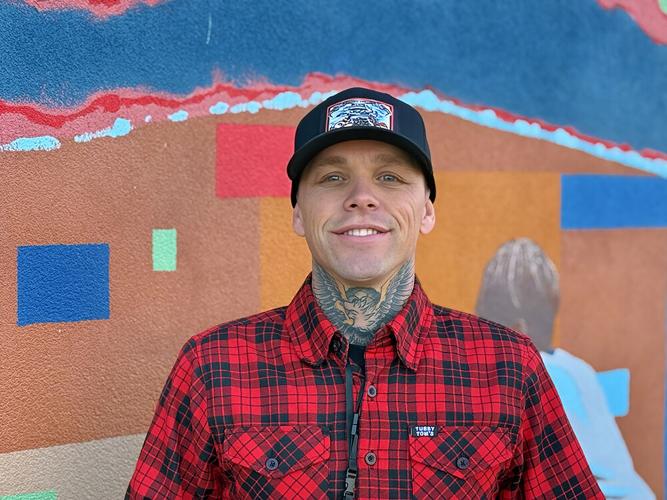
Smallmon does most of his work in The Dalles. Local police call him when they want to get someone connected to services. Smallmon always has food, water and heating or cooling supplies, depending on the season. His law enforcement connection can be a barrier to overcome for people who mistrust police. But he just keeps showing up and building trust with clients, he said.
He’s reaching out to people in crisis, who maybe haven’t eaten in days. “A bottle of water and a granola bar can change the whole vibe,” he said.
Part of his work is just convincing people that the police aren’t the bad guys. “I haven’t met one [police officer] yet — and I’ve worked with all of them — that are out to try to ‘get’ these guys, per se. They want to see them off the streets and in a better spot,” he said.
Housed out of the Hood River Sheriff’s Office, the LEAD program got underway in early 2025. They’ve spent a “building year” getting to know community partners and establishing relationships, Smallmon said.
Schilling said this year will be about educating the public, since community members can also refer someone to the LEAD program. Smallmon has already gotten calls in The Dalles from stores and the library.
To refer someone, visit the LEAD website at leadcolumbiagorge.org.
Of seven active participants in the LEAD program, four now have housing. “Thanks to Nick,” Schilling said. But Smallmon quickly added, “Thanks to everybody.”
He has worked hard, he said, to get to know the people providing services locally. “It’s constant connection,” he said.
Smallmon knows where to send people for showers, food, job help, housing, substance use treatment and mental health services.
Bathroom access is “a big issue to this day because there is no 24-hour bathrooms open in Hood River or The Dalles,” Smallmon said. “They’re going in their clothes because they don’t want to get out of their tent.”
Smallmon and Schilling can also help sign people up for health insurance under the Oregon Health Plan, or even get an ID.
He’s learned that a specific physical address is not needed for an ID. “The last one I did, their address was First and Union.”
A broad range of involved agencies meet every other week to discuss ways to help specific people. They include Mid-Columbia Center for Living (MCCFL), One Community Health, law enforcement agencies and district attorneys, Mid-Columbia Community Action Council (The Gloria Center and The Annex), and local hospitals.
“It takes all of those people that work together and collaborate to get these people connected to the services they need,” Schilling said. “Nick does a lot of that coordination.”
So far, the program has had 61 people referred to their program, 42 in Wasco County (27 in The Dalles) and 19 in Hood River County (12 in Hood River).
Smallmon credited the Providence Health system in Hood River’s BOB Program (Better Out-comes Through Bridges) as a big helper. “I get a lot of stuff from them. Very, very helpful, very smart, very educated team over there,” he said. Smallmon works with clients on what is important to them. One client has been houseless for 20 years, but his main concern wasn’t housing, since he was used to being houseless. Instead, he wanted to find work. So Smallmon began helping with that first.
They started at a Columbia Gorge Community College job-finding program, and that opened doors at Mid-Columbia Center for Living, which has a job placement program. That program required abstaining from drugs, so the client did a substance use assessment.
Working with the Mid-Columbia Community Action Council, Providence, and others, service providers were able to find permanent housing for the man.
He’s has had no further law enforcement contact in the seven months since he’s been housed, Smallmon said.
Another client came to LEAD’s attention when her husband died. The couple had consistently done nuisance crimes, such as trespassing, disorderly conduct and resisting arrest.
After her husband died, she was almost immediately housed at The Annex due to her age and disability. Since then, she’s quit drinking and has had zero interactions with law enforcement, Smallmon said.
“She has thrived. She’s active in a church group, she’s done different things to benefit the community,” he said.


Commented
Sorry, there are no recent results for popular commented articles.