
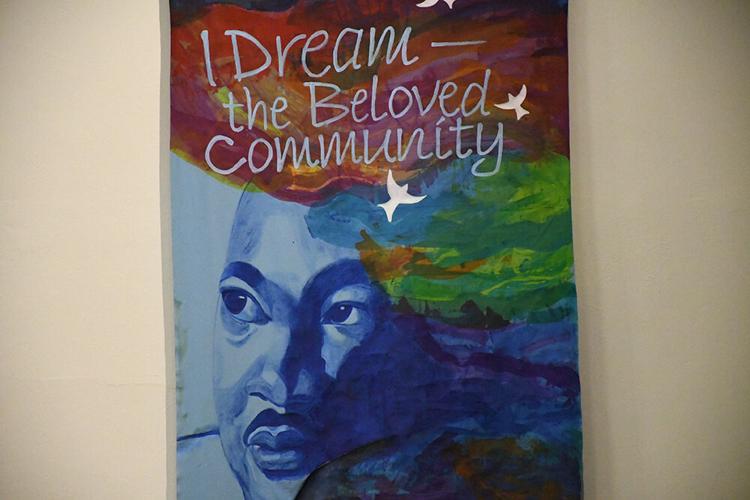

HOOD RIVER — Community members gathered at Riverside Community Church on Jan. 19 to celebrate the life and legacy of Martin Luther King Jr., enjoy music from gospel singer Cynta Butts, and converse about unified action.
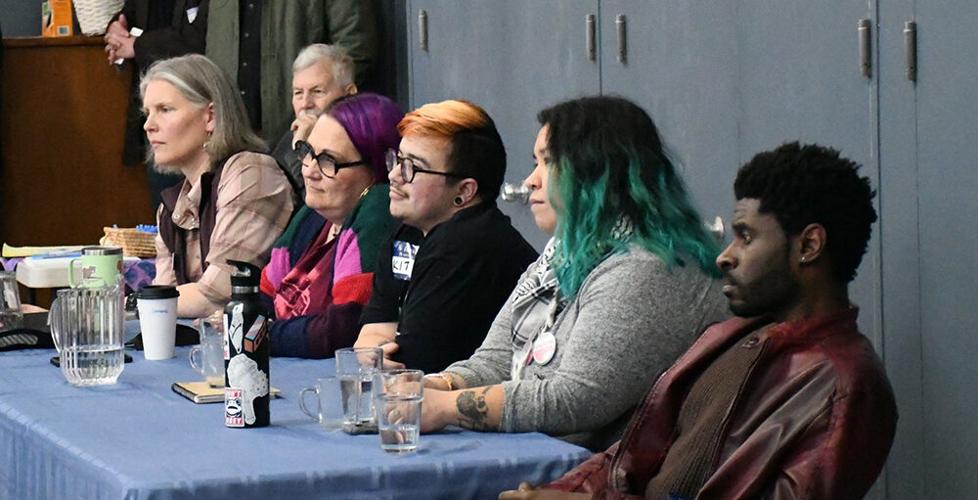
Themed “Hope is in Our Hands,” the event kicked off with an interactive panel discussion hosted by Rev. Vicky Stifter, spotlighting five community voices of diverse, intersectional backgrounds. Panelists answered questions from Stifter and audience members, sharing how they’re reconciling joy, hope, heartbreak, and advocacy in an increasingly turbulent sociopolitical climate.
“We want to acknowledge the fact that these are hard times,” Stifter said. “Sometimes we get so focused on responding to hard times that we forget to pause and recognize that there’s some lament needed.”
Panelists included Breen Goodwin, director of the Columbia Gorge Food Bank; Amber Rose, community engagement coordinator at Hood River Latino Network; Kit Clasen, project coordinator for Columbia Gorge Pride Alliance; August Oaks, creative producer with Black in the Gorge; and Rosie Strange, registered member of the Confederate Tribes of the Warm Springs and project coordinator for Áqwłtpwisha Chúushna, a Native American support program of the Columbia Board Health Council.
Q&A
STIFTER: What brings you joy?
OAKS: Gardening. It’s good for us.
STRANGE: Movement and community. I’m very lucky to have found that dance and movement serve my soul. The land holds me as I move on the Earth.
CLASEN: Community is a big piece right now. New and rekindled relationships and partnerships, especially with the queer community, that have come into my life have been lovely.
STIFTER: It’s been a heartbreaking year for those of us concerned about justice and the well-being of our neighbors. What tears have you shed?
GOODWIN: There have been a lot of tears this year; there will be tears today. In the food banking world, it’s been pretty striking to have federal funds cut. There are no words that can justify the decisions to withhold life-sustaining support. My whole team has cried. We allow it — we encourage it because we have to keep moving forward; we still have food to move.
STRANGE: I’ve been crying for two and a half years. The injustice, the genocide in Palestine, has cracked open my heart in ways I didn’t think were possible. I feel the pain for Indigenous people, and I cry almost every day for every mother, child, father, every community that’s being torn apart, and the number of people that are willing to look away. I grieve for the children — generations that are coming that we can’t protect.
STIFTER: Where have you found hope? What moments, events and people have provided you with courage and inspiration?
ROSE: It’s the people; it comes back to the people and what we can do in this moment. There was a march we did back in April. More people than I had ever seen showed up in one place together. That was shocking and incredible — the energy people brought from all over.
OAKS: I am filled with so much hope, and one primary source of my hope is engaging with empathy. It’s so easy for us these days to just disengage. But at the end of the day, most of us have very similar values. If you remember to have a bit more empathy, you can engage in conversations with a broader perspective, which can help us have more collaborative conversations and take proactive action.
STRANGE: I felt a lot of hope at Pride this year. I find a lot of hope in my children, in the fact that I get to teach them on our ancestral homeland, and in the fact that I get to dance here, cry here, and grieve here. Grief gives me hope: I appreciate people acknowledging the grief and the pain and not just moving past it.
GOODWIN: During the SNAP crisis, I was sitting outside of a pantry just listening, and the pantry manager got a call, and the person said, “I want to let you know that we’re not going to come in this week because we have enough food, and we want to make sure someone else has food as well.” It was a small moment of community care and love in what was an incredibly difficult and hard time. I had to hold on to that moment.
STIFTER: What do you see as the biggest challenge facing our community in this coming year, and where are opportunities for collective action?
STRANGE: Looking around this room, there aren’t many BIPOC individuals. Why are they hiding? Where are they? Now more than ever, we need to show up for people outside of our circles. I do a lot of houseless work and outreach. I see the look people give to houseless people. They’re invisible in our communities, and people forget they’re there. We can get to know them. We can become the people that we need in our community, but it’s a matter of getting to know each other, being willing, and being brave enough to go talk to someone that we don’t know and risk what happens next.
CLASEN: I’m going to be a little mean. I’m begging folks to pay attention to what’s happening. There are so many folks I interact with, even in my work in the nonprofit sector, who say they don’t engage with the news because it’s too hard, too scary, or makes them feel bad. But there are folks who have to engage in order to be safe. I beg you to look deeper.
ROSE: We’re experiencing a class war driven by white supremacy and patriarchy, and they’re coming for you. I’m not saying that to try to scare people. It’s the truth. They are coming for every person in this room. I’m not sleeping at night if my neighbors are being kidnapped. So if you have extra time, extra money, an idea, an ear, a car, anything to share, please do.
GOODWIN: In food banking, people think that the problem is food. It’s not. We don’t have a lack of food in our community. This is not a food issue. This is a power issue. This is a class issue. So many of our challenges are interrelated: colonialism and capitalism. This is by design. The separation is by design. So, whether that is food insecurity, queer rights, immigration rights, or the prison system, find a topic and go learn about it.


Commented